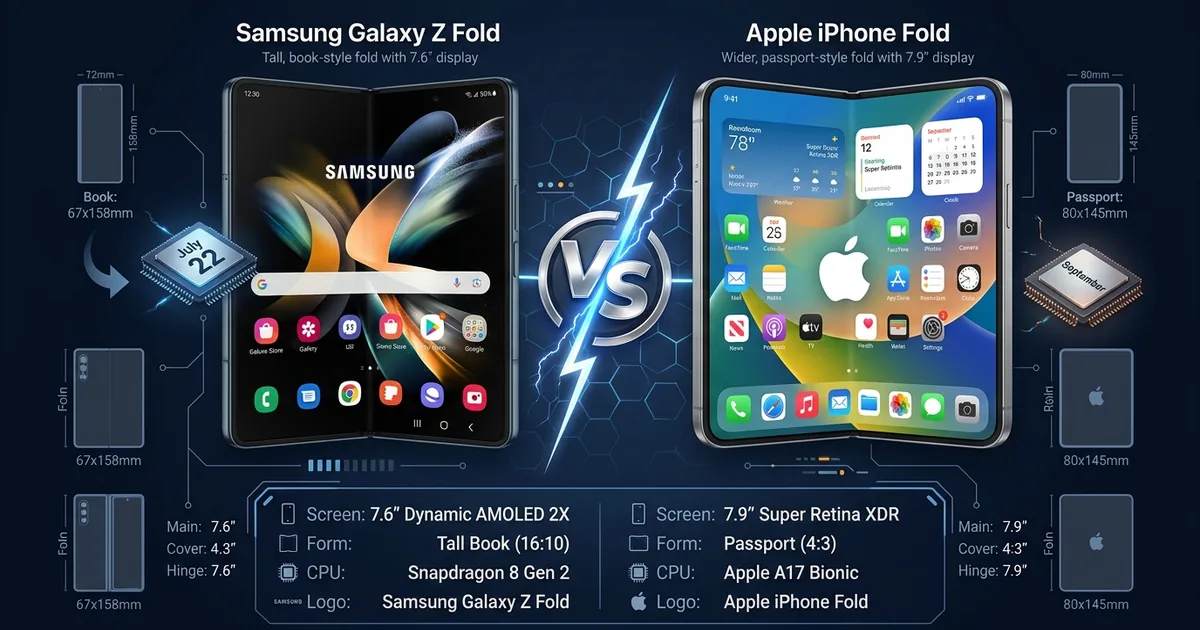
Samsung is launching the Galaxy Z Fold 8 and a brand-new Galaxy Z Fold 8 Wide on July 22 in London. Apple first foldable, expected to be marketed as the iPhone Fold or iPhone Ultra, arrives in September alongside the iPhone 18 Pro lineup. For the first time in the foldable category, the two biggest smartphone makers on the planet will have competing products on shelves at the same time, and they have taken fundamentally different design bets.
Two Phones, Two Design Philosophies
Samsung approach is iterative and vertical. The Galaxy Z Fold 8 features an 8.0-inch inner display at 2208×1768 with a taller form factor that folds into a slim candy bar. The Fold 8 Wide variant goes even bigger. Samsung has eight generations of foldable manufacturing behind it, a supply chain that can produce at scale, and a loyal base of early adopters who have been buying foldables since 2019.
Apple approach is completely different. The iPhone Fold adopts what leakers call a “passport” form factor: shorter and wider, with a 5.5-inch outer screen that feels like a classic iPhone and an 8.3-inch inner display at 2520×2080. Apple bet is that people do not want a phone that unfolds into a tablet. They want a phone that unfolds into a bigger phone, one that maintains the one-handed usability that the iPhone is known for.
The Production Problem
Samsung is ready. It has been shipping foldables in volume for years, and the July 22 launch is on schedule. Apple, by contrast, has hit production delays. Mass production was reportedly pushed from June to August, and analyst Ming-Chi Kuo has warned of shortages stretching into 2027. That means the iPhone Fold could launch as a supply-constrained premium device rather than a mainstream alternative, which is both a marketing advantage (exclusivity) and a strategic risk (Samsung gets months of uncontested shelf time).
Why This Matters Beyond Phones
The foldable category has been a niche within a niche, representing roughly 2% of global smartphone shipments in 2025. Samsung has owned it by default because nobody else shipped a credible competitor at scale. Apple entry changes the calculus entirely. When Apple commits to a form factor, the supply chain follows: component costs drop, third-party case makers invest, and app developers optimize.
The business implications extend beyond unit sales. Foldables carry higher average selling prices (1,500 to 2,000 dollars) than standard flagships, which means they disproportionately impact revenue mix and margins. For Samsung, defending the foldable category it created is an existential priority. For Apple, the foldable is the first major new hardware category under incoming CEO John Ternus, who takes over from Tim Cook later this year.
The Summer Showdown
The timing creates a natural narrative. Samsung launches in July with a head start and eight years of iteration. Apple launches in September with a different design thesis and the most loyal customer base in consumer electronics. By the holiday season, the market will have its first real comparative data on whether consumers prefer Samsung tall-fold or Apple wide-fold approach.
Whichever form factor wins the early sales battle will likely define the foldable category for the next decade, the same way the iPhone touchscreen design killed the BlackBerry keyboard. The stakes are that high, and the clock starts ticking in five weeks.