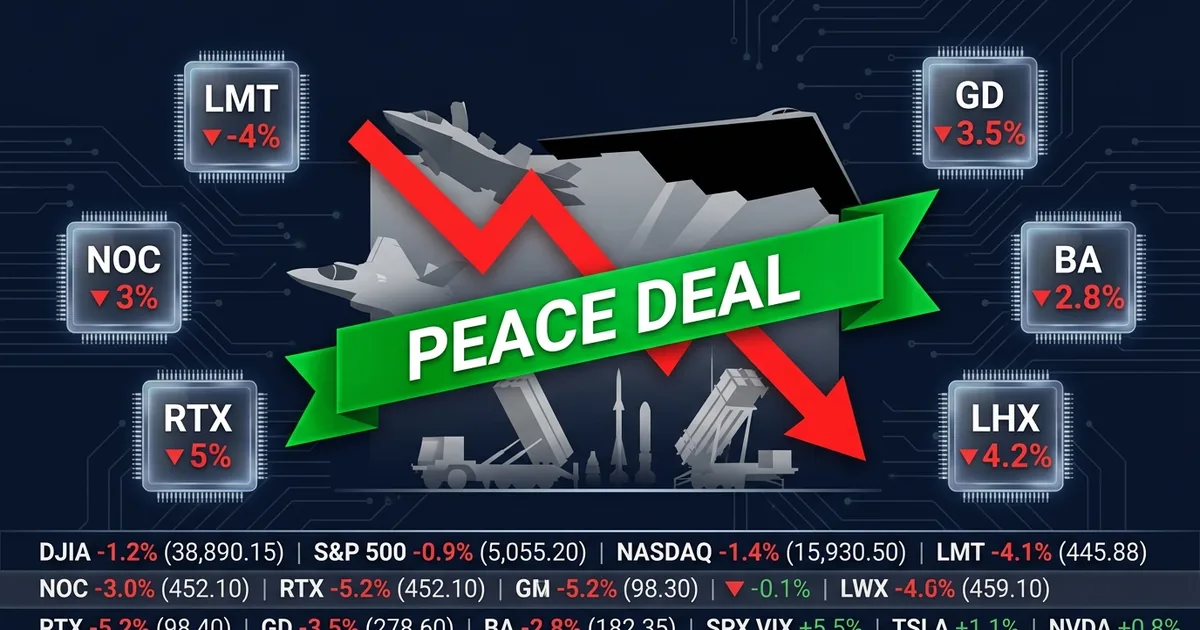
Lockheed Martin, Northrop Grumman, and RTX are all pointing lower in pre-market trading Monday, with defense primes slipping 3% to 5% as the US-Iran peace deal strips out the geopolitical risk premium that has inflated the sector since late February. For an industry that gained 40% to 110% on the back of the Strait of Hormuz crisis, the reversal is overdue, and it may just be getting started.
How Big the War Premium Got
When the US launched strikes against Iran in late February and Tehran retaliated by blockading the Strait of Hormuz, defense stocks became the clearest beneficiary trade on Wall Street. RTX saw the single largest gain at 110% from March 2023 to March 2026, driven by missile system demand and the prospect of sustained Middle East operations. Northrop Grumman gained 60%, General Dynamics 57%, and Lockheed Martin 37%.
The rally was logical. Wars consume munitions, create replenishment cycles, and drive new procurement programs. Congress moved to authorize supplemental defense spending, and the Pentagon fast-tracked several existing weapons contracts. For a few months, the thesis was clean: conflict equals revenue.
Why the Premium Is Evaporating
The peace deal announced Sunday does not end defense spending, and nobody on Wall Street expects it to. The US military footprint in the Middle East will remain substantial for years, and European allies are in the middle of their own multi-year rearmament cycle driven by the Ukraine conflict.
But the deal does three things that hurt the sector near-term multiples. First, it removes the urgency premium on munitions replenishment. Second, it reduces the probability of a sustained, multi-year US combat operation in the Gulf, which was the bull case for elevated procurement. Third, it shifts investor attention back to the sector pre-war problems: margin pressure, execution issues, and cash flow concerns that Bank of America analyst Ronald Epstein has called “skewed too high” relative to actual delivery timelines.
The Sector Was Already Showing Cracks
Here is the part the headline misses: defense stocks had already been underperforming the broader market even before the peace deal. Despite the war, company-specific execution issues, including supply chain bottlenecks, labor shortages, and program delays, kept dragging on performance. The initial euphoria faded as Wall Street realized that wartime revenue does not automatically translate into improved margins when you cannot hire fast enough to meet delivery schedules.
Post-earnings sell-offs at several major defense companies in Q1 and Q2 2026 reflected this disconnect. Investors bought the headline (war equals revenue) but sold the reality (costs up, margins flat, deliveries delayed).
What Comes Next for Defense
The sector is not going to zero, and nobody should short it on a single peace deal headline. European defense budgets are still expanding, NATO commitments are being repriced upward, and the US defense budget remains at historically elevated levels regardless of Iran. But the easy money in the war premium trade is gone.
The stocks most exposed to the unwind are those that rallied hardest on pure Iran sentiment without underlying earnings improvement. RTX, which gained the most, faces the sharpest repricing risk. Lockheed and Northrop, which have more diversified revenue streams across space, cyber, and allied programs, may hold up better.
For the broader market, the rotation out of defense and energy into tech and growth is the Monday morning story. It could become the rest-of-summer story if the June 19 signing holds.