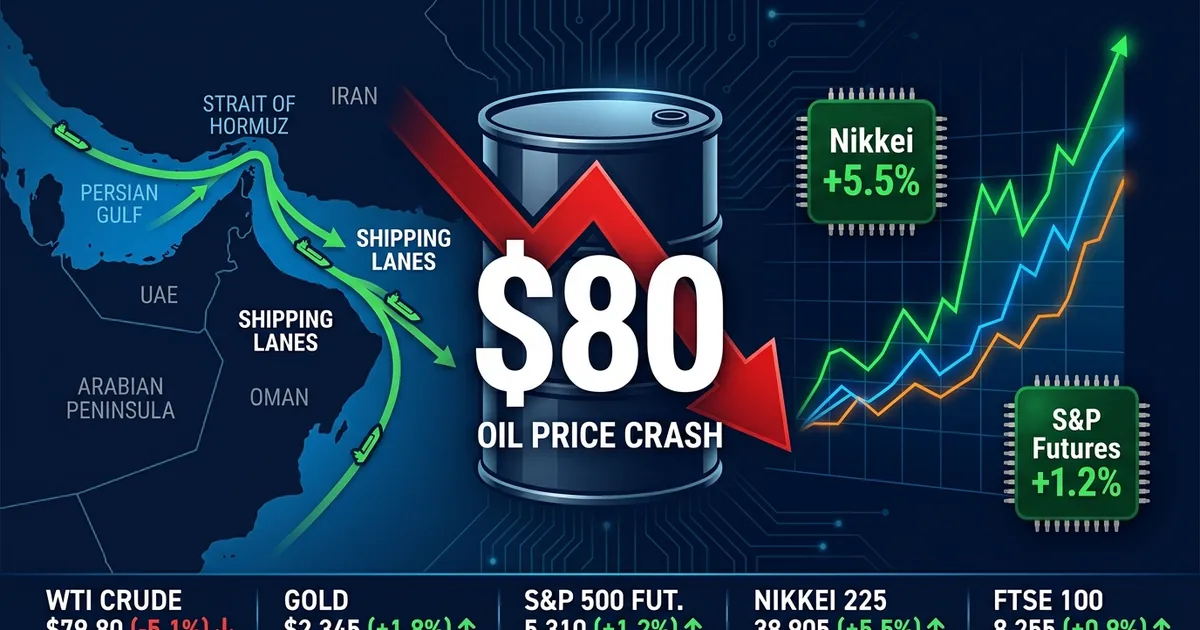
The United States and Iran confirmed on Sunday that they have finalized a framework agreement to end months of conflict, reopening the Strait of Hormuz and triggering the sharpest single-day drop in crude oil prices since March. Brent crude fell more than 4% to around $83 per barrel, while WTI crashed through $80 for the first time in three months, as traders repriced the geopolitical risk premium that had propped up energy markets since the war began in late February.
What the Deal Contains
President Trump announced the completion of what he called a “comprehensive deal” in a social media post late Sunday, authorizing the toll-free reopening of the Strait of Hormuz and the immediate removal of the US naval blockade on Iranian ports. Iran’s Supreme National Security Council confirmed the final wording of a memorandum of understanding shortly after, with an official signing ceremony scheduled for June 19 in Switzerland.
The framework includes an immediate cessation of hostilities on all fronts, including Lebanon. It suspends sanctions on Iranian oil sales and releases $24 billion in frozen Iranian assets, a concession the administration had resisted for months. In return, Iran has reportedly agreed to provisions for dismantling elements of its nuclear program, with economic incentives tied to compliance milestones.
The deal reopens a chokepoint that handles roughly 10 to 11 million barrels of crude oil per day. The Strait had been effectively closed for more than three months, a disruption that sent Brent briefly above $100 in March and forced airlines to ground routes, shipping companies to reroute, and central banks across Europe and Asia to recalibrate their inflation outlooks.
Markets React With a Risk-On Surge
The response was immediate and global. Japan’s Nikkei 225 surged 5.5% to a record intraday high of 69,317, led by SoftBank, which jumped more than 12% as the peace deal removed the biggest overhang on risk assets in Asia. South Korea’s Kospi leapt 5.2% to 8,545 as chipmakers Samsung and SK Hynix rallied on renewed confidence in global trade flows, according to Al Jazeera’s Monday morning coverage.
Taiwan’s Taiex climbed 2.7%, Australia’s ASX200 rose 1.5%, and US equity futures pointed to a strong open, with S&P 500 futures up more than 1.2% in pre-market trading. SpaceX, in its first full week as a public company after a record $75 billion IPO, gained 6% in pre-market to hover near $170 per share. Bitcoin also caught the risk-on wave, climbing 2% to $65,695 as improved sentiment and reports of SpaceX’s substantial Bitcoin treasury holdings drew buyers.
The sell-the-risk trade hit energy and defense stocks hardest. Defense primes including Lockheed Martin, Northrop Grumman, and RTX slipped 3% to 5% in early indications, unwinding a chunk of the war premium that had lifted the sector 40% to 110% since hostilities began.
The Oil Math Changes Fast
Before this deal, WTI had hovered near $85 and Brent around $88. CNN reported last week that oil had already begun testing three-month lows as diplomatic signals intensified. With the Strait reopening, the supply picture flips: JPMorgan’s pre-war forecast of oil in the $50s to $60s per barrel suddenly looks relevant again, though the timeline depends on how quickly Iranian exports resume and whether OPEC+ adjusts production targets in response.
For consumers and businesses, the implications are straightforward. Lower crude means cheaper gasoline, reduced jet fuel costs for airlines that have been hemorrhaging cash since the Strait closure, and a potential easing of the energy-driven inflation spike that pushed the US May CPI to 4.2%, a three-year high. The Fed, which meets Tuesday for its June FOMC decision, now faces a meaningfully different inflation backdrop than it did even a week ago.
What Could Go Wrong
Plenty. Iran’s Supreme Leader has historically used interim agreements as negotiating leverage without following through on disarmament commitments. State-level opposition within the US is already surfacing, and European regulators have signaled they want independent verification before lifting their own sanctions packages.
The signing ceremony is five days away. Polymarket puts the probability of a permanent deal at roughly 60%, reflecting the market’s awareness that framework agreements and finalized treaties are not the same thing. If the June 19 ceremony collapses or produces only a partial agreement, expect a sharp reversal in oil and a reversion to risk-off positioning across every asset class that rallied Monday morning.
The Bigger Picture
This is not just an oil story. The Strait of Hormuz blockade stressed every corner of the global economy: it drove inflation expectations higher in Europe, forced the ECB into its first rate hike since 2023, and contributed to the volatility that hammered chip stocks and growth names in early June. The reversal of those pressures, if it holds, could reshape the second half of 2026 for central banks, equity markets, and consumer spending alike.
The deal still needs to survive contact with reality. But for one Monday morning, global markets are trading like the worst is over.