By Marcus Feld, BusinessTech.news markets desk. 15 years covering equity capital markets and tech M&A.
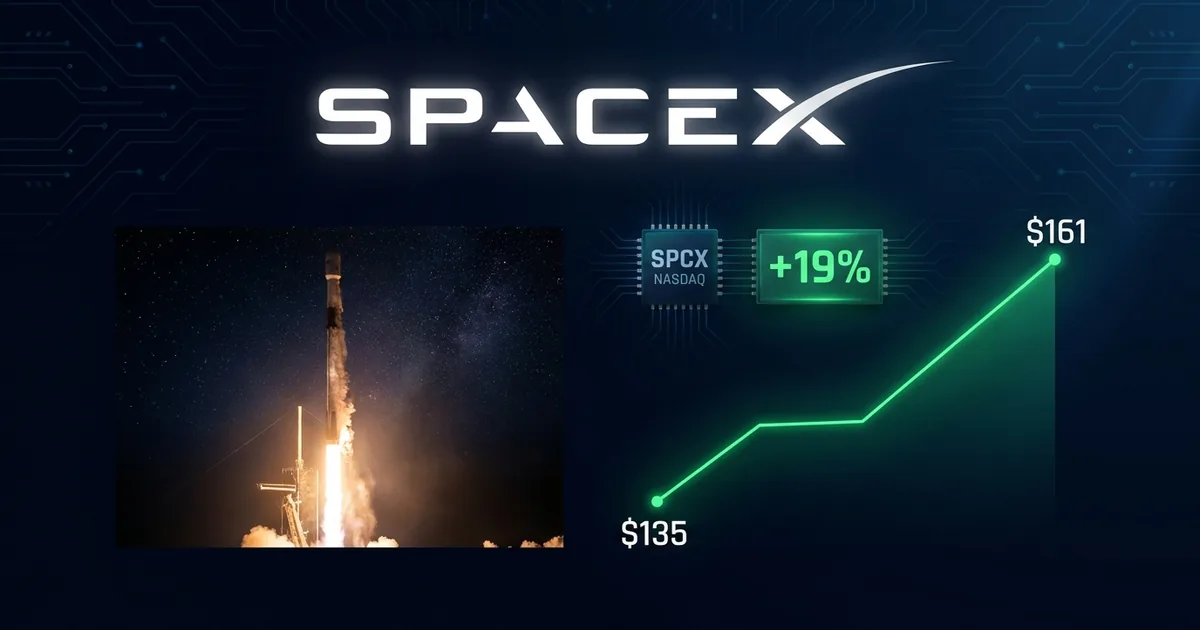
SpaceX priced its IPO at $135 a share on Thursday night, raised $75 billion, and then watched the stock open Friday and run. By the closing bell on Nasdaq, SPCX sat at $160.95, up 19 percent, with a market value north of $2 trillion. For a few minutes around midday it was worth more than $2.25 trillion, which is the kind of number that stops being about a rocket company and starts being about the entire market’s appetite for one man’s ambitions.
This is the largest stock-market debut in history. It clears Saudi Aramco’s 2019 listing, which raised $29.4 billion, by a margin so wide the comparison barely holds. The pop was real, the demand was real, and the champagne in Hawthorne was earned. The interesting question is not whether Friday was a triumph. It was. The question is what Elon Musk just sold, what he kept, and what the people who bought in actually own.
What the Buyers Got, and What They Didn’t
Start with the cap table, because that is where this story really lives. SpaceX went public on a dual-class structure that hands Musk and a small circle of insiders super-voting shares. Public investors are buying economic exposure, not a say. Musk walks away from Friday controlling roughly 85 percent of the voting power while holding something closer to 42 percent of the equity, a gap engineered to keep him in command even as outside money pours in.
That is not unusual for a founder-led tech listing, and SpaceX is hardly the first to do it. But the scale changes the stakes. When you concentrate this much capital around a control structure this tight, you are asking public shareholders to underwrite a strategy they cannot vote on, led by a CEO whose attention is split across a car company, a social network, a brain-implant startup, and now a merged AI lab. The market said yes on Friday. It said yes enthusiastically. It is worth being honest that “yes” came with almost no governance attached.
Then there is the float. SpaceX earmarked roughly 30 percent of the offering for retail investors, about three times the typical allocation for a mega-cap IPO, which is great theater and a genuine democratization of access. It also means a relatively thin pool of freely trading stock chasing enormous demand, which is a large part of why the thing spiked 30 percent intraday before settling. Low free float cuts both ways. It juices the debut. It also means the price can move hard in either direction on comparatively little volume, a dynamic some skeptics flagged loudly before the bell.
The xAI Merger Is the Whole Valuation
You cannot make sense of a $2 trillion first-day close by counting Falcon 9 launches and Starlink subscriptions alone. The number is what it is because SpaceX absorbed xAI in an all-stock deal back in February, folding Musk’s artificial-intelligence operation into the rocket business at a combined $1.25 trillion valuation, with xAI carried at roughly $250 billion. What public investors bought on Friday is a launch monopoly bolted to a frontier AI lab bolted to a satellite-internet utility, sold as a single ticker.
That is either the most vertically integrated bet on the future ever brought to market, or it is three very different companies with three very different risk profiles wearing one valuation. Starlink throws off real, recurring revenue. The launch business is a genuine moat. xAI burns cash at a frontier-model pace and competes with OpenAI, Google, and Anthropic in the most capital-hungry race in technology. Pricing all three as one growth story is a choice, and Friday’s buyers made it at a premium. We tracked the pre-IPO skepticism in our look at the short sellers circling the SpaceX debut, and none of their concerns evaporated because the stock went up.
What Wall Street Is Quietly Watching
The lockup is the variable nobody on the syndicate wants to talk about on a green day. Early employees, venture backers, and the banks all become potential sellers when the lockup expires, and Musk’s own willingness to sell is the single largest unknown hanging over the stock. A debut this hot sets a high bar. The first earnings print, the first quarter where xAI’s burn shows up on a consolidated income statement, the first time Musk’s attention visibly wanders, all of it now happens in public, on a 10-Q, in front of shareholders who can read.
There is also the matter of what this IPO does to everyone else. A $75 billion raise vacuums up an extraordinary amount of capital, and a successful one reopens a window that had been jammed shut for three years. Bankers who spent 2025 watching the IPO market thaw just got the signal flare they wanted. Expect a rush of filings from companies that were waiting to see whether public investors still had appetite for a story stock at scale. The answer, as of Friday’s close, is a resounding and slightly nervous yes.
The rocket cleared the tower. Now SpaceX has to do the thing public companies do that private ones never have to, which is explain itself, every ninety days, to people who can sell.