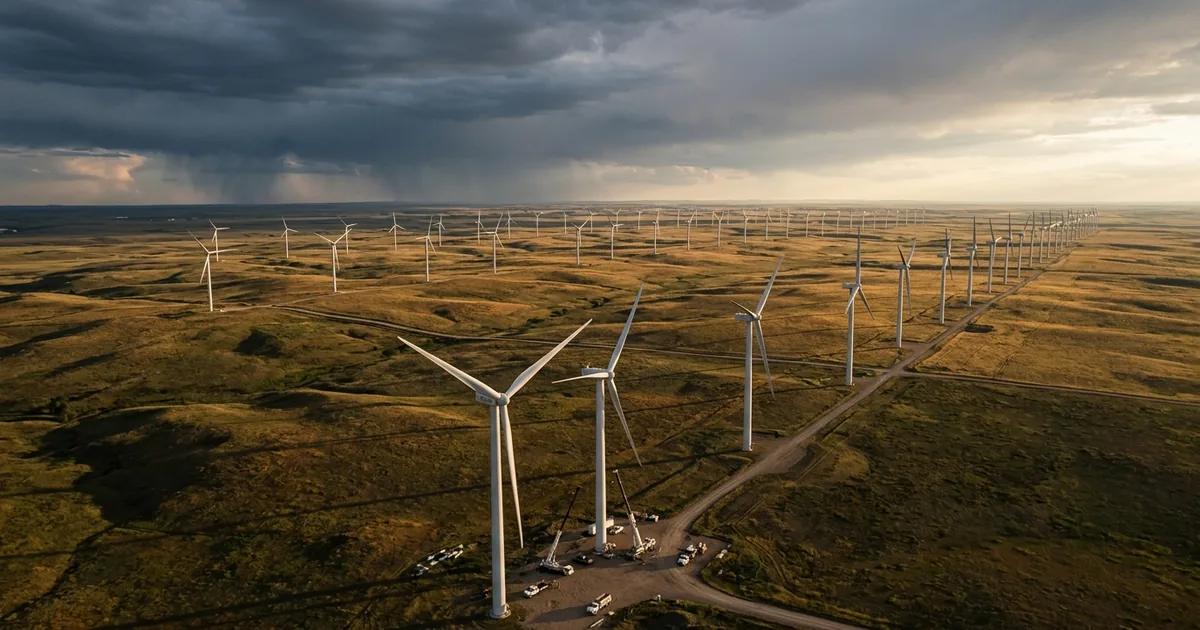
The Trump administration is invoking national security to stall 165 permitted wind-farm projects, freezing roughly 18 gigawatts of clean-energy capacity that developers had already pencilled into their 2027 build plans. The legal mechanism is unusual. The financial impact is concrete, and it lands hardest in red states that voted for the man now pulling the brake.
The Legal Hook Is Stranger Than the Politics
National security review of energy infrastructure is not new. What is new is using it as a blanket pause on projects that have already cleared the National Environmental Policy Act, secured Bureau of Ocean Energy Management leases or state PUC approvals, and locked in interconnection queue positions. Reuters first reported the move on April 30, and the framing is telling: the administration is citing radar interference, foreign-supplier risk in turbine components, and grid-cyber exposure, then folding all three into a generic "national security pause." No specific statutory authority has been published, which is itself the story. If the lever is the Defense Production Act, expect court challenges from developers within weeks. If it is an executive order leaning on Section 232 of the Trade Expansion Act (the steel-tariff statute), expect a different fight. Either way, the legal frame is improvised, and improvisation in federal energy policy is not a pricing-in event for capital markets.
The precedent that matters here is the offshore-wind moratorium that Trump issued by executive order in his first week, which BOEM has since used to stall five projects on the East Coast. The 165-project pause extends that logic to onshore wind in the lower 48, and that is the structural shift, not the headline number.
Who Bears the Load: The Capital Markets View
NextEra Energy, Avangrid, Orsted, EDF Renewables, and Pattern Energy account for roughly 60 percent of the affected pipeline by megawatts, according to the Lawrence Berkeley National Laboratory wind-pipeline tracker. NextEra's exposure is the cleanest read: 18 of the paused projects are either wholly owned or co-developed, representing about 4.2 GW of capacity that the company had baked into its 2026 to 2028 capex guidance. Orsted, already bruised by its US offshore retreat in 2023, sees another 2.1 GW of onshore stalled. The stocks moved on the news. NextEra closed down 6.4 percent on April 30. Orsted, listed in Copenhagen, dropped 11 percent.
The geography is the politically interesting part. Texas hosts 38 of the paused projects. Iowa, 22. Oklahoma, 14. These three states alone account for 74 of the 165, or 45 percent of the freeze. They are also the three largest onshore wind producers in the country. The IRA production tax credit framework, which Treasury extended in 2025 to projects placed in service through 2032, becomes a different instrument when the projects cannot reach service. Roughly 7 to 9 billion dollars in PTC value sits in suspended animation, depending on which capacity factor and merchant-power assumptions you use.
This is also where the corporate offtake market starts to wobble. Microsoft, Amazon, and Meta have all signed virtual PPAs tied to specific projects in the affected list. None of them have public exposure breakdowns, but the SEC filings will be informative if the pause runs past Q3.
The Grid Wonks Are Already Filing Letters
The grid-stability layer is where the policy gets technical, and where the second-order effects could exceed the first-order capital impact. PJM, the largest grid operator in the US, filed its 2025 capacity auction results assuming 4.7 GW of new wind would clear interconnection by mid-2027. ERCOT''s most recent Capacity, Demand, and Reserves report, filed with the Public Utility Commission of Texas in December, baked in 6.1 GW of new wind by summer 2027. Both filings now reference capacity that may not arrive on schedule, and FERC has already received three letters from independent system operators flagging reliability risk if the pause extends beyond Q4.
Capacity-market prices respond to expectations as much as inventory. PJM''s 2026/27 capacity auction cleared at 269 dollars per megawatt-day, roughly triple the prior year, partly because new clean-energy entry was already running behind. Pulling another 4.7 GW out of the assumption set tightens that further. Households in PJM territory paid the last clearing price through their utility bills. They will pay this one too. This is the kind of pass-through that gets filed quietly and noticed loudly twelve months later. For more on how capacity pricing flows to ratepayers, see our explainer on PJM auction mechanics.
Negotiating Posture or Structural Pivot
The honest read is that nobody on Wall Street, in Texas attorneys'' offices, or at FERC actually knows yet. Two scenarios are live. In the first, this is a pressure play: the administration uses the pause to push individual developers on supplier sourcing (specifically, Chinese-made nacelle components and US Steel''s stake in tower manufacturing), then lets approved projects proceed on a case-by-case basis through the rest of 2026. That would resemble the Section 232 tariff-and-exemption playbook from 2018, and it would let the administration claim a domestic-content win without crashing the IRA edifice.
In the second scenario, the pause is the leading edge of a structural pivot away from utility-scale wind, paired with the natural-gas permitting acceleration that DOE Secretary Christopher Wright signaled in his March address to the Edison Electric Institute. Under that read, the 165-project freeze is not a negotiation. It is policy, and the courts become the primary venue for resolution.
The tell will arrive within 60 days. Watch for two signals: a White House readout of meetings with NextEra and Avangrid leadership, and the next FERC reliability docket, which will quantify the capacity gap if the pause holds. The capital markets are pricing in scenario one. The grid operators are quietly preparing for scenario two. One of them is going to be wrong, and the spread between those two outcomes is roughly 45 billion dollars in cumulative project value over the next five years.
That is not a pricing band. It is a coin flip with a clean-energy transition on the line, and the people closest to the data are the most uncertain about how it lands.