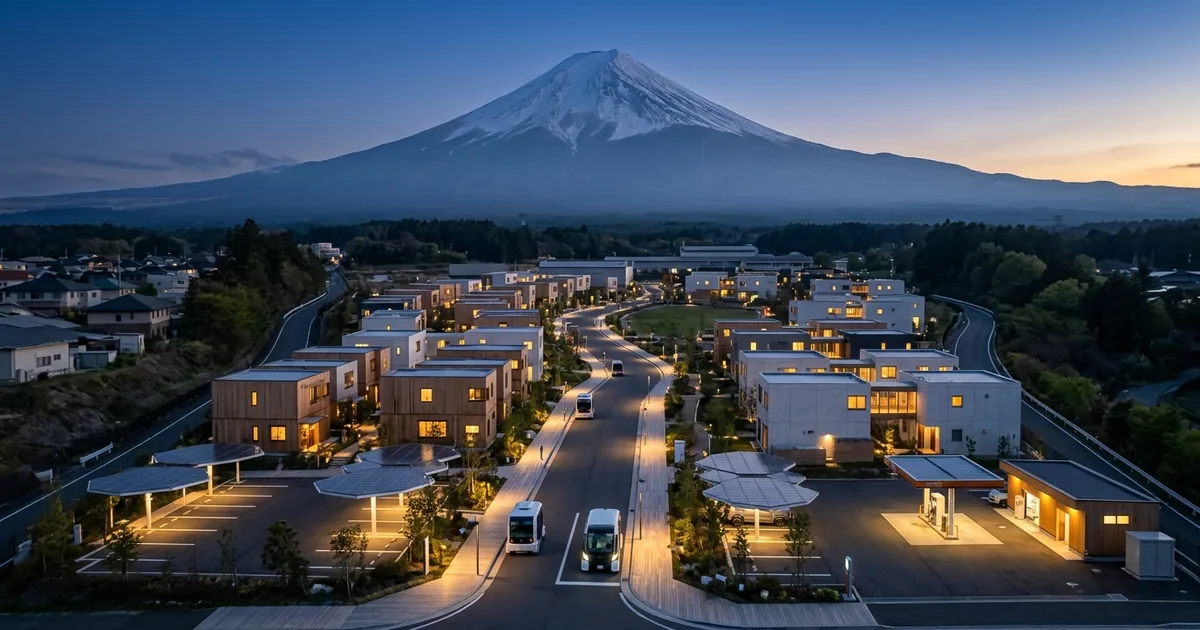
At the foot of Mount Fuji, on the site of a defunct car factory, Toyota has spent five years and roughly 10 billion dollars building a private city. Woven City has 360 residents now, autonomous shuttles, hydrogen pipes laid under the streets, and a partner ecosystem that reads like a Japanese industrial-complex chart: Daikin, NTT, Eneos, Joby Aviation. Phase 1 opened to its first wave of “weavers” in October 2025. The next phase doubles the population by 2027. The strategic question is whether this is a hardware moat that Detroit and Munich cannot replicate, or the most expensive corporate vanity project of the decade. The honest answer requires separating the press-release version from what has actually been built.
What Is Actually There
Woven City is 175 acres, fenced, and operationally closed to the public. The first residential phase comprises 12 apartment buildings, a school, three retail blocks, a clinic, and two test laboratories. The roads are stratified into three categories: high-speed autonomous, slow shared use, and pedestrian only. Toyota’s e-Palette autonomous shuttles run the high-speed lane on a closed loop that connects the residential cluster to the test labs. The shared-use streets allow human-driven vehicles, but only Toyota-issued ones, and only at speeds capped by the city’s central traffic system.
The infrastructure spend is the unsexy interesting part. Hydrogen pipelines run under the streets to fuel residential heating and the city’s three filling stations. Eneos co-developed the pipeline grid; this is one of the only at-scale residential hydrogen distribution networks in the world. NTT supplies the network backbone, including a private 5G slice and the data fabric for what Toyota internally calls “lived telemetry.” Daikin provides the climate systems, with sensor density that Toyota has not publicly disclosed but which several engineering reports place at one ambient sensor per square meter of communal space. Per Reuters’ on-site reporting, the goal is to capture every interaction between a resident and a Toyota-built environment, then feed that signal into the next generation of vehicle and home products.
Who Lives in a $10 Billion Sandbox
The residency question is the first place the corporate-utopia framing meets reality. Of the 360 current residents, Toyota has confirmed that approximately 100 are Toyota Motor Corporation employees on rotational assignments. Another 80 are partner-company researchers, mostly from Daikin, NTT, and Eneos. The remaining roughly 180 are what Toyota labels “external weavers”: senior citizens recruited through partnerships with Shizuoka Prefecture, families selected through a national application process, and a small cohort of academic researchers from Keio and the University of Tokyo. They pay below-market rent. They sign waivers covering the data collected on their daily lives.
This is closer to Apple Park than it appears at first glance, but with a key inversion. Apple Park is a workplace that excludes the public. Woven City is a residential laboratory that pays selected outsiders to live a fully instrumented life. The closest historical analogue is not Cupertino but Bell Labs’ Murray Hill campus in the 1960s, which produced the transistor partly because researchers, families, and infrastructure shared one site. The differences matter. Bell Labs published. Toyota’s data is proprietary, and the Nikkei Asia analysis on the IP framework around Woven City suggests that tenant-generated data is owned outright by Toyota Woven Holdings.
The labor-force optics are awkward enough that Toyota is doing something it rarely does: managing the press cycle directly. The October 2025 phase-one opening was covered by exactly seven outlets, all of them Japanese, all of them with Toyota investor relations as the primary source. Western tech press has been kept at arm’s length. That is the kind of media discipline that signals strategic value, not theater.
Why Toyota Thinks This Is a Moat
The argument inside Toyota, articulated most clearly by Akio Toyoda in his 2024 shareholder letter, is that the next decade of automotive value creation is not in the vehicle but in the integration between vehicle, home, energy, and city infrastructure. If that is correct, then the company that owns the integration platform owns the margin. Tesla has Autopilot data from millions of vehicles but no home or city telemetry. Apple has personal-device data but no transportation primitive. Stellantis and Volkswagen have neither.
Toyota’s bet is that 5 to 10 years of running an instrumented city produces something none of them can buy: a closed-loop dataset on how humans actually use mobility, energy, and home services in an integrated environment. The mobility analog is what Tesla did with Autopilot: collect at scale before competitors can, then use the data lead to sell the next-generation product at a higher margin. The risk in the analogy is that Tesla’s data was generated by paying customers driving paying-customer cars. Toyota’s is generated by 360 selected residents on a closed campus, which raises the question of whether the data generalizes.
Generalization is the core technical risk. If the patterns Woven City surfaces are specific to a Toyota-curated population in a Japanese cultural context, the moat is narrow. If they generalize to consumer behavior in Hamburg, Houston, and Hyderabad, the moat is the company.
The Smart-City Graveyard Is Crowded
Woven City is not the first attempt. NEOM, Saudi Arabia’s $500 billion mega-project, has shrunk from a 170-kilometer line to a 2.4-kilometer prototype after burning through cash and headlines. Sidewalk Labs in Toronto collapsed in 2020 under privacy backlash and Alphabet’s withdrawal of capital. Songdo in South Korea, the original “smart city from scratch,” opened in 2009 and is at 70 percent occupancy, profitable but commercially unremarkable. Each failure surfaced a different lesson. NEOM showed that scale outpaces governance. Sidewalk Labs showed that surveillance backlash is faster than feature rollout. Songdo showed that a smart city without a strategic owner becomes a real-estate development with extra sensors.
Woven City is structured to avoid all three failure modes. It is small (175 acres, not 26,500 square kilometers). It is private (no public-records statute applies inside the fence). It has a strategic owner with vehicle and energy distribution products that consume the data. Whether those structural advantages convert into a sustainable competitive position depends on something Toyota cannot fully control: whether vertical integration of city-scale data turns out to be the right framing for the 2030s consumer technology stack. For more on the vertical-integration debate in Japanese industrial strategy, see our coverage of the Sony-Honda EV joint venture.
What to Watch in 2026 and 2027
Three signals will tell you whether Woven City is a moat or theater. First, the phase-two residency cap: if Toyota publishes a hard limit (the rumored ceiling is 2,000), it is a laboratory. If they push toward open residency, it is a real-estate play. Second, the partner-ecosystem expansion: Joby Aviation joined in March, and the next two partner announcements (rumored to include a Korean battery firm and a US silicon designer) will signal whether this is a Japan-only project or a platform. Third, the IP carve-outs: any Toyota patent filing in 2026 that explicitly cites Woven City telemetry as a data source is a flag that the moat is real and starting to compound.
The press-release version of Woven City will not tell you which of those happens. The 10-K filings, the patent dockets, and the prefecture-level disclosures will.