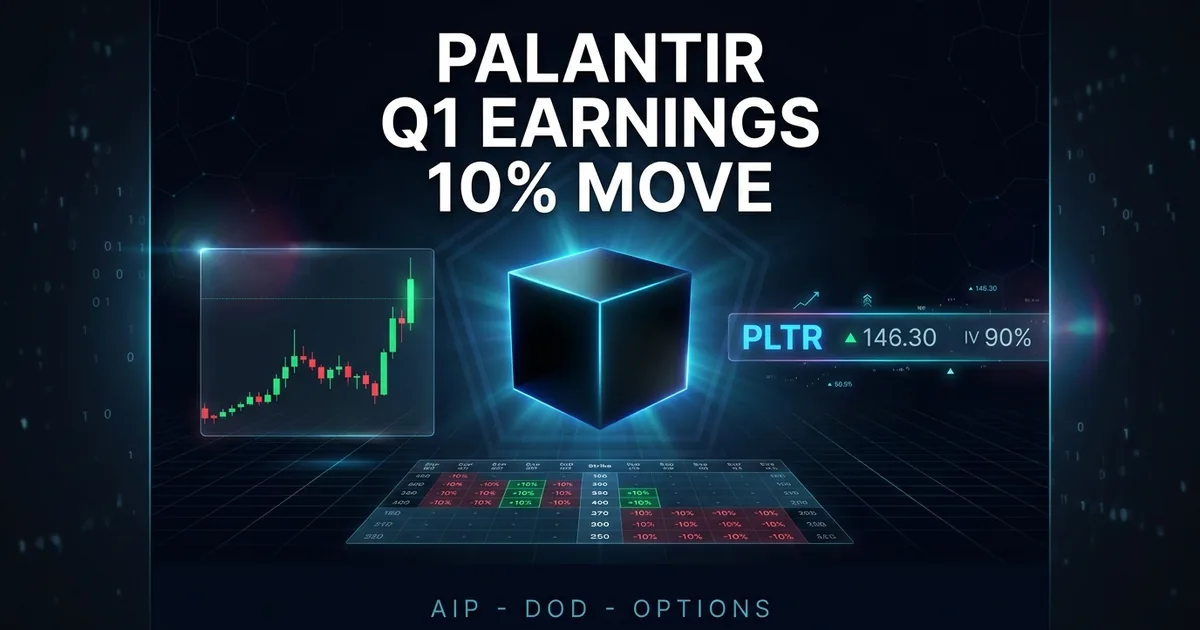
Palantir reports first-quarter earnings after the close at 5:00 p.m. ET, and the options market is bracing for a much louder evening than the consensus print would suggest. Wall Street is modeling $1.54 billion in revenue, up 74% year over year, and adjusted EPS of $0.28, up 115% from a year ago. Palantir has beaten the consensus EPS estimate ten quarters running. Polymarket prices the probability of yet another beat at 96%. Implied volatility on the at-the-money options is hovering near 90%, with traders pricing roughly a 10% move in either direction by Tuesday’s open.
In other words, the market is not betting on whether Palantir will beat the number. The market is betting on the size of the gap between the print and the guide.
What Wall Street Wants To Hear
There are four lines on the conference call that will move the stock more than the headline EPS.
First, AIP commercial revenue. Palantir’s Artificial Intelligence Platform has been the single biggest narrative driver for the stock since 2023, but the question on this call is whether the commercial book is widening at the expected pace. Pilot-to-production conversion rate, average contract value, and net-new logos in the U.S. commercial segment are the three sub-metrics that will frame the next 12 months of analyst models.
Second, U.S. government revenue trajectory. Palantir’s Department of Defense business sits inside what is now an aggressively pro-software-procurement Pentagon environment. The recent Project Maven elevation to Program of Record status is a meaningful tailwind, and analysts will probe whether that translates into expanding contract values across the broader U.S. government segment.
Third, international growth. Palantir’s international commercial business has been the soft spot. Europe-driven defense modernization (Bundeswehr contracts, NATO supply-chain projects, Ukraine reconstruction planning) creates a structural opportunity that the company has been slow to capture. CEO Alex Karp has been telegraphing a more aggressive international push for two quarters. The market wants proof.
Fourth, operating margin. Palantir guided 2026 to a 35-plus operating margin baseline. Anything above 38% would tell you the AI software thesis is working at the margin level, not just the revenue level. Anything below 33% reignites the bears.
The Bear Case Has Quietly Gotten Smarter
For most of 2024 and 2025, the bear case on Palantir was crude: too expensive on every multiple, too dependent on government revenue, too many founder-CEO eccentricities for institutional comfort. Karp’s stock sales did not help.
The 2026 bear case is more refined. It runs like this. Palantir’s stock trades at roughly 60 times forward sales, which means even a clean beat-and-raise quarter has to clear an extraordinarily high implied bar. Commercial pipeline conversion is running, but the average deal cycle is still roughly six to nine months, which constrains how fast revenue can compound. And the AIP narrative has competition. Microsoft Fabric, Snowflake’s AI Data Cloud, Databricks’ Mosaic, and the new wave of vertical AI platforms (Glean, Hebbia, Writer) are all chasing the same enterprise budget line.
Then there is the macro overlay. Bank credit spreads widened on the Iran news and oil spike. Defense-stock outperformance is already baked into Palantir’s setup. The 115% expected EPS growth and the consensus revenue forecast assume continued margin expansion alongside the top-line acceleration. If the print disappoints on commercial conversion specifically, the multiple compression risk is real.
Why The Stock Has Held Above $140
Despite all of the above, PLTR shares have held a bid above $140 into the print. That is not random. Three things are supporting the level.
One, the AI capex debate has shifted from “are hyperscalers spending too much?” to “where does the spend translate into deployment?” Palantir is the clearest publicly traded answer to that second question. The company has been deploying AI models inside enterprises since before generative AI was a category.
Two, the Pentagon’s procurement reform momentum is producing actual contract awards rather than press releases. The defense-tech complex (Anduril, Shield AI, Palantir, and the prime contractors that have integrated their software stacks) is winning the budget fight against legacy primes for the first time in modern memory.
Three, the buyer base has matured. Palantir’s institutional ownership has been climbing for four quarters. The retail crowd that drove the stock to $40 in 2023 still owns size, but the marginal buyer is now a large active manager looking for AI exposure that does not require buying Nvidia at the top.
What A Beat Looks Like, And What A Sell-The-News Looks Like
A beat that holds the stock would deliver three things at once: revenue above $1.6 billion (clearing the high end of the guide), commercial U.S. revenue growth above 60%, and a 2026 full-year revenue guide raised by at least $200 million. That combination would justify the multiple and reset the bar for Q2.
A beat that sells the stock would post the headline number but miss on commercial pipeline visibility, leave the full-year guide untouched, and reveal margin pressure in the international segment. The 90% implied volatility tells you the options market is hedged for both outcomes, which is part of why the print itself will trigger such a violent realized move. The latest sell-side price-target updates ahead of the print show analysts increasingly unwilling to hold neutral stances, with both upgrades and downgrades clustering in the past two weeks.
The bigger question, the one that will define Palantir’s narrative for the rest of 2026, is not whether the company is winning at AI deployment. It is whether the rate of winning is accelerating.
The Setup Beyond Tonight
Three things to watch beyond the print itself.
The conference call tone. Karp’s prepared remarks have historically been the single biggest driver of post-earnings price action. A more measured, analyst-friendly script would tell you the company is preparing for the next leg of institutional ownership. A combative one would signal nothing has changed.
The Q2 guide. With AMD reporting tomorrow, Disney, Uber, and Coinbase later this week, and the S&P 500 already setting fresh highs, the bar for AI-adjacent guides is moving up by the day. Palantir’s guide for next quarter will be read against the broader AI-spending narrative, not just its own history.
And the analyst-day calendar. Palantir has been hinting at a fall analyst event with deeper enterprise customer panels. If management telegraphs that on tonight’s call, expect the sell-side to start updating models in the direction of the bull case before the event itself.
The Government Side Is The Quiet Edge
One under-the-radar angle the call should address: the cross-pollination between Palantir’s defense and intelligence work and its commercial AI business. The same Foundry and AIP infrastructure powering targeting workflows for the U.S. military is now being repackaged for enterprise customers in regulated industries (banking, healthcare, energy) that need to deploy AI on sensitive data without sending it to a third-party cloud. That is a structural moat the pure cloud-native AI competitors do not have.
If Karp opens up the call by linking the DoD wins to specific commercial-sector use cases (think a bank that uses the same audit-trail infrastructure the Army uses, or a hospital system using the same data-lineage tooling that runs through Project Maven), the institutional thesis on Palantir gets simpler in one sentence. That kind of clarity is what turns a 60-times-sales stock from “stretched” to “deserved.”
The trade into the print is asymmetric and crowded. The trade out of it depends entirely on what Karp says between 5:00 and 6:00 p.m. ET. The options market thinks tonight ends with PLTR somewhere between roughly $126 and $158. Pick your side.