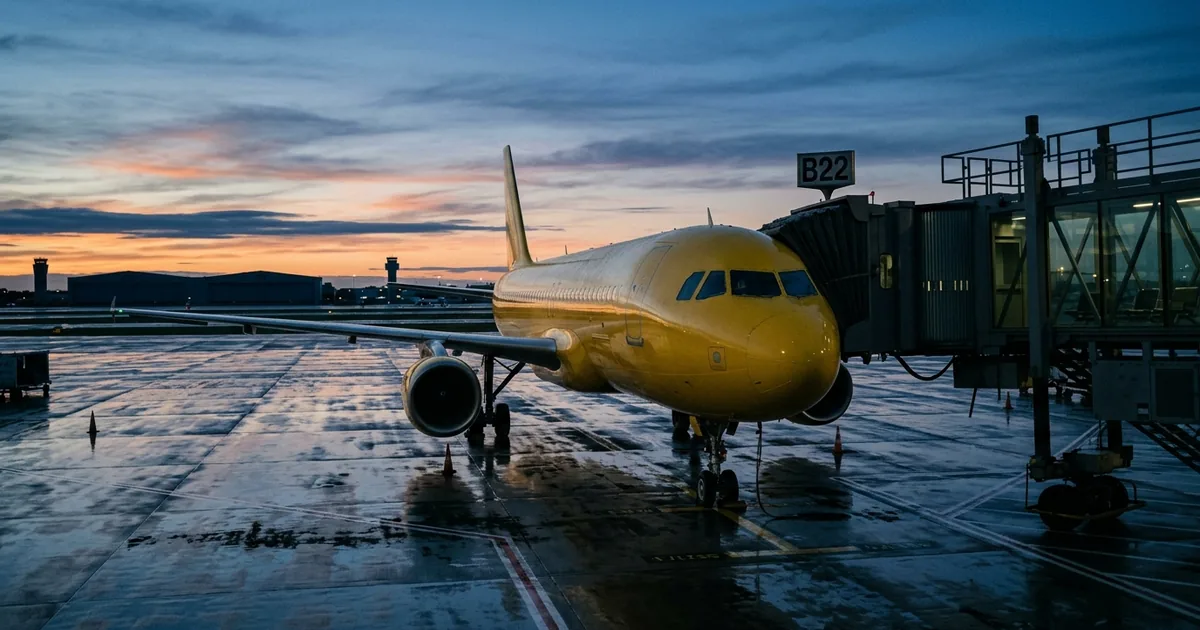
On May 2, 2026, Spirit Airlines started winding down its 34-year run after filing for bankruptcy court protection in White Plains for the third time since 2024. Per CNBC, the carrier submitted a cumulative wind-down budget of about $217 million stretching through February 2028. Seventeen thousand jobs are gone. Tens of thousands of bookings, made by people who chose Spirit because cheap was the entire point, are now stranded on a refund framework most travelers have never read.
This is the largest U.S. airline collapse in a generation. The proximate cause is jet fuel. The structural cause is everything else.
Two Numbers Tell The Story
Spirit's last restructuring plan, the one filed during the second 2024 bankruptcy, assumed Aviation Turbine Fuel costs of $2.24 a gallon in 2026 and $2.14 in 2027. By the end of April 2026, ATF had climbed to about $4.51 a gallon. Per NPR's reporting on the shutdown, the price gap is what closed the door on new financing. No lender was willing to underwrite a low-margin carrier whose largest single line item just doubled.
Geopolitics did the work. The recent Iran war squeezed Persian Gulf supply just as Spirit's hedges from the previous restructuring rolled off. A carrier with deeper margins absorbs that shock; an ultra-low-cost carrier whose entire pitch is a fare ten percent below the legacy bracket cannot. The Spirit model assumed perpetually cheap fuel and perpetually price-sensitive demand. Both assumptions broke at once.
What The DOJ Decision Looks Like Now
In early 2024 the U.S. Department of Justice blocked the proposed JetBlue-Spirit merger on antitrust grounds. The argument was reasonable on its merits: a JetBlue-Spirit combination would have removed the largest ULCC from the market and lifted average fares on the routes the combined carrier served. Consumers, the DOJ argued, would pay more.
Two years later, the DOJ's preferred outcome is that Spirit no longer exists as a market-discipline force. Routes Spirit served on a price-pressure basis revert to legacy carriers and Frontier. Average fares on those routes are not staying flat. Whether the DOJ would make the same call today is rhetorical. The point is that the antitrust framework that produced the 2024 decision treats market structure at the moment of the merger as the relevant input. Bankruptcy risk five quarters out is not, formally, the regulator's question. It probably should be.
This is how policy and economics drift apart in aviation. The DOJ optimizes for the snapshot. The capital markets optimize for fuel-curve forwards. When those two views diverge by enough, you get a wind-down docket in White Plains.
What The Industry Reorders Into
Spirit's gates, slots, and aircraft do not vanish. They get bid on, leased, redeployed. The early read on who wins:
Frontier and Allegiant pick up the most accessible route capacity. Both already operate the same Airbus narrowbody fleet Spirit relied on, which means absorbing aircraft and crews is logistically straightforward. Frontier in particular has been quietly expanding pricing discipline since late 2025; the Spirit collapse hands it a near-monopoly on several Caribbean and Florida-leisure pairs that produce reliable margin.
Legacy carriers (Delta, American, United) take the slot value at major hubs. Spirit had an unusually concentrated slot footprint at Fort Lauderdale and Las Vegas, and those slots will move quickly. The legacies will not match Spirit fares on those city-pairs because they do not have to.
JetBlue is the structural loser. The 2024 merger would have given JetBlue a ULCC subsidiary and a dramatically expanded fleet. We have followed the broader U.S. airline market shifts at BusinessTech.news since the original block. Without the merger, JetBlue is the same mid-tier carrier it was, now competing for Spirit's leftover markets against bigger competitors with cheaper unit costs. The blocked merger looks, retroactively, like a worse outcome than the merger would have produced for JetBlue's own competitive position.
The Consumer Stranding Story Is The Hardest
About 17,000 employees lost their jobs over a weekend, per Skift's published timeline of the collapse. Tens of thousands of passengers had bookings on flights that did not happen. The Department of Transportation's automatic-refund rule, finalized in 2024, forces the carrier to issue refunds on canceled flights regardless of fare class. In practice, those refunds come from the bankruptcy estate, which means consumers join a creditor queue.
Travel insurance covers some of the gap. Credit-card protections cover more. The blunt outcome for any flier who paid in cash or via a debit card is months of paperwork and partial recovery. Read the policy before the next time you book a ULCC ticket on a discretionary trip; that is the durable lesson.
What To Watch Over The Next Six Months
Three things.
First: how fast Frontier and Allegiant raise prices on the inherited routes. The pricing curve will tell you whether the market's competitive structure is genuinely thinner now or whether new entrants emerge.
Second: whether the DOJ shifts how it analyzes airline mergers in light of the Spirit outcome. A formal acknowledgment that bankruptcy risk is a relevant antitrust input would reshape the next decade of airline consolidation. Silence from the DOJ would be its own answer.
Third: jet fuel. ATF curves are pricing in elevated levels through 2027 on Iran-war risk premiums. If those normalize faster than expected, Frontier and Allegiant get a margin lift that funds capacity expansion. If they stay elevated, the survivor cohort starts looking thin too. The ULCC business model does not get easier from here.
Spirit's wind-down docket will run through February 2028. By then the airline will be a footnote in two business-school case studies: one on antitrust myopia, one on commodity hedging. The market it served will have rearranged around the absence. Travelers will pay more. The argument over whether that was preventable will be ongoing.
By Scott Coy. Founder, BusinessTech.news. 20+ years in digital media and SEO.
Published May 5, 2026.