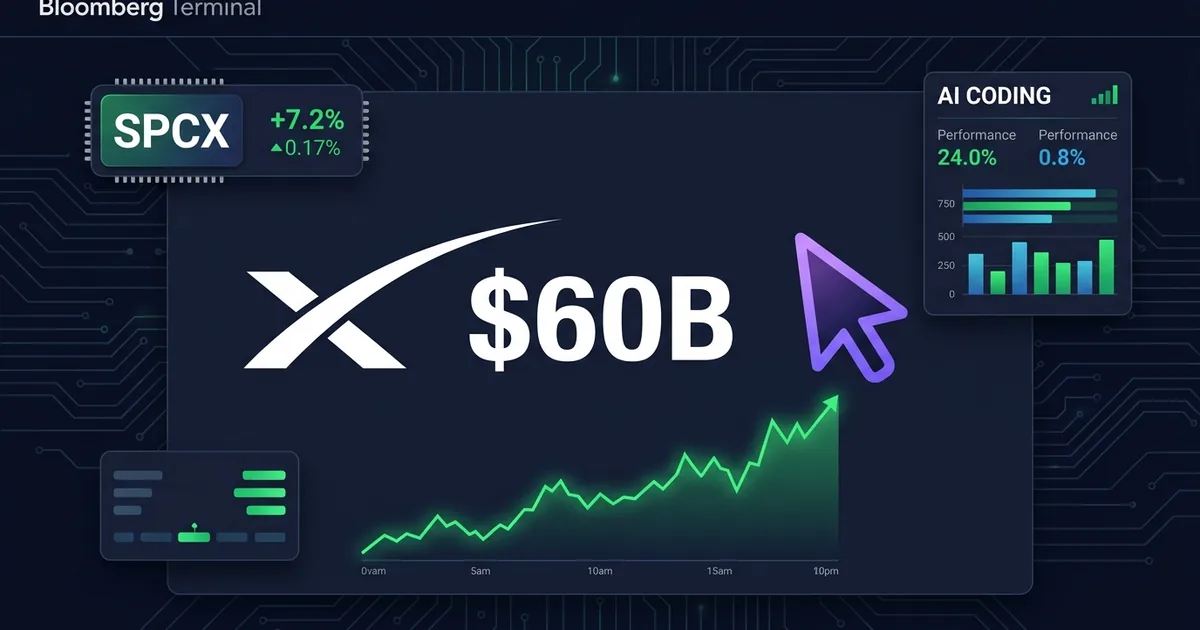
SpaceX just made the biggest startup bet of the year, and it is not a rocket. The company announced a $60 billion all-stock agreement to acquire Anysphere, the maker of AI coding tool Cursor, in a deal that cements Elon Musk’s play for dominance in the fast-growing AI developer tools market.
The Deal That Rewrites the AI Playbook
The transaction, confirmed by CNBC on Monday, will see Cursor investors receive SpaceX shares pegged to the startup’s $60 billion valuation. No cash changes hands. That structure matters: it lets SpaceX preserve its post-IPO liquidity while using the surging value of SPCX stock as acquisition currency, a page straight out of the late-1990s tech consolidation playbook.
Cursor, founded in 2022, builds an AI-powered code editor that helps developers generate, edit, and debug software using natural-language prompts. The product sits at the center of what Silicon Valley now calls “vibe coding,” a workflow where engineers describe what they want in plain English and let AI handle the implementation. It sounds like a parlor trick until you see the revenue: Cursor hit $2.6 billion in annualized B2B revenue before the acquisition, making it one of the fastest-scaling enterprise software companies in history.
Why SpaceX Wants a Code Editor
The strategic logic runs deeper than headline numbers. SpaceX operates one of the most complex software environments on the planet, from Starlink’s orbital routing algorithms to Starship’s autonomous flight systems to the xAI division’s large language models. Cursor slots directly into that stack. Instead of licensing third-party AI coding tools across thousands of engineers, SpaceX now owns the platform.
CBS News reported that SpaceX had secured an option to buy Cursor earlier this year as part of a broader partnership, but delayed the formal acquisition until after its own Nasdaq debut. That timing was deliberate. SpaceX’s record-breaking IPO closed at $161 per share in early June, giving the company a $1.78 trillion market capitalization and the stock-price credibility to close a deal of this scale without dilution anxiety.
The Valuation Debate
Not everyone is convinced the price tag makes sense. Bill Ackman weighed in publicly, questioning whether any pre-profit AI startup warrants a $60 billion premium. Chamath Palihapitiya countered that Cursor’s growth trajectory, from zero to $2.6 billion in annualized revenue in under four years, justifies aggressive multiples in a market where AI infrastructure is being priced like critical utilities rather than discretionary software.
The math is polarizing but not unprecedented. At roughly 23 times annualized revenue, Cursor’s acquisition multiple falls in line with what Snowflake, Databricks, and other enterprise AI infrastructure plays commanded at comparable growth stages. The difference is speed: Cursor reached this scale without a decade of enterprise sales cycles, fueled instead by bottom-up developer adoption that converted individual engineers into paying teams almost organically.
Crunchbase News called it the largest startup M&A transaction of 2026, surpassing a year already crowded with mega-deals. The deal is expected to close in the third quarter of 2026, subject to regulatory review. Given that both companies are private-turned-public with limited market overlap, antitrust hurdles look manageable.
What This Means for the AI Coding Market
The acquisition sends a clear signal to every developer tools company still operating independently: consolidation is accelerating, and the acquirers are not traditional software giants. SpaceX buying Cursor is the equivalent of an aerospace company absorbing a fintech unicorn, except the product actually integrates into the buyer’s core operations.
GitHub Copilot, backed by Microsoft, remains the market leader by seat count. But Cursor’s rapid enterprise penetration, particularly among teams building mission-critical systems, has positioned it as the premium alternative. Under SpaceX ownership, that positioning only sharpens. The question now is whether Alphabet, Amazon, or Meta move to acquire one of the remaining independent AI coding startups before the field narrows further.
The Bigger Picture
SpaceX’s Cursor acquisition is not really about a code editor. It is about vertical integration in the AI era. The companies winning the next decade are not just using AI tools; they are owning them. Musk, for all his contradictions, understood this with Tesla’s chip design, with xAI’s model training, and now with Cursor’s developer platform. Whether the $60 billion price proves prescient or reckless will depend on something no valuation model can capture: how fast vibe coding moves from novelty to necessity across the global engineering workforce.