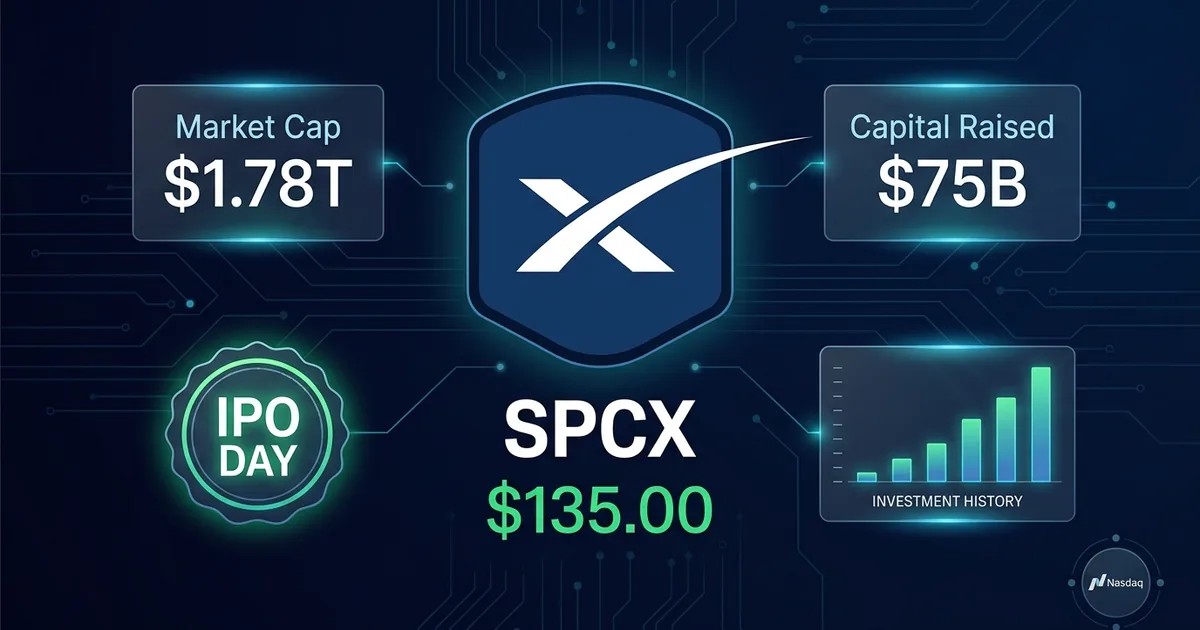
SpaceX opened for trading on the Nasdaq Friday morning under the ticker SPCX at $135 per share, giving Elon Musk’s rocket and satellite company a market capitalization of $1.78 trillion and clinching the title of the largest initial public offering ever conducted. The listing dwarfs every prior IPO by an order of magnitude, and Wall Street spent most of the week scrambling to figure out whether that is a triumph or a warning.
The Numbers Behind the Record
The company sold 555.6 million shares at $135 apiece, raising approximately $75 billion in gross proceeds. Goldman Sachs led the underwriting syndicate, followed by Morgan Stanley, Bank of America, Citigroup, and JPMorgan Chase. The underwriters hold a greenshoe option to purchase an additional 83.3 million shares, which would push total proceeds north of $86 billion if exercised.
At $1.78 trillion, SpaceX instantly becomes the seventh-largest public company in the United States, slotting in above Tesla’s roughly $1.6 trillion market cap. That alone should give pause: the parent company is now worth more than the CEO’s other publicly traded empire, and SpaceX has never posted an annual profit.
Retail Investors Get an Unusual Seat
One of the more striking features of the offering is its retail allocation. SpaceX earmarked 30% of shares for individual investors, roughly three times the 5% to 10% retail slice that is standard on large IPOs. The move is deliberate. Musk’s retail following, built through years of Tesla stock evangelism and social media presence, is being treated as a distribution channel rather than an afterthought.
The IPO was multiple times oversubscribed, with total orders exceeding $10 billion before the books closed. Institutional demand was overwhelming, but the outsized retail tranche signals that SpaceX wants a broad, loyal shareholder base that will be less likely to dump shares at the first sign of volatility. Whether that loyalty holds through the 180-day lockup expiry remains an open question.
What SpaceX Actually Sells
The bull case for SPCX rests on two businesses that look very different from each other. Starlink, the satellite internet division, generates real recurring revenue from more than 5 million subscribers across 100 countries. It is the closest thing SpaceX has to a cash-flow engine, and it is growing fast.
Then there is the launch business, which includes Falcon 9, Falcon Heavy, and the still-in-development Starship. SpaceX dominates commercial launch with roughly 70% global market share by payload mass. The company completed over 100 orbital launches in 2025 alone. But launch economics are lumpy, capital-intensive, and tied to government contracts that carry political risk.
The S-1 also referenced SpaceX’s ambitions to place AI data centers in orbit, a concept that attracted enormous investor excitement but has not yet generated revenue. The gap between Starlink’s proven subscription model and the speculative orbital-infrastructure thesis is where the valuation debate lives.
Musk Keeps Control
Post-IPO, Elon Musk retains more than 82% of voting power through a dual-class share structure. Public shareholders are buying economic exposure, not governance rights. That is not unusual in tech IPOs, but the concentration is extreme even by Silicon Valley standards, and it arrives at a moment when concerns about SpaceX’s valuation and Musk’s broader commitments have intensified.
Steve Eisman, the investor famous for his role in “The Big Short,” publicly flagged SPCX as a potential short target last week, arguing that the valuation embeds assumptions about orbital infrastructure revenue that may take a decade to materialize. Eisman’s skepticism did not deter the order book, but it set the tone for a debut that Wall Street is watching as much for downside risk as for upside potential.
The IPO Wave Is Just Getting Started
SpaceX’s listing is the opening act in what may be the most consequential IPO season since the dot-com era. Anthropic filed its confidential S-1 on June 1, fresh off a $65 billion raise that pushed its valuation to $965 billion. OpenAI is targeting a September debut after its own $852 billion valuation round in March. Bank of America strategist Michael Hartnett warned that these three listings alone could push U.S. market concentration from 40% toward 48% of total market value, a level that would exceed the dot-com bubble, Japan’s 1980s boom, and the Roaring Twenties.
The question hanging over Friday’s open is not whether SPCX will pop. Oversubscribed IPOs almost always do on day one. The question is whether a $1.78 trillion valuation for a company that has never turned a profit is the beginning of a generational wealth-creation event, or the moment the music started playing just a little too loud. The answer probably depends on which business you think you are buying: the satellite company with real subscribers, or the orbital dream factory that could change everything, if it works.