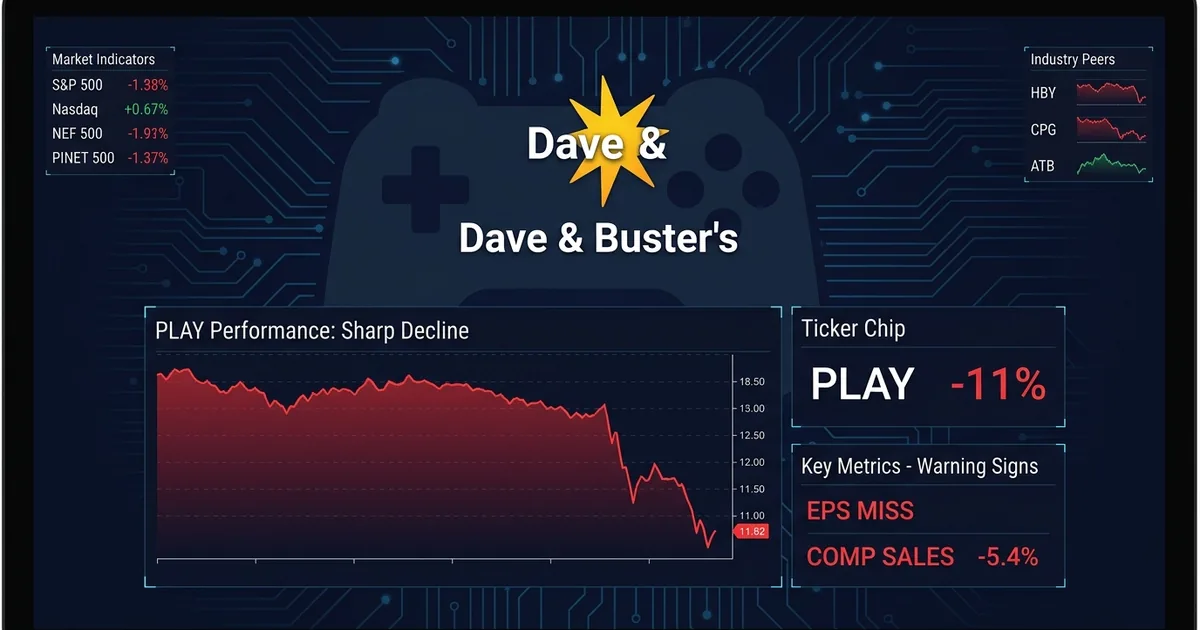
Dave and Buster’s just delivered the kind of earnings report that makes you wonder whether the American consumer has finally hit the wall. The entertainment and dining chain missed on every line that matters: revenue, earnings per share, and comparable store sales, sending PLAY shares down 11% in after-hours trading Monday and flashing a warning signal across the entire consumer discretionary sector.
The Numbers Are Ugly
First-quarter revenue came in at $559.2 million, missing the $578.4 million Wall Street expected. Adjusted earnings per share landed at $0.22, less than a third of the $0.66 consensus estimate. The headline wrecker: comparable store sales fell 5.4%, dramatically worse than the 1.2% decline analysts had modeled. When comparable sales miss by four percentage points, the story is not about one bad quarter; it is about a consumer pulling back hard.
Benzinga reported that the stock fell 19% in premarket Tuesday after the after-hours slide continued, marking the steepest single-day decline in the company’s public history.
What Went Wrong
Management blamed a familiar cocktail: elevated gasoline prices squeezing household budgets, geopolitical uncertainty dampening discretionary spending, and promotional experiments that backfired. The company tested several new promotional formats during the quarter that “failed to connect with cost-conscious consumers,” a polite way of saying the deals were not deep enough to get people off the couch.
The one bright spot was food and beverage same-store sales, which grew roughly 5% and extended a nine-month streak of positive comparable growth. That detail actually makes the overall picture worse, not better. It means the foot traffic that did show up was eating and drinking but not spending on games, the higher-margin entertainment side of the business that drives profitability. Customers came for discounted meals, not $100 game cards.
The Consumer Discretionary Canary
Dave and Buster’s sits at the intersection of dining and entertainment, two categories that are among the first to get cut when household budgets tighten. The miss is not happening in isolation. Consumer confidence hit a record low in May, and the pattern of discretionary pullback has been building for months.
Proactive Investors noted that the earnings miss comes during a quarter when gas prices crossed $4 per gallon nationally for the first time since 2022, squeezing the middle-income households that make up Dave and Buster’s core demographic. When filling a tank costs $70, a family entertainment outing becomes the thing that gets cancelled.
What the Market Is Pricing
The 11% after-hours drop is the market repricing Dave and Buster’s from a recovery story to a deterioration story. The company had been touted as a pandemic comeback play, with management investing heavily in venue renovations and expanded food menus. Those investments assumed a consumer who would show up and spend. The Q1 data says that consumer is staying home.
The read-through extends beyond PLAY. Other experiential dining and entertainment names, from Topgolf parent Callaway to bowling chain Bowlero, face the same macro headwinds. If gas prices stay elevated and consumer sentiment stays depressed, comparable sales declines will spread across the category.
The Bigger Question
Dave and Buster’s Q1 report is a data point, not a verdict. But it is the kind of data point that forces a question the market has been dodging: how long can consumer spending hold up when real wages are flat, energy costs are elevated, and confidence is at generational lows? The stock market’s answer, at least for PLAY, is that it cannot hold up much longer. The rest of consumer discretionary is watching to see if the market extends that judgment more broadly.