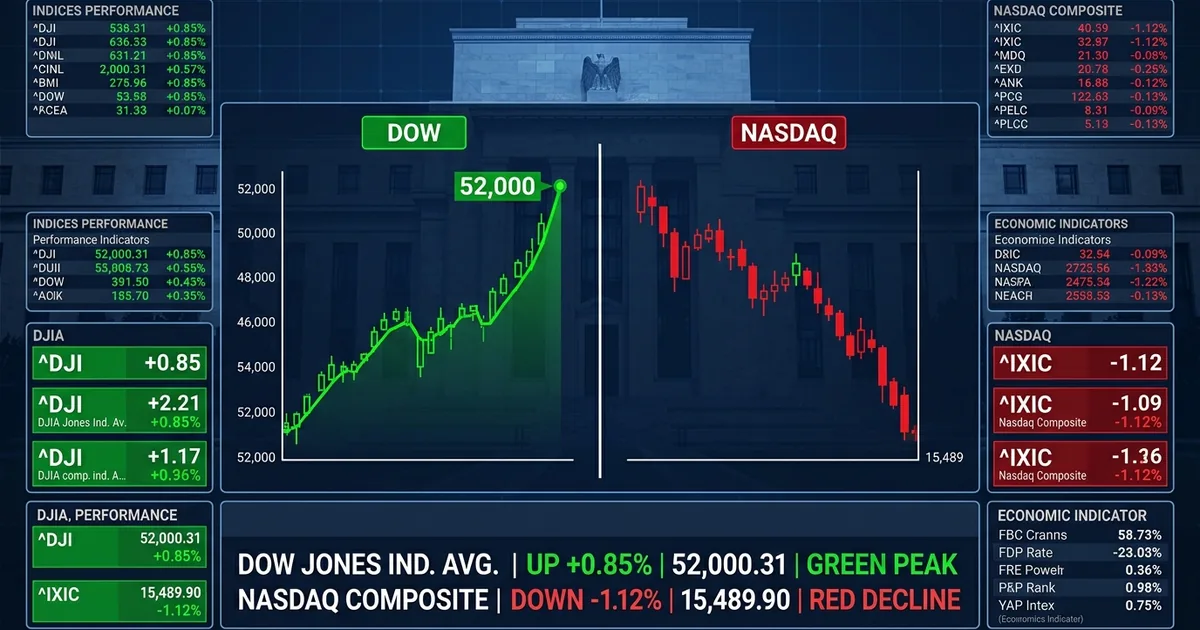
The Dow Jones Industrial Average posted a fresh all-time high on Monday, closing up 0.64% and pushing within striking distance of 52,000. The celebration was not shared. The Nasdaq Composite fell 1.15%, the S&P 500 slipped 0.08%, and the Russell 2000 backslid, painting a picture of a market that is rotating hard into value and cyclicals while dumping the growth names that led for years.
A Market Split Down the Middle
The divergence is not subtle. Goldman Sachs rallied 1.27%, Caterpillar climbed 2.15%, and American Express gained 1.71%, dragging the price-weighted Dow to its record. Meanwhile, technology and communication stocks weighed on the broader indexes. The pattern has been building for weeks, but Monday’s session made the divide impossible to ignore.
The catalyst is not a single event but a convergence: the Bank of Japan hiked rates last week, tightening global liquidity conditions. The Federal Reserve begins its two-day meeting Tuesday, with new Chair Kevin Warsh presiding for the first time. And the semiconductor sector, which drove much of the Nasdaq’s gains in 2024 and 2025, is still nursing wounds from the Broadcom-led selloff earlier this month that wiped $1.3 trillion from chip stocks in a single session.
What the Rotation Tells Us
When the Dow hits records while the Nasdaq falls, the message from institutional money is clear: risk appetite has not disappeared, but it has changed address. Capital is flowing into companies with pricing power, dividend yields, and earnings visibility: industrials, financials, healthcare. It is leaving companies priced for exponential growth in AI revenue that has not yet materialized at the scale the market was paying for.
CBS News noted that the Fed meeting carries unusual weight because it is Warsh’s debut as chair, complete with an updated dot plot and his first post-meeting press conference. Markets widely expect a hold at 3.50% to 3.75%, but the dot plot’s 2026 median projection could shift from the March reading of 3.4%, signaling whether the committee still sees room for cuts this year or has quietly abandoned that path.
The Warsh Variable
Warsh has signaled a hawkish posture since his confirmation, using the phrase “regime change” in testimony that Wall Street has been parsing for clues. His track record as a Bush-era Fed governor suggests comfort with tighter policy and less tolerance for the dovish forward guidance that characterized the late Powell era.
If Warsh’s first dot plot revision eliminates the remaining projected cut for 2026, expect the growth-to-value rotation to accelerate. Higher-for-longer rates compress the present value of future earnings, which hits long-duration growth stocks hardest. The Dow’s industrial and financial components, by contrast, benefit from stronger economic activity and wider net interest margins.
Bitcoin Holds Steady, Watching the Same Clock
Bitcoin stabilized near $65,800 on Tuesday morning, consolidating in a tight range ahead of the Fed announcement. Kiplinger’s earnings preview flagged the week as a pivotal one for market direction, with the Fed decision, Warsh’s press conference, and a cluster of major earnings reports all landing in a 48-hour window.
Crypto traders are watching the dot plot as closely as equity investors. A hawkish surprise that pushes rate-cut expectations further into 2027 would likely pressure risk assets across the board. A dovish surprise, even a subtle one, could reignite the bid for both tech and digital assets.
The Question That Matters
The Dow-Nasdaq divergence is not just a one-day curiosity. It is the market voting on what kind of economy we are heading into: one where steady earners with real cash flows command the premium, or one where the AI growth narrative gets a second wind. Warsh’s press conference on Wednesday at 2:30 p.m. ET will be the next data point. The rotation has a thesis. The Fed is about to tell us whether it agrees.