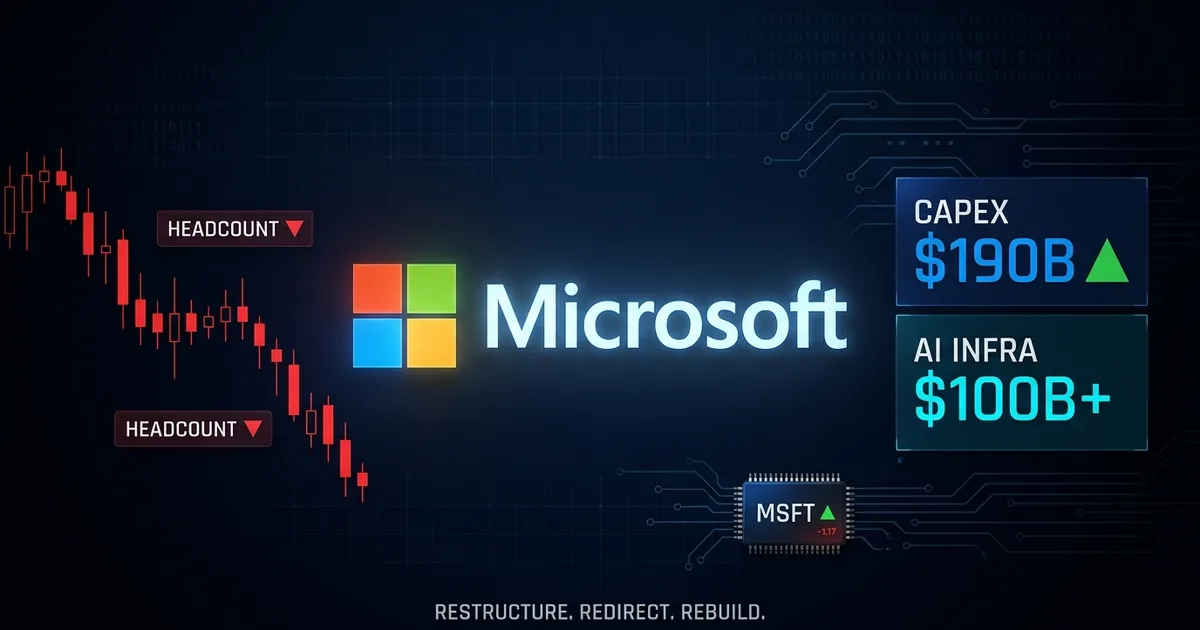
Microsoft is preparing to cut thousands of jobs across its sales, consulting, and Xbox gaming divisions as early as next week, Business Insider reported on Tuesday, the latest evidence that the AI infrastructure race is being bankrolled by gutting the headcount in everything else.
The planned reductions would stay below 2.5% of Microsoft’s roughly 228,000-person workforce, making it a smaller round than last year’s cuts. But the timing, landing on the first day of Microsoft’s fiscal 2027 (which began July 1), is not coincidental. It is structural. Microsoft has used its fiscal year transition as the mechanism for workforce resets in each of the past three years: roughly 9,000 cuts in July 2024, another 6,000 in May 2025, and now a fresh round that GeekWire confirmed will span Xbox, enterprise sales, and consulting.
The Real Story Is Where the Money Goes
The layoffs do not exist in isolation. They exist inside a capital reallocation machine. Microsoft expects to spend approximately $190 billion in capital expenditures this calendar year, a 61% increase from the prior year, with north of $100 billion directed at AI infrastructure alone. That is not a budget that coexists peacefully with a bloated cost structure in divisions that are not contributing to the AI thesis.
Follow the money: Xbox has absorbed more than $20 billion in investment over the past five years while revenue has declined by roughly half a billion dollars. The gaming unit got a new CEO in Asha Sharma this past February, and the mandate appears to be a full operational reset. Sales and consulting, meanwhile, are classic targets when enterprise software companies pivot from human-led go-to-market motions toward AI-assisted ones. The pattern is not unique to Microsoft. It is the playbook.
A Sector-Wide Reckoning Disguised as Individual Company Decisions
Microsoft is not alone. U.S. tech companies have announced 123,653 job cuts so far in 2026, up 66% from the same stretch of 2025, according to CNBC’s analysis of Challenger data. AI was the most commonly cited reason for workforce reductions in May. What makes the Microsoft round notable is the scale of the corresponding investment: no other company is simultaneously cutting thousands of jobs while committing $190 billion in capital spending. The message to Wall Street is explicit. Headcount in non-AI functions is a liability, not an asset.
This is the structural tension the latest AI job displacement data has been warning about. The 88,000 AI-linked job cuts tracked in 2026 are not a temporary adjustment. They are the cost side of a permanent capital reallocation from labor to infrastructure. Microsoft’s layoffs, framed internally as efficiency measures, are better understood as the financing mechanism for a $190 billion infrastructure bet. You cannot spend that much on data centers and keep paying the same number of people to fly to client sites.
Xbox Gets the Hardest Reset
The gaming division faces the deepest proportional cuts. Sharma’s appointment in February was already a signal that the Activision Blizzard integration, which cost Microsoft $69 billion, had not delivered the growth trajectory the board expected. Revenue has declined despite that historic acquisition, and the division’s operating model, built around exclusive console hardware and first-party studio investment, is increasingly at odds with Microsoft’s platform-and-services identity.
Fortune reported that the cuts are part of a broader cost-control push as Microsoft tries to manage investor expectations around the gap between AI spending and AI revenue. The company’s cloud and AI segments are growing, but not fast enough to offset the capital intensity. Something has to give, and that something is payroll in the divisions that are not on the AI growth curve.
What Wall Street Is Watching
Microsoft shares (MSFT) enter fiscal 2027 near all-time highs, which tells you the market has already priced in the logic: cut costs in legacy divisions, redirect to AI infrastructure, and grow into the capex over time. The risk is execution. A $190 billion spending commitment is a bet that enterprise AI demand will materialize at scale within the next two to three years. If it does, the layoffs look like prescient capital allocation. If it does not, Microsoft will have simultaneously gutted its human sales force and overbuilt its data center footprint.
The broader question is whether this model, massive AI infrastructure investment funded by rolling layoffs in non-AI functions, is sustainable for the sector or whether it creates a fragility that only becomes visible in a downturn. Meta ran the same playbook earlier this year. So did Intuit, GitLab, and Fidelity. The pattern is consistent: announce AI as the future, cut the humans who do the present work, and tell shareholders the capex will pay for itself. It is a compelling story when markets are rising and AI hype is at peak velocity. The test comes when it is not.
For the thousands of Microsoft employees receiving notices next week, the macroeconomic thesis is irrelevant. The fiscal year turned over. The spreadsheet won.