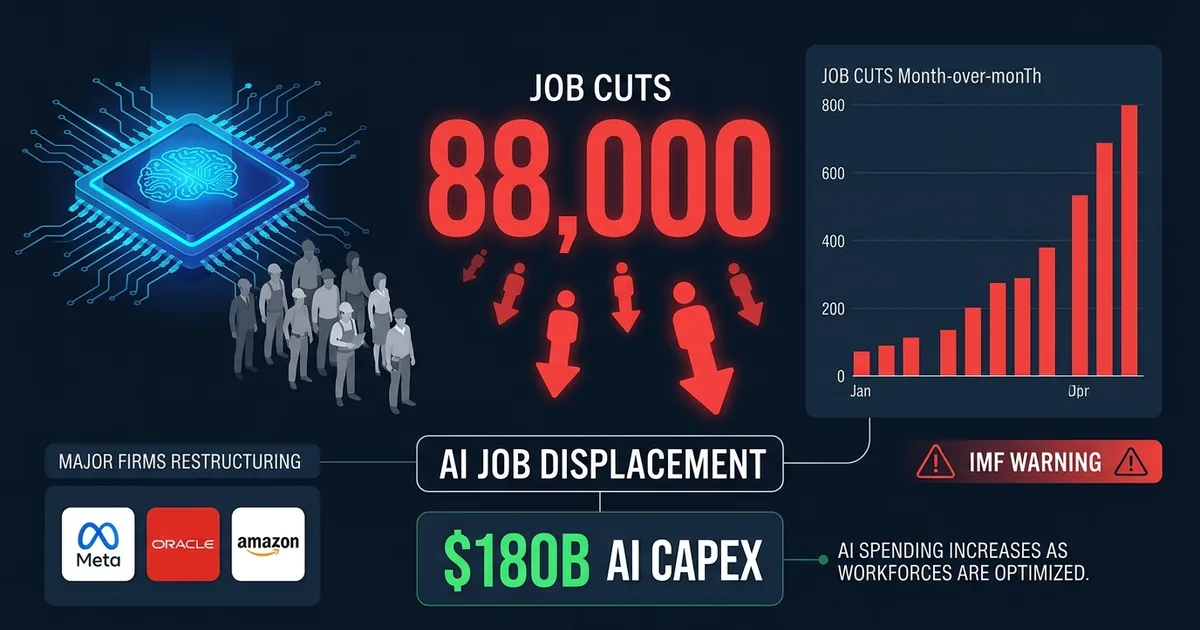
The number keeps climbing, and the companies doing the cutting are the same ones spending hundreds of billions on AI infrastructure.
The Body Count
Fifty major tech employers, including Amazon, Meta, Oracle, and Coinbase, have eliminated nearly 90,000 jobs since January citing AI as the primary driver, according to tracking data compiled across SEC filings and corporate announcements. That figure already exceeds the total number of AI-attributed job cuts from all prior years combined. At the current pace of roughly 16,000 per month, the year-end total will approach 200,000.
The scale of the cuts contrasts sharply with industry rhetoric about AI creating more jobs than it destroys. The companies making the deepest reductions are not struggling businesses trimming fat. They are the most profitable technology companies on Earth, simultaneously announcing record capital expenditure on AI infrastructure while reducing the humans who used to do the work those systems now handle.
Who Is Getting Cut and Why
The pattern is consistent across sectors. Oracle cut 21,000 positions in a single SEC filing earlier this month, the largest single AI-attributed reduction announced this year. Meta eliminated 8,000 roles in May. GitLab cut 14% of staff while explicitly citing its pivot to agentic AI. Intuit restructured 17% of its workforce, a $340 million charge, to reallocate headcount from human-performed tasks to AI-automated ones.
The jobs being eliminated cluster in predictable categories: customer support, content moderation, QA testing, basic software development, data entry, and back-office operations. These are the roles where current AI models can perform at 80% to 95% of human quality, which is good enough when the alternative costs $70,000 to $120,000 per year in salary and benefits.
Entry-level positions are taking the heaviest hit. The IMF warned earlier this year that AI would deliver a “tsunami” to entry-level employment, particularly affecting Gen Z workers entering the labor force. Goldman Sachs data shows that workers aged 22 to 25 in AI-exposed occupations have seen a 14% decline in job-finding rates compared to pre-pandemic baselines.
The Paradox: Spending Up, Headcount Down
The contradiction at the heart of the AI labor story is financial. The same companies cutting headcount are pouring capital into AI at unprecedented rates. Alphabet’s $180 billion to $190 billion capex guidance. Meta’s $145 billion AI spending plan. Microsoft, Amazon, and Oracle each committing tens of billions to data center buildouts.
This is not a contradiction. It is the business model working as designed. AI capital expenditure replaces recurring labor expense with a fixed infrastructure investment that scales without proportional headcount growth. A $500 million data center that automates customer support for 50 million users is cheaper over five years than the 5,000 support agents it replaces, and it operates 24 hours a day without benefits, turnover, or training costs.
The math extends up the skill ladder. GitHub Copilot’s metered billing transition, which closed its first cycle today, reflects the same dynamic: developer productivity tools that let a team of 10 do what used to require 15. The 5 who are no longer needed do not show up in a single dramatic layoff announcement. They show up as positions that simply are not backfilled when someone leaves.
What the Research Actually Shows
The aggregate picture is more nuanced than the headline suggests. A comprehensive March 2026 study found no detectable increase in aggregate unemployment for workers in highly AI-exposed occupations since ChatGPT launched in late 2022. Job displacement is real at the individual level, but the broader labor market has absorbed the shock so far, partly because the economy is growing and partly because displaced workers are moving into adjacent roles.
But the composition is shifting. The unemployment rate gap between entry-level workers under 30 and experienced workers aged 31 to 50 has widened sharply in AI-exposed occupations relative to pre-pandemic averages. The workers who are finding new jobs are finding them at lower wages and in less stable arrangements. The aggregate employment number masks a structural redistribution of economic opportunity that favors the people and companies that control AI systems over the people whose labor those systems are replacing.
The Political Dimension
The 88,000 figure lands in an election year where economic anxiety is already elevated. Both parties have made competing claims about AI’s impact on American workers, but neither has advanced legislation that addresses the specific dynamics playing out in corporate earnings reports: companies using AI-driven productivity gains to reduce headcount while distributing the savings to shareholders via buybacks and dividends.
The policy gap creates an opening for states. California’s AI bias lawsuit against Workday, which BTN covered in June, represents one vector. The EU’s AI Act employment provisions represent another. But federal action remains stalled, and the job cuts continue at a pace that will force the conversation whether Washington is ready for it or not.