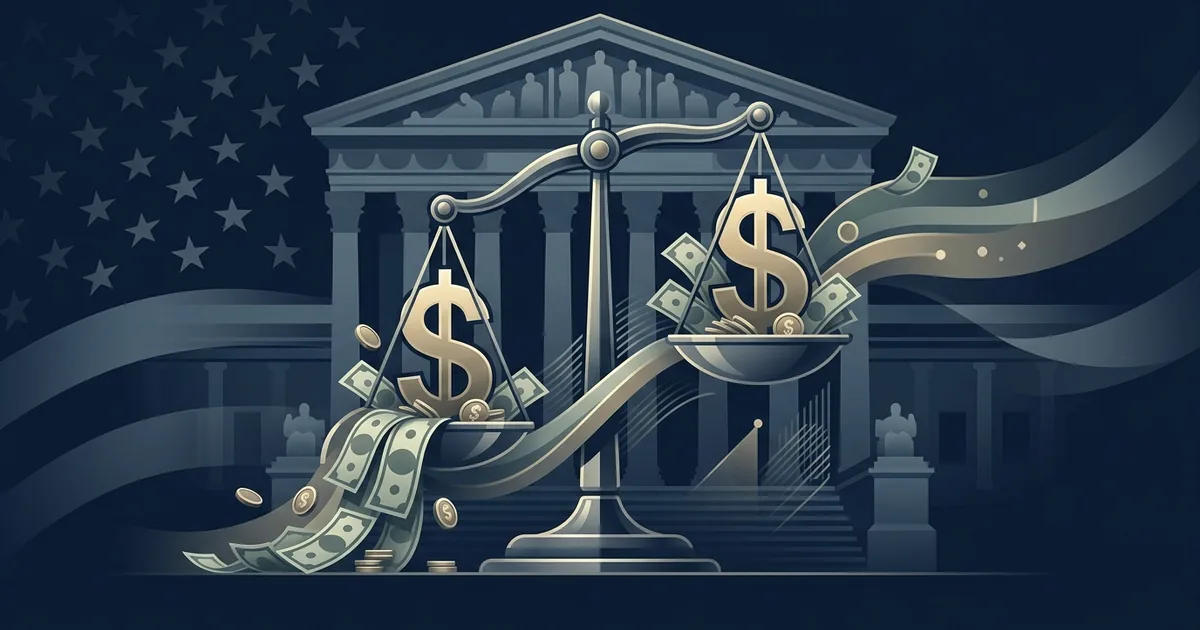
The Supreme Court on Monday struck down federal limits on how much political parties can spend in coordination with their candidates, ruling 6-3 along ideological lines that the restrictions violate the First Amendment. The decision in National Republican Senatorial Committee v. Federal Election Commission overturns a 2001 Supreme Court precedent and dismantles one of the last structural guardrails from the post-Watergate campaign finance framework.
What the Ruling Does
The case challenged a provision of the Federal Election Campaign Act (FECA) that capped how much a national party committee could spend in direct coordination with a candidate’s campaign. Justice Brett Kavanaugh, writing for the conservative majority, held that the coordinated spending limits burden political parties’ speech rights without a sufficiently compelling government interest. As NPR reported, the ruling joins a series of decisions since Citizens United that have systematically unraveled the post-Watergate campaign finance architecture.
The practical effect is immediate. National party committees, the RNC, DNC, NRSC, DSCC, and their House counterparts, can now spend unlimited amounts in direct coordination with individual candidates. Before this ruling, coordinated expenditures were capped at relatively modest levels, forcing parties to route large spending through independent expenditure arms that could not legally strategize with the candidate’s team. That firewall is gone.
Follow the Money
This is a ruling that will be measured in dollars before it is measured in precedent. The 2026 midterm cycle was already projected to be the most expensive in history, with total spending estimates north of $12 billion. Removing the coordination cap transforms national parties from constrained fundraising vehicles into direct financial extensions of their candidates’ campaigns.
According to CBS News, the case was originally filed by then-Senate candidate JD Vance and other Republicans, and the Republican Party stands to benefit most in the near term. The GOP’s national committees have historically outraised their Democratic counterparts, and the coordination freedom allows them to deploy that financial advantage with surgical precision rather than through the blunt instrument of independent ads.
Justice Elena Kagan, dissenting, captured the structural concern: “With no limits on coordinated expenditures, the party can serve as the candidate’s checking account.” Justices Sonia Sotomayor and Ketanji Brown Jackson joined the dissent.
The Broader Pattern
This ruling did not arrive in isolation. It landed on the same day the Court upheld its independence ruling on the Federal Reserve and decided several other consequential cases, capping one of the most consequential terms in recent memory. The campaign finance decision fits a clear trajectory: since Citizens United in 2010, the Court’s conservative majority has treated campaign spending restrictions as presumptively unconstitutional speech burdens, shifting the balance of power from regulatory agencies to donors and party organizations.
For the business community, the implications run deeper than partisan advantage. When parties can coordinate unlimited spending directly with candidates, the influence of individual large donors and corporate-aligned PACs becomes more potent, not less. A donor who maxes out to a candidate can now also funnel unlimited resources through the party committee with full confidence that every dollar will be spent according to the candidate’s strategy. The return on political investment just got more predictable.
The Ad Market Impact
Media buyers and political ad strategists were already adjusting projections within hours of the ruling. Coordinated spending is more efficient than independent expenditure spending because the party and the candidate share strategy, messaging, and targeting data. That efficiency means more dollars chasing the same finite inventory of persuasion-stage voters in battleground districts. Political advertising already crowds out commercial advertisers in swing states during October and November. Removing the coordination cap will intensify that displacement, creating both pricing pressure for consumer brands and a revenue windfall for local broadcasters and digital platforms that dominate political ad delivery.
What to Watch
The ruling takes effect immediately, meaning the 2026 midterm cycle will be the first real test of uncapped coordinated spending. Expect a surge in party committee fundraising pitches over the coming weeks as both sides race to capitalize. The downstream effects on advertising markets, media spending, and political consulting firms will be substantial, with battleground-state television and digital ad inventory likely to see accelerated demand and rising CPMs.
The longer-term question is whether this ruling incentivizes Congress to attempt new forms of campaign finance regulation, or whether the Court’s trajectory has made any meaningful reform effectively unconstitutional. Based on the 6-3 alignment, the answer is likely the latter for at least a generation.