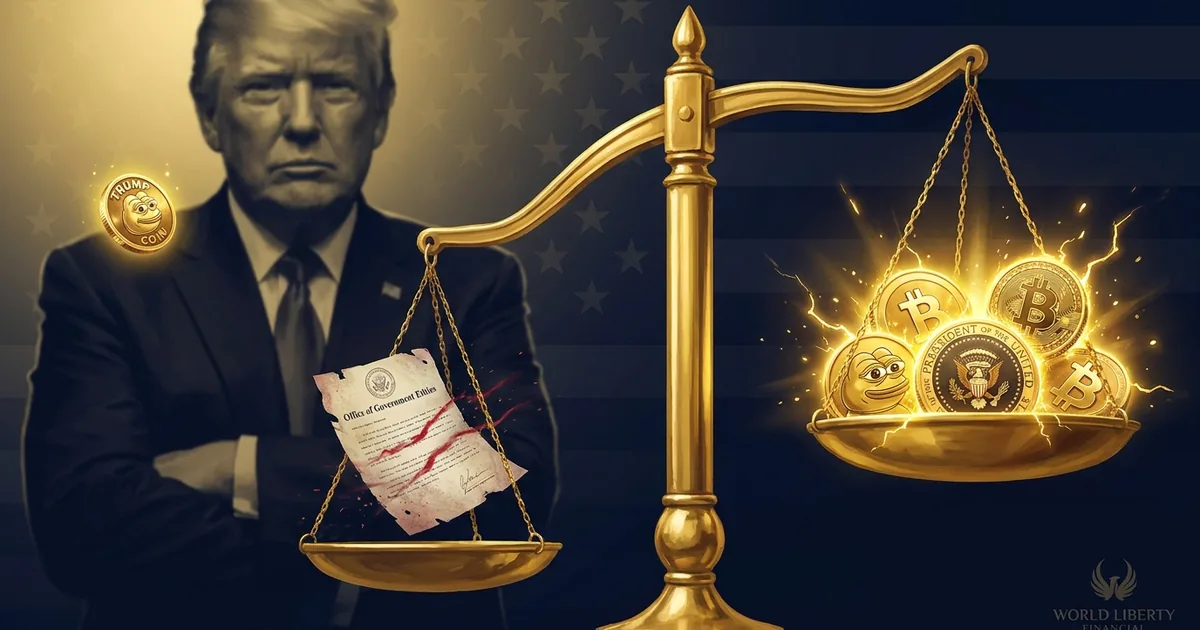
President Donald Trump earned at least $1.4 billion from cryptocurrency ventures during 2025, according to a 927-page financial disclosure filed with the U.S. Office of Government Ethics. It is the first time crypto has eclipsed Trump’s real estate empire as his dominant income source, and it happened in the same year he made crypto deregulation a cornerstone of his presidency. The disclosure does not reveal a conflict of interest. It reveals a business model.
The Revenue Streams: Meme Coins, Token Sales, and a Family Crypto Firm
The filing, first reported by NBC News, breaks Trump’s crypto income into three streams that trace the architecture of the operation.
The largest single line: more than $635 million from a licensing agreement with Celebration Coins, the entity behind Trump-branded meme coins that launched in January 2025 and briefly spiked above $74 per token. Those coins now trade at $1.68. Trump collected his cut on the way up. Retail buyers absorbed the 98% collapse on the way down.
Then there is World Liberty Financial, the crypto firm co-founded by Trump, his sons Eric and Donald Jr., and Steven Witkoff, who simultaneously serves as the president’s principal Middle East envoy. World Liberty generated more than $594 million in token and equity sales, plus another $290 million classified as income from associated cryptocurrency wallets. Bloomberg reported that the combined haul marks the largest crypto-derived presidential income ever disclosed.
An additional $236 million came from other crypto token sales and a $65 million equity transaction tied to the World Liberty venture. Add it up and crypto alone dwarfs the golf courses, hotels, and licensing deals that defined the Trump financial brand for decades.
The Structural Conflict the Filing Makes Undeniable
Here is what makes this more than a disclosure story. The president who earned $1.4 billion from crypto is the same president who dismantled the regulatory framework designed to police the industry. Trump signed executive orders rolling back SEC enforcement actions against crypto firms, installed industry-friendly appointees at key financial regulators, and publicly championed crypto deregulation at rallies and on social media. He did all of this while his family’s ventures were actively selling tokens to the public.
The mechanism is straightforward: deregulate an industry, launch products into the deregulated space, use the presidential platform as both marketing engine and regulatory shield, then collect the profits. Don Fox, who served as acting director of the Office of Government Ethics, told CBS News that ethics norms are “totally out the window.”
The White House response follows its standard script. Spokeswoman Anna Kelly told reporters that “neither the President nor his family has ever engaged, or will ever engage, in conflicts of interest,” adding that Trump placed his business in a trust managed by his sons. The trust argument collapses on contact with the facts: the president’s sons are co-founders of the ventures generating the income, and the president himself publicly promotes the tokens.
Retail Investors Lost Nearly Everything
The human cost sits in the token prices. World Liberty Financial governance tokens have fallen 80% since they started trading in September 2025. The Trump meme coins cratered from above $74 to $1.68, a 98% loss for anyone who bought near the peak.
This unfolded in a broader crypto market already under pressure. Bitcoin ETFs posted their worst month on record in June, with $4.5 billion in outflows as institutional investors retreated from the asset class. The retail holders of Trump-branded tokens had no such institutional risk management. They bought because the president of the United States told them crypto was the future, and they lost nearly everything while he collected $1.4 billion.
The Witkoff Problem
Steven Witkoff’s dual role warrants its own scrutiny. Witkoff co-founded World Liberty Financial while simultaneously managing some of the administration’s most sensitive diplomatic relationships as Trump’s top Middle East envoy. The crypto firm he co-founded generated hundreds of millions in revenue during a period when he was representing the United States government in negotiations with foreign powers.
There is no historical precedent for a senior diplomat co-founding a crypto venture with the sitting president’s family while actively conducting foreign policy. The arrangement creates an obvious vector for foreign influence: any government seeking favorable terms from Witkoff at the negotiating table knows his business partner is the president’s son and the president’s financial interest is directly tied to the venture’s success.
What Happens Next
Fox Business noted that Trump’s crypto income exceeded all other income categories combined, including the real estate portfolio that once defined his public identity. The president is now, by the numbers, a crypto mogul who happens to run a country and a real estate business on the side.
Congressional Democrats have called for investigations into the administration’s crypto policy decisions and their relationship to the Trump family’s financial interests. Whether those investigations gain traction in a Republican-controlled Congress is an open question. What is not open to question is the 927-page filing itself.
For the business audience watching this unfold, the disclosure answers the question of what Trump’s crypto deregulation agenda was really for. It was not an ideological commitment to financial innovation. It was a revenue strategy, and it generated $1.4 billion in its first year.