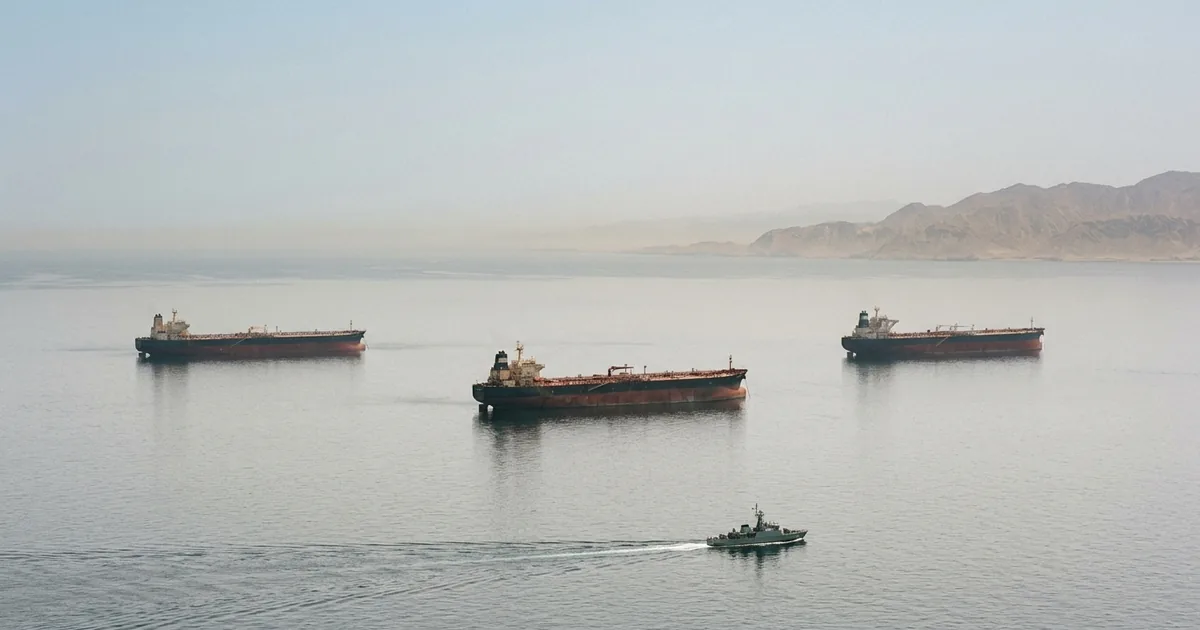
There are two irreconcilable accounts of the Strait of Hormuz in circulation this week. The White House says the United States has the waterway under control and is escorting oil through it, with the energy secretary putting the flow at an average of 10 million barrels a day over the past week. Independent ship tracking says roughly 14 vessels a day are transiting, against a pre war average of more than 100 carrying about 20 million barrels.
Every outlet covering this is arguing about whose barrel count is right. There is a third number that nobody is treating as evidence, and it is the only one in the dispute that is repriced every day by people risking their own capital on the answer: the war risk insurance premium. It has not come down. Before the conflict, cover for a Hormuz transit ran about 0.25 percent of hull value. It now runs between 7.5 and 10 percent across the tanker segment. If the escorts were materially reducing the risk, that is the number that would move first, and it has not moved at all.
What the Premium Is Actually Saying
Marine war risk is underwritten mostly at Lloyd’s and in the London company market, repriced per voyage, and priced by underwriters who are paid to be right about precisely this question and who lose money when they are wrong. It is the closest thing to a live market verdict on whether the strait is safe.
At current rates, a $100 million tanker faces a premium of $3 million to $10 million for a single transit, against roughly $250,000 before hostilities. At the top of the range, a 270,000 deadweight tonne crude carrier valued at $210 million can be quoted around $21 million to make one crossing. Those are not the numbers of a market that believes a naval escort has changed the underlying hazard. They are roughly thirty to forty times the pre crisis price and, by mid summer, about four times the five year average.
Availability Was Never the Constraint
There is a persistent framing that the insurance market closed the strait by withdrawing cover, and it deserves correcting because it points policy at the wrong problem. The Lloyd’s Market Association addressed this directly in a market statement back in March, when traffic first collapsed.
The reason ships are not moving is not through a lack of insurance; it is a question of the risk to crew and vessel safety being assessed by the ship masters and owners as too high.
The association’s survey at the time found 88 percent of respondents still underwriting hull war risks for the region and more than 90 percent still writing cargo cover. It listed the real impediments as depleting ship supplies, uncertainty over salvage availability, a shortage of ports of refuge, and specific concerns around chemical tanker stabilisers. Cover has been purchasable throughout. Masters and owners have simply been declining to use it.
That distinction is the whole argument. If the binding constraint were insurance capacity, a government backstop would reopen the strait, and several have been floated on exactly that reasoning. If the binding constraint is that crews and owners judge the transit too dangerous, a backstop moves the loss onto taxpayers and leaves the ships where they are.
The Price Tape Agrees With the Insurers
Crude is behaving like a market that has not been reassured either. Brent rose $3.21 to $107.82 a barrel on Monday and West Texas Intermediate gained $3.17 to $103.22, moves triggered by fresh attacks on shipping and a drone strike that shut Saudi Arabia’s East West pipeline, the single most important piece of infrastructure for routing barrels around the strait rather than through it. The International Energy Agency has classified the disruption as the largest supply shock in the history of the global oil market.
We have written before about the transit fee Iran’s Persian Gulf Strait Authority has been extracting from tankers, and it is worth noting what the insurance number does to that calculus. When war risk cover alone can reach $21 million for one crossing, a $2 million toll stops being the decisive cost. The economics of the strait are now set in London, not at Bandar Abbas.
Our View: Believe the Premium, Not the Podium
Claims of total control of a waterway are unfalsifiable in the short run and politically useful, which is a combination that should lower rather than raise the weight placed on them. The war risk market is the available check, it is updated continuously, it is made by people with money at stake, and it is flatly contradicting the official account. When a market and a podium disagree, the market is the one that has to pay for being wrong.
None of this means the escorts are worthless. Moving two thirds of prior volume, if that figure holds up, is a real achievement under fire. But the administration is claiming something considerably stronger than that, and the correct response to an unverifiable claim is to look for the party who is betting against it. Underwriters are betting against it, at thirty times the old price, every single day.
The number to watch is not the barrel count and not the Brent print. It is the additional war risk premium quoted for a Hormuz transit. On the day that comes off 10 percent of hull value and settles somewhere near 3, the strait has genuinely reopened, whatever anyone says at a press conference. Until then the market is pricing a closed waterway, and it is the best information available.