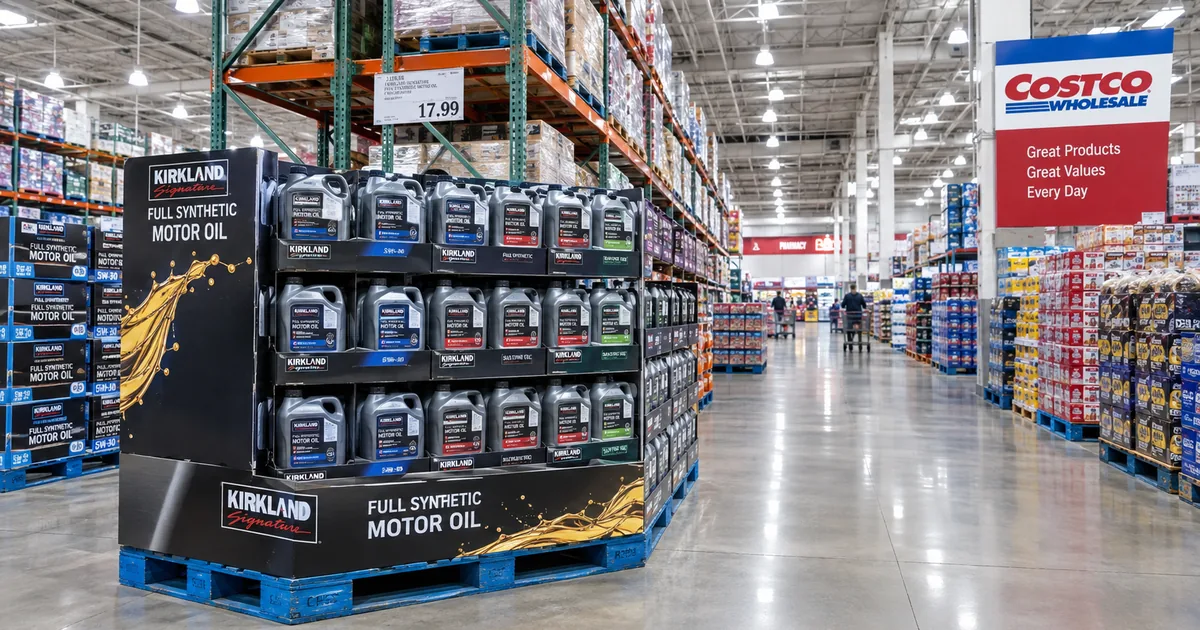
Costco has begun rationing motor oil, and the coverage has settled on a comfortable explanation: a global shortage arrived, and the warehouse club reacted. That gets the sequence backwards. The supply shock that put a two-box cap on Kirkland Signature full synthetic happened in late February and March. It was fully visible in base oil contract prices by May, when the benchmark grade cleared $10 a gallon against roughly $5.80 before the disruption. What shoppers are hitting in September is not a fresh emergency. It is a seven month old one finishing its walk down the supply chain, and almost nobody told the people at the end of it that it was coming.
What Actually Changed on the Shelf
The mechanics are blunt. A 10 quart box of Kirkland Signature full synthetic that historically sold for about $30 now runs $58, and members are capped at two units every seven days. Mobil 1 got a softer treatment, with a six quart case at $44 and a five unit ceiling. The Drive noted that Costco moved to rationing rather than simply letting the price clear, which for a retailer built on bulk purchasing is a real break with the format.
Rationing is the interesting signal, not the price. A 90% markup tells you a cost pass through happened. A purchase limit tells you the retailer does not believe it can restock on its normal cycle at any price it is willing to charge.
Forty-Four Percent of US Supply Came From Three Plants
Modern full synthetic oil depends on Group III base stock, and the United States has been sourcing close to 44% of it from three Persian Gulf producers: Shell’s Pearl GTL in Qatar, ADNOC in the United Arab Emirates, and Bapco in Bahrain. That concentration is the whole story, and it is the part the retail coverage skips.
When the Strait of Hormuz closed in late February, that share stopped moving. Pearl GTL, the world’s largest Group III producer, then lost one of its two base oil trains outright, with Shell putting repairs at roughly a year. The second train kept running. The arithmetic from there is not complicated: combined premium grade base oil shipments from Bahrain, Qatar and the UAE into Asia, Europe and the United States fell below 50,000 metric tonnes in May, down from more than 185,000 tonnes in March.
The Independent Lubricant Manufacturers Association has been saying so since spring. Its own members asked the American Petroleum Institute for emergency relief on Group III specifications, which is the industry equivalent of requesting permission to reformulate the product because the input is not available. ILMA later confirmed that the supply crisis was continuing even as shipping conditions improved. Shipping was never the binding constraint. Production was.
A Lubricant Shortage Is a Refinery Allocation Decision
Base oil and diesel come out of the same barrel. When refining margins on fuel run hot, the economics of finishing a barrel into lubricant stock stop making sense, and base oil output gets squeezed on purpose. That is not a malfunction. It is refiners doing exactly what the spread tells them to do.
Which is why this lands on top of a fuel market that is already stretched. Brent topped $107 after Houthi forces seized Yemen’s Red Sea port of Mokha, near a strait that normally carries about 12% of seaborne traded oil, and crude closed out the week above $100. AAA has US gasoline near $4.30 a gallon, up more than 34% year over year, with diesel above $6 and up more than 63%. We covered the diesel record last week and made the same structural point: the record was a refining and allocation story rather than a crude price story. Motor oil is that same decision, one product further down the barrel, showing up at a cash register instead of a truck stop.
A price increase is a cost being passed on. A purchase limit is a retailer admitting it does not trust its own restock schedule.
Where We Come Down on This
Costco is the one party in this chain behaving well. Capping units is the correct response to a genuine input shortage, because the alternative is letting a handful of buyers clear the shelf and resell at a markup. Charging $58 for a box that cost $30 is not gouging when the base stock underneath it roughly doubled. Retail did its job.
The failure sits upstream, and it is a disclosure failure rather than a pricing one. A strategic industrial input was allowed to run at 44% single region concentration with no public visibility, and when that region went offline in February the response from the lubricant industry was to quietly petition for spec relief while consumer facing prices held steady through spring and summer. Anyone buying a case of oil in June was buying into a shortage the trade association had already formally escalated. That gap between what the industry knew in March and what the shelf said in August is the actual scandal here, and it will repeat, because nothing in the current setup requires anyone to announce it.
The fix is unglamorous and entirely achievable: base oil is a tracked commodity with public import data, and a single quarterly disclosure of Group III sourcing concentration by major blenders would have given buyers and fleet operators two full quarters of warning. Refiners will keep sending barrels wherever the spread points, and that is their job. Telling the market which strategic inputs are one chokepoint away from unavailable is a regulatory job, and right now nobody is doing it.
What to Watch
The second Pearl GTL train is the number that matters. Shell’s roughly one year repair timeline puts restored capacity in early 2027, which means the current base oil price floor holds through at least two more contract cycles regardless of what happens at Bab al-Mandeb. Korean refiners can take some of the volume and already supply a meaningful share of US Group III imports, but not 44% of it at once.
For anyone running a fleet, the practical read is that lubricant cost has stopped being a rounding error in the maintenance line. For everyone else, the purchase limit at Costco is worth treating as what it is: the most honest price signal in the entire chain, arriving about six months late.