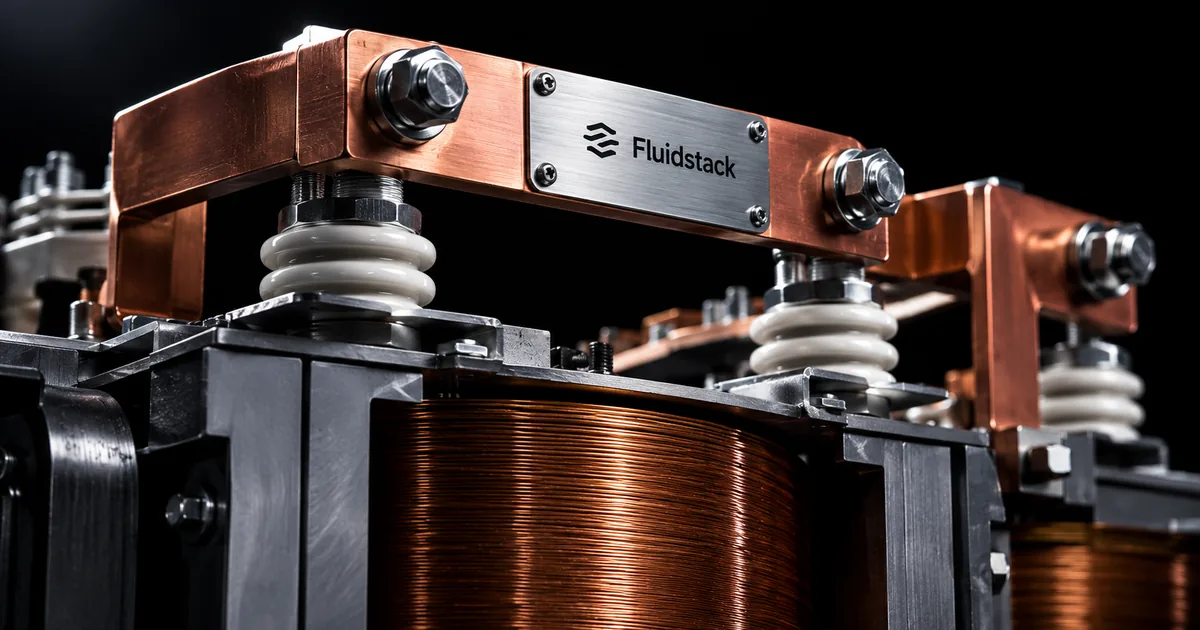
The Wall Street Journal reported last Thursday that the Department of Defense is in talks to lend roughly $5 billion to Fluidstack, and the coverage that followed mostly landed on the obvious frame: the Pentagon is backing AI infrastructure. Read what the money is for and a different story appears. The loan would not fund a single server hall. It is earmarked for domestic manufacturing capacity for data center components, the transformers and switchgear that sit between a signed compute contract and an actual delivered megawatt. The Pentagon is not buying compute here. It is trying to fix the electrical bottleneck that is currently rationing the entire AI buildout, and it is doing it through a lending office that almost nobody has been watching.
The Office Doing the Lending Grew Roughly 200 Times in 18 Months
The money would come from the Office of Strategic Capital, which is the part of this that deserves far more scrutiny than the borrower. OSC was stood up in 2022 and given statutory loan authority in the fiscal 2024 defense authorization act, aimed at critical technologies where the United States depends on Chinese supply. In January 2025 it opened for business with $984 million in lending authority and a $150 million ceiling per equipment loan.
That was 20 months ago. Under Defense Secretary Pete Hegseth the same office now sits on more than $210 billion in available authority and has reoriented around individual loans of between $1 billion and $5 billion, with the department requesting over $20 billion more for the program in its 2027 budget. A credit facility went from writing $150 million cheques to writing $5 billion ones, and its per loan ceiling now exceeds what its entire original authority could have covered by a factor of five. At $5 billion the Fluidstack deal would be the largest loan OSC has ever made.
This is industrial policy, and it is being run as credit rather than as appropriation, which is precisely why it has attracted so little attention. Loans do not go through the annual scrutiny that spending does. They score differently, they carry terms the office describes as flexible on repayment, and they can be stacked on top of private equity and corporate debt to complete a capital structure that would not otherwise close.
Fluidstack Is a Reasonable Borrower With an Unreasonably Short History
The company itself is not the weak point, though its trajectory is startling. Fluidstack was founded in 2017 out of Oxford University, moved its headquarters to New York, and now builds and runs large scale GPU clusters and custom data centers. It is the partner Anthropic picked to deliver a $50 billion US data center program starting with sites in New York and Texas, work Fluidstack confirmed on its own site, with capacity also going up in Indiana and Louisiana. TechCrunch reported in April that it was raising at an $18 billion valuation months after being worth $7.5 billion.
So the Pentagon would be lending its largest ever sum to a nine year old company whose valuation more than doubled in a few months, to build factory capacity for parts that its own largest customer needs in order to fulfil a $50 billion private contract. Every individual link in that chain is defensible. The chain as a whole is the same circular structure we flagged when Nvidia agreed to backstop $105 billion so OpenAI could rent the chips Nvidia sells it, except the balance sheet absorbing the risk this time is the taxpayer’s.
The Accountability Problem Is Not Hypothetical
Our position is that the transformer bottleneck is real and worth public money, and that this specific loan is probably good policy delivered through a dangerously under supervised instrument.
Take the first half seriously, because it is true. Grid electrical equipment is a genuine chokepoint with multi year lead times, it is concentrated in foreign supply chains, and no amount of private capital has fixed it because the payback horizon is too long for venture money and too uncertain for utilities. This is close to a textbook case for state backed industrial credit.
Now the second half. This is the same office that, according to ProPublica’s reporting, was pushed by the White House into a $620 million deal with a company tied to Donald Trump Jr., an account NPR reported independently. One documented instance of political steering at $620 million, inside a program that has since scaled its authority past $210 billion and is now writing cheques eight times that size, is not a footnote. It is the whole governance question.
What should happen is straightforward and unlikely. Any OSC loan above $1 billion should require advance congressional notification with published terms, the same way major foreign military sales do. The office should disclose its portfolio. Neither of those constrains the industrial policy at all. They only constrain the discretion, which is exactly the part that has already been abused once.
What to Watch
The deal is not signed and the terms are not public, so the first real test is whether any of it becomes public before it closes. After that, watch whether OSC’s next several loans cluster around AI infrastructure generally, which would confirm the Pentagon has decided the compute buildout is national security infrastructure and made itself its lender of last resort. That is a defensible conclusion. It is also one Congress has never explicitly voted on.