Fortnite OG Season 9 goes live on Thursday, dropping a fresh battle pass, map changes, and a loot pool overhaul that will be instantly familiar to the game’s veteran player base. The launch is trending at more than 2,000 searches per minute on Google Trends US, making it one of the most anticipated gaming events of the summer. But behind the nostalgia play sits a business story that is far more complicated than the player counts suggest.
The Revenue Reality
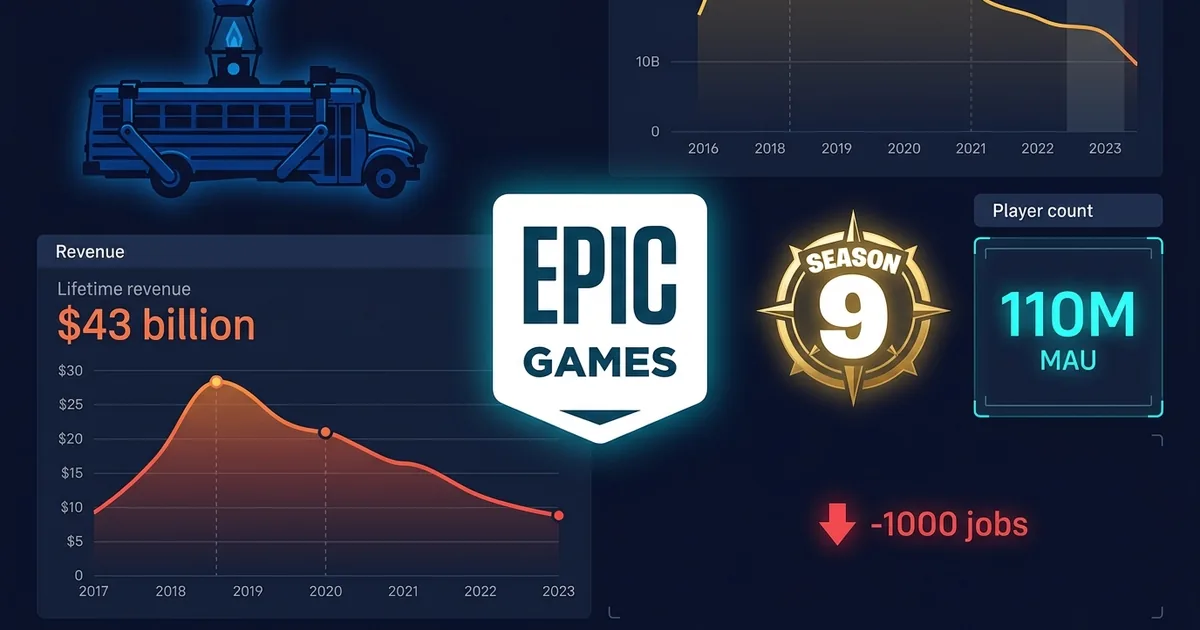
The numbers are staggering on the surface. Fortnite has generated more than $43 billion in lifetime revenue, a figure that puts it among the most commercially successful entertainment products ever created. Monthly active players average around 110 million in early 2026, and the game’s cultural footprint extends from concert tie-ins with Ariana Grande and Travis Scott to brand collaborations with Nike, Ferrari, and Marvel.
But Epic Games as a company is not riding that revenue smoothly. Tekrevol’s revenue analysis shows that Fortnite’s peak revenue years were 2018 and 2019, and while the game remains a massive earner, the per-user monetization curve has flattened as the free-to-play model matures and competition from titles like Valorant, Apex Legends, and the resurgent Call of Duty franchise intensifies.
CEO Tim Sweeney acknowledged the strain in a March 2026 internal memo that tied layoffs of more than 1,000 employees to a Fortnite engagement downturn that began in 2025. The memo was blunt: Epic was spending more than it was making and needed to find over $500 million in cost savings. For a company sitting on $43 billion in lifetime game revenue, that is a remarkable admission.
The OG Strategy: Nostalgia as a Retention Tool
Fortnite OG is Epic’s answer to the engagement problem. Rather than trying to out-innovate competitors with new mechanics, the OG mode resurrects the map layouts, weapons, and gameplay loops from Fortnite’s early seasons, the era when the game was a genuine cultural phenomenon. Season 9, launching today, continues that strategy with loot pool shake-ups that long-time players will recognize immediately.
The approach has worked. When Fortnite OG first launched in November 2023, it drew 44.7 million players in a single day, shattering records. Each subsequent OG season has produced engagement spikes, though the peaks are getting shorter. The question for Epic is whether nostalgia is a sustainable growth strategy or a series of diminishing-return events that delay rather than solve the underlying monetization challenge.
Epic Beyond Fortnite
Fortnite’s financial dominance obscures the fact that Epic is a diversified technology company with significant revenue streams beyond the game. Unreal Engine powers a large share of the global game development industry, and Epic’s licensing model generates revenue from every title that exceeds $1 million in gross revenue. The Epic Games Store, while still operating at a loss due to aggressive developer revenue splits and free game giveaways, has built a catalog of over 1,000 titles and a user base of more than 270 million.
Then there is the Apple and Google litigation, which produced a partial victory in the Epic v. Apple case and contributed to regulatory pressure that has forced both platform owners to allow alternative app stores and payment systems. SQ Magazine reported that Fortnite’s return to the iOS App Store via alternative distribution could unlock a revenue stream that has been closed since August 2020.
The company also recently raised funding at a $32 billion valuation, down from a $45 billion peak in 2022 but still positioning Epic as one of the most valuable private companies in technology. An IPO remains a possibility if Sweeney can demonstrate that the cost-cutting measures have stabilized margins.
What Investors and the Industry Should Watch
The Fortnite OG Season 9 launch is a test of whether Epic can keep its flagship franchise culturally relevant while navigating the cost restructuring Sweeney described in March. The broader pattern of tech layoffs tied to AI transformation extends to gaming, where Epic, Unity, and Embracer have all cut significant headcount in 2025 and 2026.
For the gaming industry, Fortnite’s trajectory matters because it is the purest test case for free-to-play economics at scale. If a game with 110 million monthly players and $43 billion in lifetime revenue cannot generate enough margin to avoid layoffs and cost-cutting, it raises fundamental questions about the long-term economics of the live-service model that the entire industry has adopted.
Season 9 will tell us whether the players are still showing up. The financial filings will tell us whether that matters.