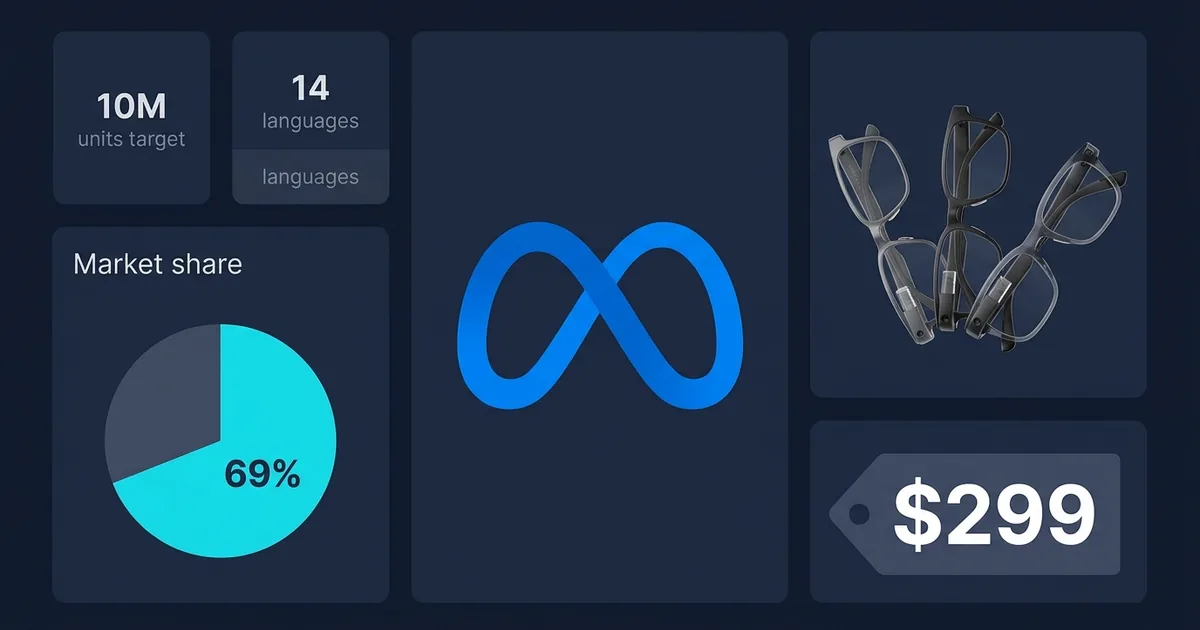
Meta just did something it has never done before: put its own name on a pair of smart glasses. The new Meta Glasses start at $299, undercutting the company’s existing Ray-Ban models by $80, and represent Mark Zuckerberg’s clearest signal yet that wearable AI is not a niche experiment but a consumer electronics category Meta intends to own.
Three Frames, One Strategy
The Meta Glasses come in three styles: Adventurer (small frame), Fury (larger, slightly rounder), and a collaboration with Kylie Jenner called Meta Glasses by Kylie. All three share the same core technology: cameras for image capture, speakers for audio, a microphone array, and Meta’s AI assistant baked in. They can play music, translate languages in real time across 14 new language pairs including Japanese, Mandarin, Hindi, and Korean, and answer questions about whatever the wearer is looking at.
TechCrunch reported that this is the first time Meta has put its own branding on smart glasses rather than relying on eyewear partner EssilorLuxottica’s consumer brands like Ray-Ban and Oakley. Meta still partners with EssilorLuxottica on the lenses, and the premium Ray-Ban and Oakley models continue to sell at higher price points.
The $299 price is the strategic move. The Ray-Ban Meta glasses start at $379, and Snap’s recently launched Spectacles AR glasses retail at a staggering $2,195. By putting a functional AI wearable below $300, Meta is making a land-grab play: get the hardware onto as many faces as possible, then monetize through the AI services and data that flow through them.
Market Dominance and the 10 Million Target
Meta already commands 69.2 percent of the smart glasses market, a number that reflects both the weakness of competitors and the strength of the Ray-Ban partnership. CNN reported that Zuckerberg’s stated goal is to sell 10 million wearables in the second half of 2026, driven by expanded country availability and the lower price point.
Ten million units would make smart glasses a real consumer electronics category rather than a curiosity. For context, Apple sold roughly 600,000 Vision Pro headsets in its first year, a product that costs $3,499 and requires users to strap a computer to their face. Meta is betting that the path to spatial computing runs through something people already wear: regular-looking glasses that happen to have AI in them.
The company is also testing models called Artemis and SSG (“supersensing” glasses) for future releases, plus an AI pendant, a device that captures audio and provides AI assistance without the glasses form factor. Meta’s wearable strategy is becoming a full product line, not a single SKU.
The Business Model Question
Here is the tension investors should watch. Smart glasses at $299 are almost certainly sold at or near cost. The hardware margins are thin or negative, following the same playbook Meta used with Oculus Quest headsets: subsidize the device, build the ecosystem, capture the user relationship, and monetize later through services, subscriptions, or advertising.
But the “monetize later” part of that equation has not yet materialized for Meta’s hardware efforts. The Reality Labs division has lost more than $60 billion since 2020 and continues to burn cash. Zuckerberg has described this as a long-term investment, and investors have largely given him a pass because the core advertising business prints enough cash to fund it.
The $299 smart glasses shift the risk profile. If they sell in the millions, Meta establishes a wearable AI platform with network effects that competitors cannot easily replicate. If they do not, it is another expensive bet in a division that has consumed capital for six years with limited consumer traction outside the Quest gaming ecosystem.
What distinguishes this launch from previous Reality Labs bets is the AI angle. The glasses are not asking consumers to enter a virtual world. They are offering to augment the real one, with language translation, visual question-answering, and contextual awareness that Snap’s $2,195 Spectacles also promise but at a price point that limits adoption to developers and early adopters.
Why $299 Changes the Competitive Landscape
Samsung launched its own smart glasses earlier this year, and Apple has been widely reported to be developing a lighter-weight successor to Vision Pro. Google’s recent moves with Gemini suggest the company is preparing its own AI wearable play. The smart glasses market is about to get crowded.
Meta’s $299 entry price is a pre-emptive strike. By establishing the category’s price anchor at a consumer-friendly level, Meta makes it harder for competitors to enter at premium pricing without offering a dramatically better product. It is the same strategy Amazon used with the Kindle and Echo: go cheap, go broad, own the relationship.
Whether Meta can turn millions of $299 glasses into a profitable business is the question that will define Zuckerberg’s hardware legacy. The bet is on the table.