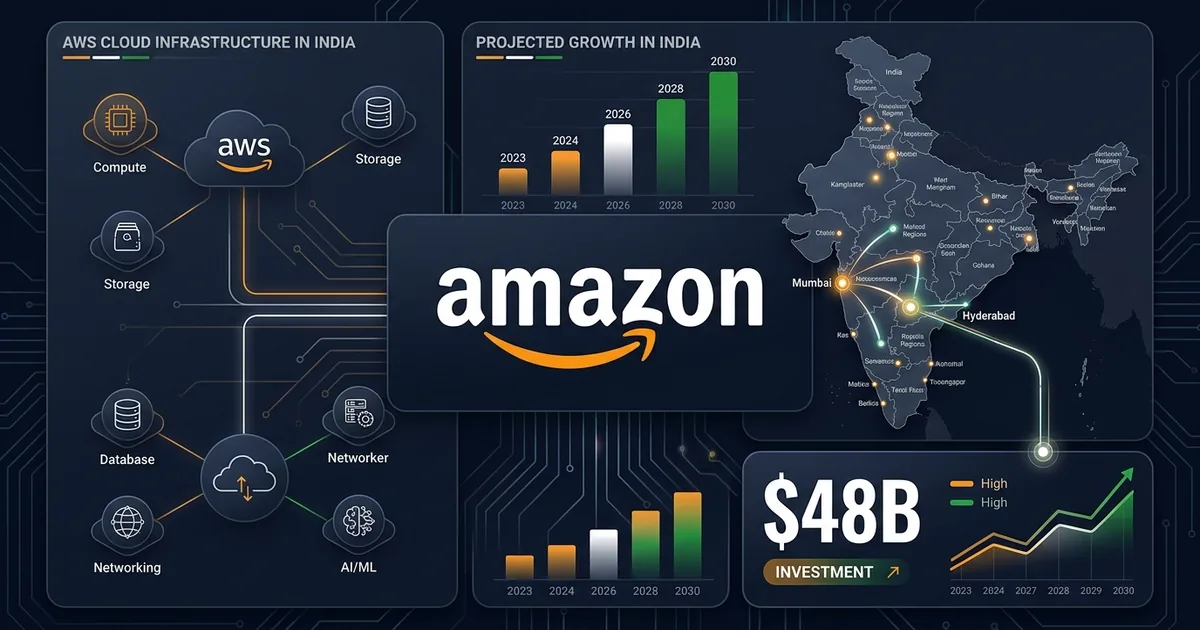
Amazon CEO Andy Jassy met Indian Prime Minister Narendra Modi on Thursday and announced a $48 billion investment commitment in India through 2030, a figure that signals Amazon views the subcontinent as one of its most important growth markets for AI, cloud infrastructure, and e-commerce at a time when the U.S. tech industry is scrambling for international capacity.
The Numbers Behind the Bet
The $48 billion commitment spans the five-year period from 2026 through 2030 and brings Amazon’s cumulative investment in India since 2010 to more than $88 billion, according to Amazon’s official announcement. Of that total, $13 billion is earmarked specifically for expanding AI and cloud infrastructure, including new AWS data center capacity in Mumbai and Hyderabad.
That $13 billion AI and cloud figure is the one that matters most to Wall Street. It gives Indian startups, enterprises, and government organizations access to Amazon’s custom AI chips, managed AI services, and the full AWS stack. It also positions Amazon to capture cloud market share in a country where digital transformation is accelerating faster than in most Western economies.
The remaining investment spans e-commerce logistics, entertainment (Prime Video India has been a growth story), and the rapid expansion of Amazon Now, the company’s quick-commerce service, to more than 300 cities. Quick commerce has become a brutal battleground in India, with Zepto, Blinkit, and Swiggy Instamart all burning cash to win 10-minute delivery. Amazon entering with deep pockets changes the competitive calculus.
Why India, Why Now
This is Jassy’s first visit to India since he succeeded founder Jeff Bezos in 2021, and the timing is deliberate. India’s digital economy is projected to reach $1 trillion by 2030, driven by a massive young population, rising smartphone penetration, and a government that has aggressively digitized payments, identity systems, and public services through its India Stack initiative.
For Amazon, India represents something the U.S. and European markets increasingly do not: greenfield cloud growth. India TV News reported that Jassy described India as “where some of AI’s most important applications” will be built, a statement that frames the investment as a technology bet, not just a logistics one.
The geopolitical context also matters. As U.S.-China tensions continue to restrict American tech companies’ access to the Chinese market, India has emerged as the primary alternative for hyperscale infrastructure buildout. Google, Microsoft, and Oracle have all announced major India expansions in the past 12 months. Amazon’s $48 billion figure is designed to be the largest.
The Competitive Landscape
Amazon’s cloud business in India faces competition from Microsoft Azure, Google Cloud, and a rising domestic player in Jio Platforms, backed by Reliance Industries. The $13 billion AI infrastructure commitment is partly a defensive move: if Amazon does not build out sufficient local capacity, Indian enterprises will migrate to whoever does.
On the e-commerce side, Amazon India continues its long-running battle with Flipkart, now majority-owned by Walmart. The quick-commerce expansion to 300 cities is a direct challenge to Zepto, which raised $1.2 billion at a $5 billion valuation earlier this year. Amazon is bringing a different weapon to that fight: integration with the broader Prime ecosystem, including same-day delivery from its existing fulfillment network.
Amazon also recently signed a multibillion-dollar fiber deal with Corning to support AI data center buildouts in the U.S., and the India commitment extends that infrastructure-first strategy to the world’s most populous country.
What Investors Should Watch
The $48 billion is a commitment, not a check already written. Amazon’s actual capital expenditure in India will depend on quarterly allocation decisions, competitive dynamics, and regulatory conditions. The Indian government has been friendlier to foreign tech investment than China but has also imposed data localization requirements and occasionally intervened in e-commerce marketplace rules that affect Amazon’s business model.
The announcement also arrives during a period of intense scrutiny around big tech capital spending on AI infrastructure. Amazon spent $100 billion on capex in 2025, and investors have been asking whether the return on that spending will materialize. The India commitment is partly an answer: this is where the growth is.
For the broader market, Jassy’s visit reinforces a theme that has dominated 2026: the largest technology companies are competing as much on infrastructure investment as on product innovation. Whoever builds the most capacity in the right markets wins the next decade of cloud and AI revenue. Amazon just made its biggest bet on India being one of those markets.