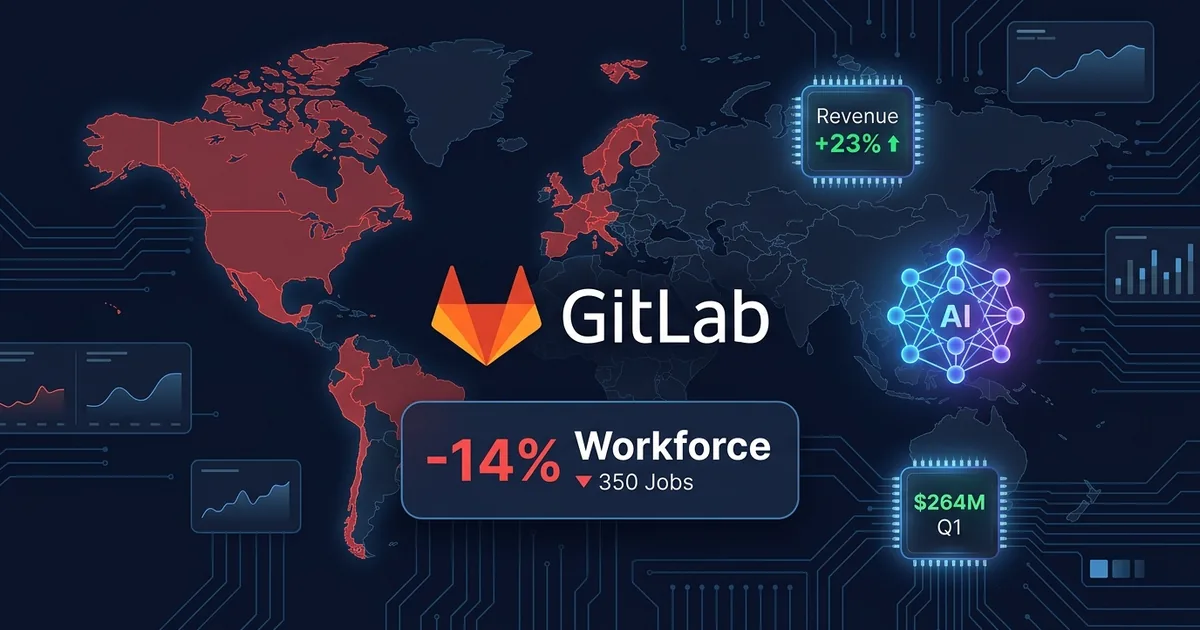
GitLab just told the market that the future of software development needs fewer humans, and it is restructuring its own company to prove it.
The DevOps platform announced it will lay off approximately 350 employees, representing 14% of its full-time workforce, and withdraw operations from 22 countries as part of what the company calls “GitLab Act 2,” a strategic pivot toward the “agentic era” of AI-driven software development. The restructuring will cost between $30 million and $35 million in charges, and the savings will be redirected into infrastructure to serve AI-generated code traffic and deeper research and development.
The Numbers Behind the Narrative
The layoffs came alongside fiscal first-quarter earnings that were objectively strong. GitLab reported revenue of $264 million, up 23% from a year earlier, with gross margins of 88%. The company is not cutting because it is struggling. It is cutting because it believes the composition of its workforce needs to change.
That is a critical distinction. When companies lay off 14% of staff while posting 23% revenue growth and 88% gross margins, the message is not “we are in trouble.” The message is “we are reallocating capital from humans to machines, and we are doing it before our competitors force us to.”
CEO Sid Sijbrandij framed the move as positioning for a world where autonomous AI agents handle much of the coding, reviewing, deploying, and maintaining of software under human oversight. The 22-country exit flattens management layers and concentrates operations in markets where GitLab can recruit and retain the AI infrastructure talent it needs for the next phase.
The Agentic Era Thesis
GitLab’s bet is that the DevOps platform of 2028 will look fundamentally different from the one it built over the past decade. Today, GitLab serves as the orchestration layer for human developers: code repositories, CI/CD pipelines, security scanning, deployment automation. In the “agentic era,” those same workflows will be initiated, executed, and monitored by AI agents that generate code, run tests, fix failures, and deploy updates with minimal human intervention.
If that thesis is correct, GitLab’s platform becomes more valuable, not less, because it is the control plane through which all that AI-generated activity flows. But the humans who operated the platform’s internal business processes become partially redundant. The irony is precise: a company that builds tools for developers is reducing its own developer-adjacent headcount because it believes AI will do much of what those roles currently handle.
The Pattern Is Accelerating
GitLab is not an outlier. ClickUp cut 22% of its workforce this week, citing a similar AI-driven restructuring rationale. Cloudflare eliminated 1,100 positions in May. Tech layoffs hit 80,000 in Q1 2026, with nearly half attributed to AI-related restructuring, according to industry tracking data.
The common thread is companies that are growing revenue while shrinking headcount, a combination that would have been paradoxical five years ago. AI is enabling that decoupling, and the companies doing it first are framing it as strategic foresight rather than cost-cutting.
What the Market Is Missing
GitLab’s stock initially rose on the earnings beat before falling in after-hours trading as the layoff details sank in. That reaction captures the market’s ambivalence: investors reward the margin expansion that headcount cuts deliver, but they worry about execution risk when a company simultaneously restructures, exits markets, and pivots its product strategy.
The deeper question is whether GitLab’s “Act 2” thesis is right on timing. Agentic coding tools from GitHub Copilot, Cursor, and dozens of startups are impressive but still require significant human oversight. The fully autonomous software development pipeline that GitLab is betting on may be 18 months away or five years away, and the difference between those timelines determines whether this restructuring looks visionary or premature.
The Labor Market Signal
For the broader tech workforce, GitLab’s move reinforces an uncomfortable pattern. Companies are not waiting for AI to fully replace roles before restructuring around the assumption that it will. The layoffs are happening on thesis, not on proof. That front-running creates real dislocation in labor markets now, even if the technology takes years to deliver on its full promise.
The workers being displaced are not failing. They are being repriced by a market that believes AI will eventually do their jobs for less. Whether that belief turns out to be correct is almost secondary to the fact that it is already driving corporate decision-making at scale.
For GitLab specifically, the 22-country exit concentrates the remaining workforce in higher-productivity markets with deeper AI talent pools: the U.S., Canada, the UK, and key European hubs. That geographic consolidation tracks with a broader trend of remote-first companies pulling back from distributed workforces when the calculus shifts from “hire anywhere cheaply” to “hire the right people in the right places for AI-native development.”
The next two quarters will show whether GitLab’s thesis holds. If AI-generated code traffic on its platform surges and revenue per employee climbs, Sijbrandij will look prescient. If the restructuring creates execution gaps and customer churn, the market will not be forgiving. Either way, the bet has been placed.