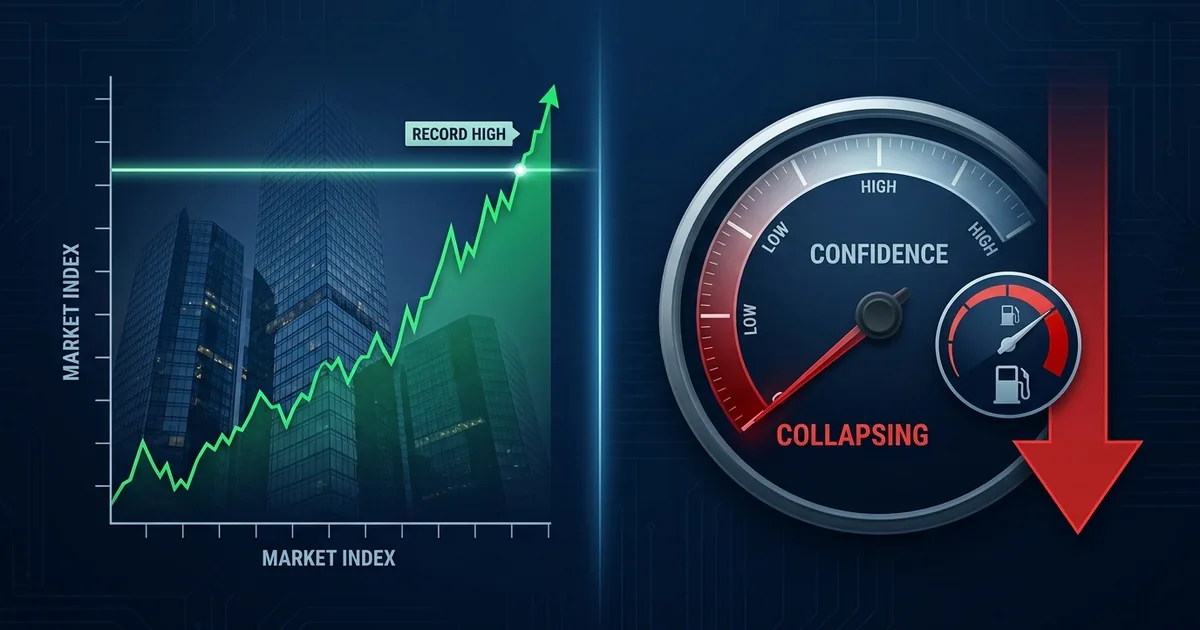
The Conference Board’s May read on the American consumer landed Tuesday morning against the most jarring backdrop in recent memory: a stock market at all-time highs sitting directly on top of consumer sentiment at an all-time low. That gap, between what Wall Street believes and what households actually feel, is the single most important divide in the US economy right now, and it is widening.
Two Surveys, One Ugly Message
Start with the data point that is already public, because it sets the table. The University of Michigan’s final May reading of consumer sentiment collapsed to 44.8, the lowest level since the survey began in 1952, as Yahoo Finance reported in its rundown of the release. That is a third consecutive monthly decline and a drop of roughly 21% since February. Year-ahead inflation expectations ticked up to 4.8%, long-run expectations jumped to 3.9% from 3.5%, and 57% of consumers volunteered high prices as the chief drag on their finances without being prompted.
The Conference Board’s own May index, released at 10 a.m. Eastern on Tuesday, is the second read on that same consumer, and it tends to hold up better than Michigan’s because it leans more on the labor market than on prices. Its April print stood at 92.8, on a scale where 1985 equals 100, and forecasters expected May to stay in that low-90s range. That is the puzzle in a single morning: one gauge anchored by a still-functioning job market, the other in free fall over the cost of living. When the price-sensitive survey collapses while the jobs-sensitive survey merely wobbles, the message is not contradiction. It is a consumer who still has a paycheck and is increasingly frightened of what that paycheck now buys.
Why the Strait of Hormuz Shows Up in Your Gas Tank and the Sentiment Index
The proximate cause is not mysterious, and it links straight back to the morning’s market story. Supply anxiety tied to the Strait of Hormuz has kept gasoline prices elevated, and gas is the one price Americans see in foot-high numbers on the way to work every day. When crude stays bid on Middle East risk, it does not just move energy stocks. It moves the inflation expectations that the Federal Reserve watches obsessively, because expectations have a way of becoming self-fulfilling once households start bracing for them.
That is the quiet mechanism connecting a missile-launch site in southern Iran to a sentiment survey in Ann Arbor. The barrel sets the pump price, the pump price sets the mood, and the mood sets spending. A consumer who expects 4.8% inflation a year out does not behave like one who expects 2%.
The Fed Just Changed Drivers at the Worst Possible Moment
Into this walks Kevin Warsh, sworn in as Federal Reserve chair on May 22 after the most divisive confirmation vote in the central bank’s history. We covered the market’s first reaction when Warsh took the Fed against a backdrop of climbing long-term yields, and the bind has only tightened since. Warsh was widely expected to favor cuts. The data is forcing the opposite conversation.
CNBC reported that markets now lean toward a rate hike rather than a cut this year, with the odds of a December increase running near 70% as oil above $90 and sticky shelter costs keep inflation uncomfortably warm. Picture the box Warsh is in. Sentiment is at a record low, which screams for relief. Inflation expectations are climbing, which screams for restraint. Cut into rising expectations and he risks unanchoring them in his first months on the job. Hold or hike into a buckling consumer and he tightens the screws on the very households the survey says are already breaking.
What the Divergence Actually Means
The temptation is to call one of these signals wrong. It is more useful to accept that both are right and that they are describing two different economies. The record in the S&P 500 reflects corporate earnings power, an artificial-intelligence capital-spending boom, and the spending of a wealthy cohort whose portfolios just hit all-time highs. The record low in sentiment reflects the median household, for whom a $417,700 home and a 6.51% mortgage are not aspirational numbers but locked doors.
This is the K-shaped economy stated plainly, and it has a market implication that is easy to miss in the glow of a record close. Roughly two-thirds of US output is consumer spending. A stock market can lead the real economy, but it cannot indefinitely levitate above a consumer this sour without one of two things happening: sentiment recovers, or the market eventually climbs down to meet it. Tuesday’s Conference Board print is one more data point on which way that gap closes.
The Number Behind the Number
Watch the expectations component inside the Conference Board report more closely than the headline index. The present-situation reading tells you how consumers feel about today, but the expectations gauge is the one that historically front-runs recessions. If expectations are sliding while a record-high stock market insists the future is bright, the most important question in the economy is not which survey is correct. It is how long the two can disagree before the disagreement gets settled the hard way.