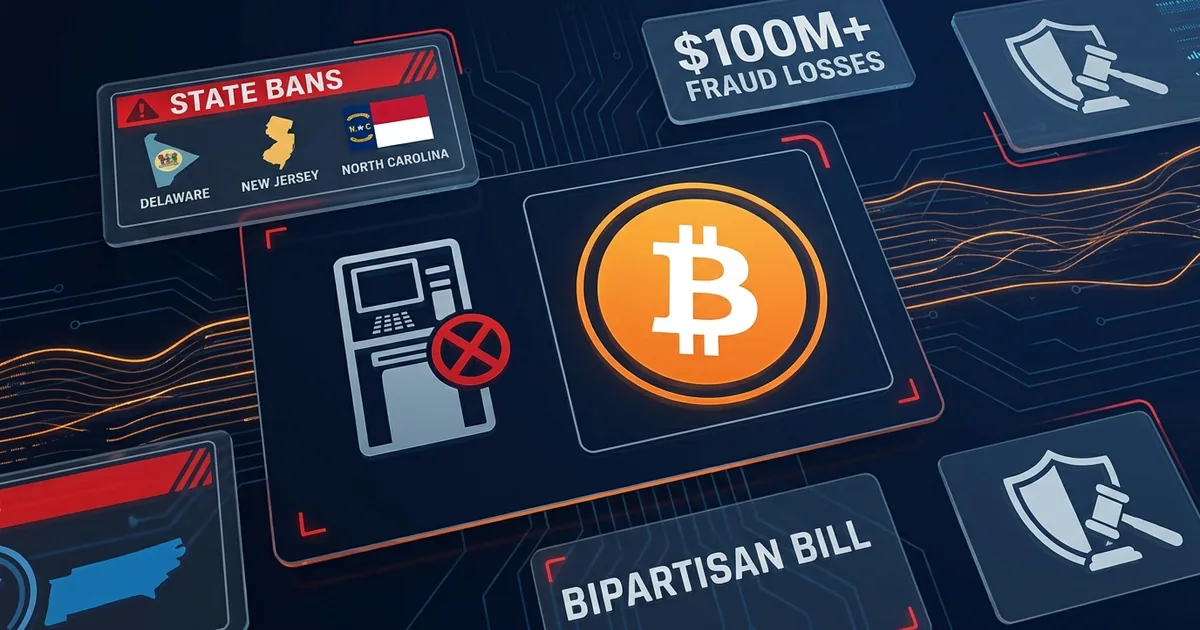
Delaware, New Jersey, and North Carolina are all advancing legislation to ban or heavily regulate cryptocurrency ATMs, a coordinated state-level crackdown that could reshape the retail crypto landscape in the United States. The bills arrived in the same week that a bipartisan federal proposal targeting crypto kiosk fraud cleared committee in Congress, signaling that what started as a consumer protection concern in a few state capitals is now a national policy conversation with teeth.
Delaware Moves First
Delaware’s House Bill 441 advanced out of the House Economic Development Committee on June 9, setting the stage for a near-total ban on cryptocurrency kiosks in the state. The bill, sponsored by Rep. Cyndie Romer and Sen. Spiros Mantzavinos, would outlaw the installation, ownership, and operation of crypto kiosks statewide. Existing machines would have to go offline immediately upon the bill’s passage and be physically removed within 90 days.
The word “predatory” in the bill’s language is not decoration. Delaware lawmakers cited specific cases where elderly residents were instructed by phone scammers to deposit cash at Bitcoin ATMs, losing tens of thousands of dollars in transactions that are irreversible by design. The machines charge fees that typically range from 10% to 25% per transaction, far above the spreads on any centralized exchange.
New Jersey and North Carolina Follow
New Jersey’s Senate Bill S2141 cleared the Commerce Committee unanimously just one day before Delaware’s vote, reflecting bipartisan momentum that crosses partisan lines. The bill would ban crypto ATMs outright in New Jersey, joining Delaware in the most aggressive regulatory posture any state has taken.
North Carolina is taking a different approach. Rather than an outright ban, the N.C. House backed a regulatory framework that would require crypto ATM operators to register with the Commissioner of Banks, comply with anti-money-laundering requirements, and implement transaction limits. Rules must be adopted by December 1, 2026.
The Federal Layer
In Washington, Representatives Maria Elvira Salazar and Sean Casten introduced the bipartisan Crypto ATM Fraud Prevention Act, which would establish federal standards for crypto kiosk operators including mandatory fraud warnings, transaction cooling-off periods, and enhanced reporting requirements. The bill focuses on protecting seniors, who account for a disproportionate share of crypto ATM fraud victims.
The federal proposal is less aggressive than the state-level bans, but it creates a regulatory floor that would apply nationwide. If both the state bans and the federal framework pass, crypto ATM operators face a patchwork of compliance requirements that could make the business uneconomical in large parts of the country.
The Industry’s Response
The crypto ATM industry, led by operators like Bitcoin Depot and CoinFlip, has pushed back against outright bans, arguing that the machines serve unbanked and underbanked populations who lack access to traditional financial services. Industry groups contend that the fraud problem is not unique to crypto kiosks and that education and transaction limits are more proportionate responses than prohibition.
That argument faces an uphill battle. The Federal Trade Commission reported that consumers lost more than $100 million to crypto ATM scams in the 12 months ending March 2026, with the median individual loss exceeding $10,000. The machines’ anonymity features, instant settlement, and irreversibility make them uniquely attractive to scammers running romance fraud, tech support scams, and government impersonation schemes.
What This Means for the Crypto Market
The state-level bans arrive at a moment when Congress is separately working on broader crypto market structure legislation. The Senate’s Clarity Act vote in May addressed exchange regulation and token classification, but crypto ATMs were explicitly carved out of that bill’s scope. The kiosk crackdown is a separate regulatory track, driven by consumer protection rather than market structure concerns.
For Bitcoin itself, the direct market impact is modest. Crypto ATMs account for a small fraction of total Bitcoin transaction volume. But the regulatory signal is significant: when 30 states and counting move to restrict a crypto access point, it reinforces the narrative that the industry’s retail-facing products face escalating compliance costs and political headwinds that no amount of institutional adoption can fully offset.
The larger question is whether crypto ATM regulation is a one-off consumer protection measure or the beginning of a broader retail crypto reckoning. If the federal bill passes with bipartisan support, it establishes the precedent that Congress can regulate crypto’s physical infrastructure without touching the underlying protocol. That precedent may matter more than the kiosks themselves.