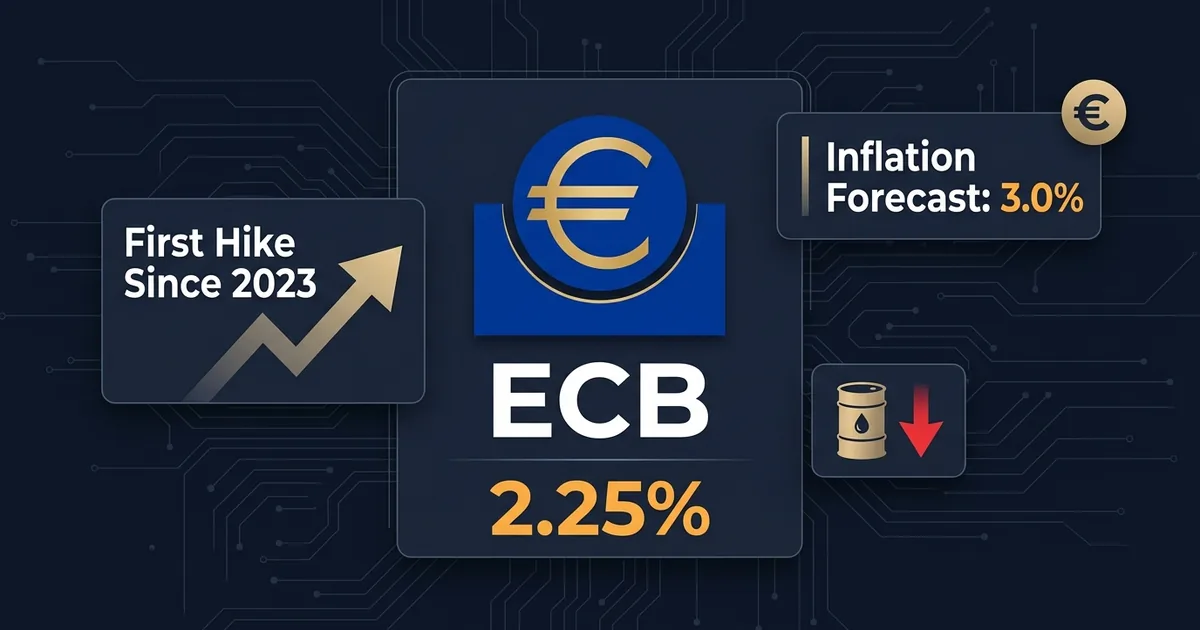
The European Central Bank hiked its deposit facility rate by 25 basis points to 2.25% on Thursday, marking the first rate increase since 2023 and signaling that the inflation genie the ECB spent two years wrestling back into the bottle has escaped again. The culprit is not wage growth or consumer demand. It is the war between the United States and Iran, and the energy price shock it has unleashed across global markets.
The Rate Decision and What Changed
The Governing Council’s decision was unanimous, and the reasoning was blunt. CNBC reported that ECB President Christine Lagarde cited the Iran conflict as the primary driver, stating that “the war in the Middle East is generating inflation pressures” that monetary policy can no longer absorb through patience alone. The ECB simultaneously raised its 2026 inflation forecast to 3%, up from a previous estimate of 2.3%, with core inflation revised to 2.5% for both 2026 and 2027.
Growth projections moved in the opposite direction. The ECB now expects eurozone GDP to average just 0.8% in 2026, down from the 1.2% forecast issued in March. The combination of higher rates and weaker growth puts Europe in a policy bind that has no clean exit: tighten too aggressively and risk recession, hold too long and let inflation expectations de-anchor.
Energy Is the Transmission Mechanism
The connection between the Iran conflict and European inflation runs through the energy complex. Brent crude surged above $100 per barrel in April after Iran closed the Strait of Hormuz to commercial shipping, then oscillated between $85 and $100 as ceasefire talks repeatedly started and collapsed. Natural gas prices in Europe followed a parallel trajectory, with TTF benchmark prices roughly 40% above pre-war levels.
European economies, far more dependent on imported energy than the United States, absorb these price shocks faster and deeper. German industrial output, already weakened by two years of flat growth, faces compressed margins. French consumer spending has softened. Southern European tourism economies, which were supposed to carry the growth load, are contending with higher transport and energy input costs.
The ECB’s own projections acknowledge that higher energy prices will feed through to the cost of food, goods, and services throughout 2026 and into 2027. The pass-through is not a forecast; it is already visible in May’s inflation data across the eurozone’s four largest economies.
Markets React, Oil Sends Mixed Signals
European bond yields climbed after the announcement. The euro strengthened modestly against the dollar, though traders noted the move was muted by doubts about whether the ECB will follow through with additional hikes. Rate futures are pricing roughly 60% odds of a second 25-basis-point increase by September.
Oil itself is sending contradictory signals. Brent crude fell below $89 per barrel on Friday after President Trump announced that the U.S. and Iran had reached a framework memorandum of understanding, raising hopes that the Strait of Hormuz could reopen within 30 days. But Tehran has not confirmed any agreement, and a 14-point draft circulating among diplomats has not been signed. If the deal collapses, oil returns to triple digits and the ECB’s inflation problem deepens.
What This Means for the Fed
The ECB’s move puts additional pressure on the Federal Reserve, which is now the outlier among major central banks. The Fed has held rates steady since its March 2026 pause, but markets are pricing a 52% probability of a Fed rate hike after May’s strong jobs report and a CPI reading that hit 4.2%. If the ECB is already tightening in response to the same energy shock, the argument for continued Fed patience becomes harder to sustain.
The transatlantic policy divergence also has currency implications. A tightening ECB with a stagnating economy and a pausing Fed with a stronger labor market creates a dollar-euro dynamic that commodity traders and multinational CFOs are watching closely. Any sustained euro weakness against the dollar would paradoxically worsen Europe’s energy import bill, creating a feedback loop the ECB’s single tool, interest rates, cannot easily break.
The Bigger Picture
The ECB’s rate hike is a reminder that geopolitical risk is not an abstract concept for central bankers. The Iran war has reintroduced energy-driven inflation to a continent that thought it had moved past the post-pandemic price surge. The ECB’s pivot from the most aggressive easing cycle in its history to a surprise tightening in the span of six months illustrates just how fast the macro landscape can shift when supply shocks meet already-fragile growth.
The question for business leaders and investors is whether this is a one-and-done adjustment or the start of a tightening cycle that has no obvious endpoint until the geopolitical situation resolves. Given that the Iran conflict shows no sign of a durable settlement, the safe bet is that 2.25% is not the ceiling.