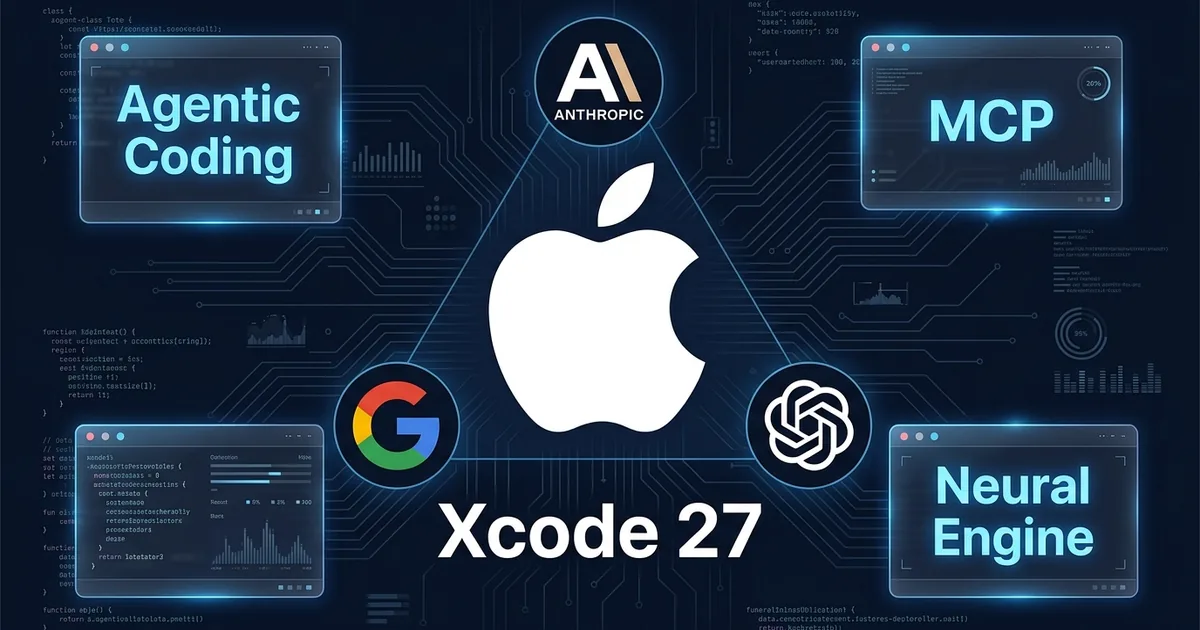
Apple quietly dropped the most significant change to its developer ecosystem in a decade this week, and it was not Siri AI or Liquid Glass. Xcode 27, unveiled during WWDC 2026, now ships with built-in support for third-party AI coding agents from Anthropic, Google, and OpenAI, giving developers a choice of models inside their IDE for the first time. The move turns Apple’s historically closed development environment into an open battlefield for AI infrastructure companies.
How the Dual-Engine System Works
Xcode 27 runs a dual-engine architecture. The first layer is local: Apple’s own on-device model runs on the Neural Engine inside every Mac with Apple Silicon, handling real-time Swift code completions without sending a single line of source code to any server. This is fast, private, and free. Apple is leaning hard on the privacy angle, and for good reason: developers working on proprietary apps do not want their code transiting through external APIs.
The second layer is cloud-based and optional. Developers who need heavier analysis, multi-step refactoring, or complex debugging can opt into agentic coding sessions powered by Claude (Anthropic), Gemini (Google), or GPT (OpenAI). These agents can plan multi-file changes, write and run tests, interact with simulators, and validate their own work through Xcode’s new Device Hub. The routing requires an explicit opt-in and is never the default behavior.
Why Apple Went Multi-Vendor
The multi-vendor approach is a strategic hedge that doubles as a developer retention play. By giving developers their choice of AI backbone, Apple avoids the risk of betting on a single model provider that might fall behind in the next generation. It also sidesteps the antitrust scrutiny that a single exclusive AI partnership would invite at a time when the Department of Justice is already watching Apple’s app ecosystem closely.
For Anthropic, Google, and OpenAI, the deal is distribution at scale. Roughly 34 million registered Apple developers now have one-click access to each company’s models. 9to5Mac reported that the Gemini integration was the latest addition, arriving on Day 3 of WWDC after Claude and GPT integrations were announced in the keynote. The race to be the default opt-in among professional developers is now a three-way contest playing out inside Apple’s IDE.
The Model Context Protocol Connection
One of the quieter announcements is Xcode 27’s support for the Model Context Protocol (MCP), an open standard that allows AI agents to connect to external tools and data sources. Developers can extend Xcode with custom skills, bring in their own toolchains via MCP plug-ins, and connect any agent compatible with the Agent Client Protocol.
This matters because it means Xcode is not just consuming AI models. It is becoming a platform for agentic workflows that can reach beyond the IDE into CI/CD pipelines, databases, design tools, and deployment infrastructure. The developer who wires up their Xcode agent to their production monitoring dashboard and their Figma files is operating in a fundamentally different mode than the developer who uses autocomplete. Apple is betting that its hardware advantage, the Neural Engine sitting on every developer’s desk, combined with a protocol-level openness on the cloud side, gives it a competitive position that neither Microsoft (with GitHub Copilot) nor JetBrains can easily replicate.
What the Market Heard
Apple’s stock fell roughly 2% after the WWDC keynote, which analysts attributed to investor disappointment that the Siri AI improvements were incremental rather than transformational. But the developer tools story is the one that matters for Apple’s long-term platform economics. The App Store generated an estimated $85 billion in developer billings in 2025. Keeping developers productive, loyal, and building on Apple platforms is the economic engine that funds everything else.
The WWDC developer tools overhaul also coincided with Apple’s earlier coverage on BTN about its WWDC strategy, which mapped the broader competitive positioning against Google and Microsoft. The Xcode 27 announcements fill in the developer-experience layer of that strategy.
The Agentic IDE Race Is Now a Three-Front War
Microsoft has GitHub Copilot, deeply integrated into VS Code and now expanding to Visual Studio. Google has Project IDX and Gemini Code Assist, targeting web and cloud developers. Apple now has Xcode 27 with a multi-model agent layer and an on-device privacy advantage that neither competitor can match on consumer hardware.
The winner of this race will not be determined by which AI model scores highest on coding benchmarks. It will be determined by which platform becomes the default workspace where professional developers spend their days. Apple just made a serious bid by turning Xcode from a walled garden into the only major IDE that ships a local AI engine and an open multi-vendor cloud layer in the same package.