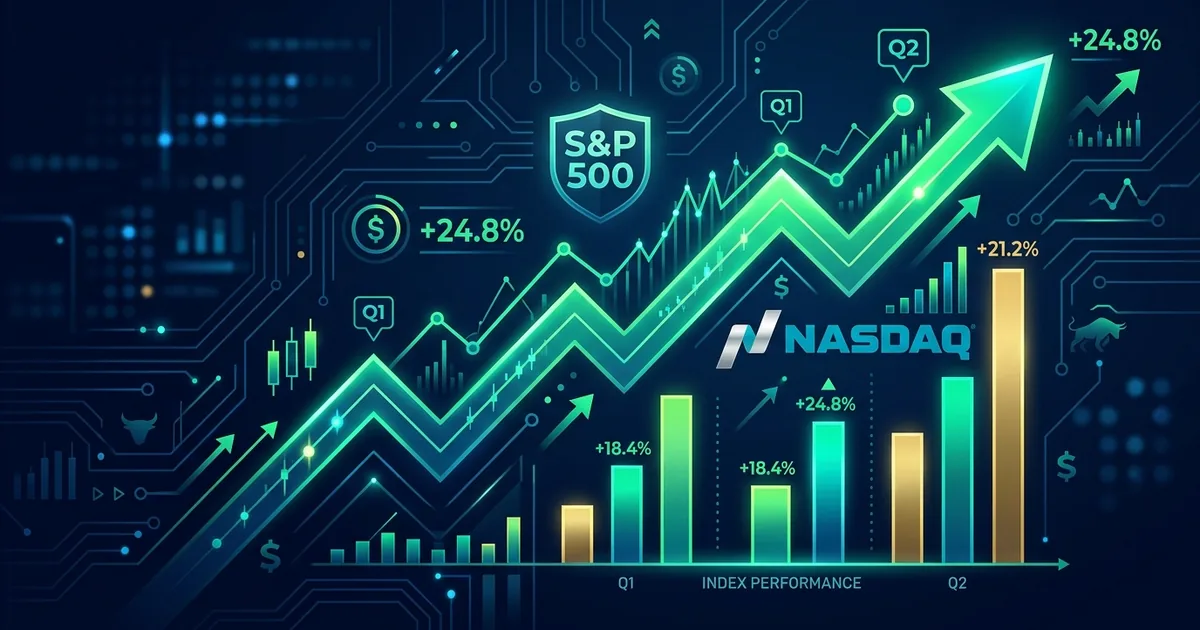
The numbers tell the story. The S&P 500 gained 14.8% in the second quarter, its strongest quarterly performance since the pandemic recovery rally of late 2020. The Nasdaq surged 21.4%. The Dow Jones Industrial Average closed at a record 52,319 on Monday, capping its best first half in five years. And the Philadelphia Semiconductor Index, the clearest proxy for the AI infrastructure trade, rocketed 87.8% in three months, putting it on pace for the strongest quarterly gain in its history.
What Powered the Rally
Two forces converged. Corporate earnings came in stronger than consensus across nearly every sector, with technology, industrials, and financials all beating estimates by wide margins. At the same time, inflation data cooled enough during the quarter to keep alive the expectation that the Federal Reserve will begin cutting rates before year-end, a combination that gave institutional investors the confidence to deploy capital aggressively.
But the real accelerant was AI. Nvidia, AMD, Marvell Technology, and Micron led the charge as companies across every industry ramped spending on GPU clusters, high-bandwidth memory, and data center capacity. The AI capex cycle has moved from speculative promise to verifiable revenue: Nvidia alone reported quarterly data center revenue above $35 billion, a number that was science fiction two years ago. As EconoTimes reported, chipmakers and AI-related stocks led the final session’s gains, with the Nasdaq climbing 1.52% on the quarter’s last day.
Small Caps Join the Party
One of the most significant developments of the quarter was the broadening of the rally beyond mega-cap tech. Small-cap U.S. stocks, measured by the Russell 2000 Index, surged more than 21% in the first half of 2026, their best start to a year since 1991. That breadth matters. A rally confined to seven stocks is fragile. A rally that lifts small caps, industrials, and financials alongside tech is a rally with a real economic foundation beneath it.
Strong jobs data reinforced the case. The labor market held firm through the quarter, with unemployment remaining below 4% and wage growth stabilizing at a level that supports consumer spending without reigniting inflation fears. That Goldilocks backdrop, growth without overheating, is exactly what equity markets reward with expanding multiples.
The Dow’s Record and What It Signals
The Dow’s close at 52,319 represented its second consecutive record, a milestone that often generates skepticism from market purists who dismiss the price-weighted index as an anachronism. But the Dow’s composition has shifted meaningfully in recent years, with heavier exposure to companies positioned for the AI infrastructure buildout. Microsoft, Apple, and Salesforce together account for a significant share of the index’s weight, and all three delivered strong quarters tied to AI product integration.
The record also signals something broader: the market is pricing in a soft landing. Investors are betting that the Fed can navigate the final stretch of its tightening cycle without triggering a recession, that corporate margins will hold, and that AI spending will translate into productivity gains that justify current valuations.
The Risk Nobody Is Pricing
That consensus is the risk. When every institutional investor agrees on a soft landing, the market becomes fragile to surprises: an inflation re-acceleration, a geopolitical shock to energy prices, or an AI spending cycle that peaks before revenue follows. The Philadelphia Semiconductor Index’s 87.8% quarterly gain is extraordinary by any historical standard, and extraordinary gains in a single sector often precede a rotation or correction.
Futures on Wednesday morning pointed to a modest pullback, with Dow and S&P 500 futures both slipping 0.4% and Nasdaq 100 contracts off 0.6%. Whether that is a healthy pause or the first tremor of a broader reassessment will depend on earnings season, which kicks off in mid-July with the major banks. According to Schwab’s market analysis, stocks opened flat on Wednesday to end what has been the best quarter in years, with futures pointing to a modest pullback after the historic run.
The first half belonged to the bulls. The second half will test whether the AI thesis can sustain a market that has already priced in a lot of good news.