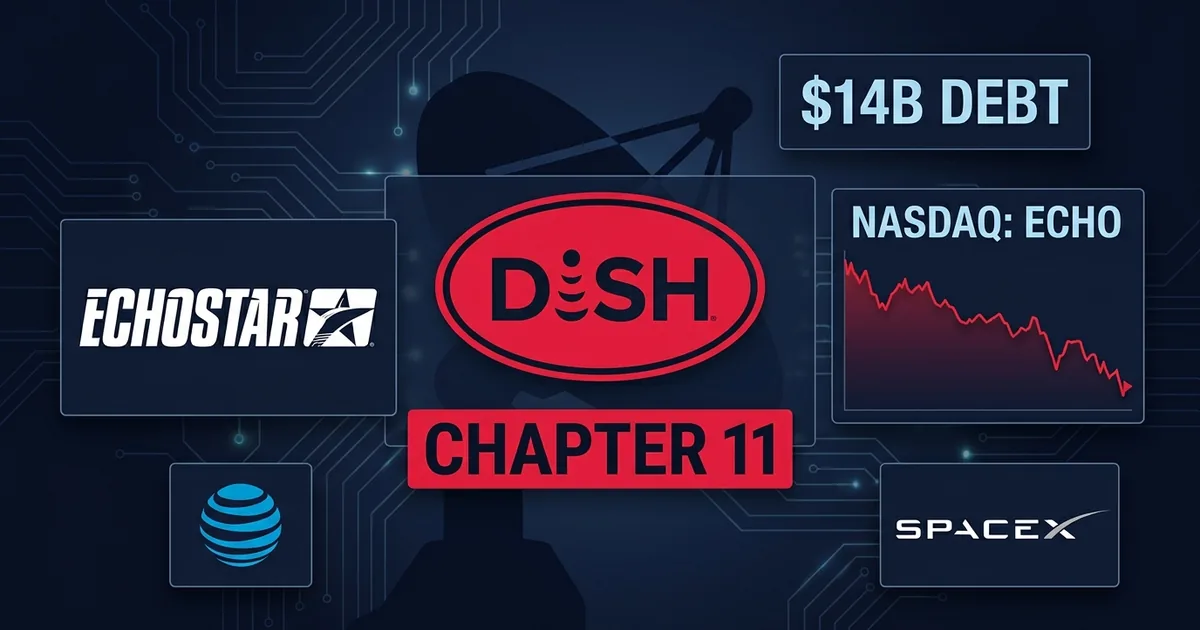
Charlie Ergen built a satellite empire on the bet that Dish Network’s pay-TV cash machine could fund a wireless future. That bet just hit the wall. EchoStar is preparing to file for Chapter 11 bankruptcy protection for its Dish DBS subsidiary as soon as today, The Wall Street Journal reported Monday, a move that would put approximately $14 billion in satellite-TV debt through the restructuring grinder while Ergen fights to preserve the spectrum portfolio that AT&T and SpaceX are circling.
The Cord-Cutting Reckoning Arrives
The filing, if it lands today, caps years of financial deterioration at what was once America’s second-largest satellite television provider. Dish DBS lost roughly 177,000 net subscribers in the first quarter of 2026 alone, according to EchoStar’s most recent earnings report, continuing a subscriber exodus that has gutted the pay-TV business model industry-wide.
EchoStar, which absorbed Dish Network in a 2024 merger, now carries approximately $25 billion in total debt across its corporate structure. The Dish DBS subsidiary accounts for the largest single chunk of that burden. A restructuring support agreement reached in March 2026 with more than 82% of Dish DBS bondholders laid the groundwork for a controlled Chapter 11 process, but the path from agreement to courtroom took months of additional creditor negotiations.
The structural problem is not complicated. Ergen spent two decades loading Dish with debt to amass one of the largest private spectrum portfolios in the United States, banking on the idea that satellite TV revenues would bridge the company into the wireless business. Cord-cutting killed the bridge. Dish’s subscriber base has been in freefall since 2017, and the revenue engine that was supposed to fund the 5G buildout simply does not generate enough cash to service the debt anymore.
Why Bankruptcy Is the Strategy, Not the Failure
This is not a liquidation story. Ergen is using Chapter 11 as a surgical instrument to separate the declining satellite television business from the spectrum and wireless assets he has spent billions to acquire.
The real prize is not Dish TV or even Sling TV, the streaming service that EchoStar also operates. It is the spectrum. Seeking Alpha reported Monday that the bankruptcy is designed to clear the balance sheet for multibillion-dollar spectrum sales to AT&T and SpaceX, two buyers who have been circling EchoStar’s airwave holdings for months.
AT&T needs mid-band spectrum to compete with T-Mobile’s post-Sprint capacity advantage. SpaceX, which recently completed its record-breaking $161 billion IPO on the Nasdaq, wants spectrum for its Starlink direct-to-cell service. Both buyers have the financial firepower to pay premium prices, but neither can close a deal while $14 billion in bondholder claims cloud the title to EchoStar’s assets.
That is the logic of this bankruptcy: kill the satellite TV debt, unlock the spectrum sales, and use the proceeds to fund whatever comes next for the wireless side of Ergen’s empire, including Boost Mobile.
The DirecTV Merger That Fell Apart
The bankruptcy path became inevitable partly because the alternative exit failed. EchoStar had been negotiating a sale of its Dish TV operations to DirecTV, which would have consolidated the two largest U.S. satellite providers into a single entity with enough scale to slow the subscriber bleed.
That deal collapsed when Dish DBS bondholders objected to the transaction terms, arguing that the proposed structure would impair their recovery on the debt. The bondholder revolt torpedoed the merger and forced Ergen back to the restructuring table. The March RSA was the result: a negotiated framework that gives bondholders a recovery through the bankruptcy process rather than through a going-concern sale.
The broader satellite TV market offers no lifeline. DirecTV itself has been shedding subscribers for years. The entire pay-TV bundle model, once a $200-billion-a-year industry, continues to contract as streaming services fragment the audience and cord-cutting accelerates across every demographic.
What Happens to Sling, Boost, and the Stock
EchoStar’s stock, which recently changed its Nasdaq ticker from SATS to ECHO on June 24, traded at approximately $103.92 heading into Monday’s session. The Chapter 11 filing covers Dish DBS specifically, not the parent company, meaning EchoStar’s other assets, including Boost Mobile and Sling TV, are not part of the bankruptcy estate.
That distinction matters for investors parsing the corporate structure. EchoStar has been running a holding-company strategy in which the satellite TV liabilities sit in a subsidiary that can be restructured without dragging down the parent. If the bankruptcy proceeds as the RSA envisions, the Dish DBS bondholders take their haircut, the spectrum assets get freed up for sale, and EchoStar emerges lighter.
The risk is execution. Bankruptcy courts are unpredictable, bondholder coalitions fracture, and the FCC must approve any spectrum transfers. AT&T and SpaceX both face their own regulatory scrutiny, and a spectrum sale of this magnitude will draw antitrust attention from an FCC that has signaled it wants to prevent excessive concentration of airwave holdings.
The Bigger Picture
Dish DBS joining the bankruptcy docket is the clearest signal yet that the satellite television business model is entering its terminal phase. The question is no longer whether satellite TV survives in its current form. It is whether the spectrum those satellites were supposed to complement can be monetized fast enough to justify the debt that was taken on to acquire it.
For Ergen, this is the final hand in a decades-long poker game. He accumulated spectrum when it was cheap, used Dish’s cash flows to buy more, and now needs bankruptcy to clear the table so he can sell to the two buyers who actually want what he has. Whether that gamble pays off depends on whether the spectrum sales close at prices that make the math work, and whether the FCC lets them happen at all.