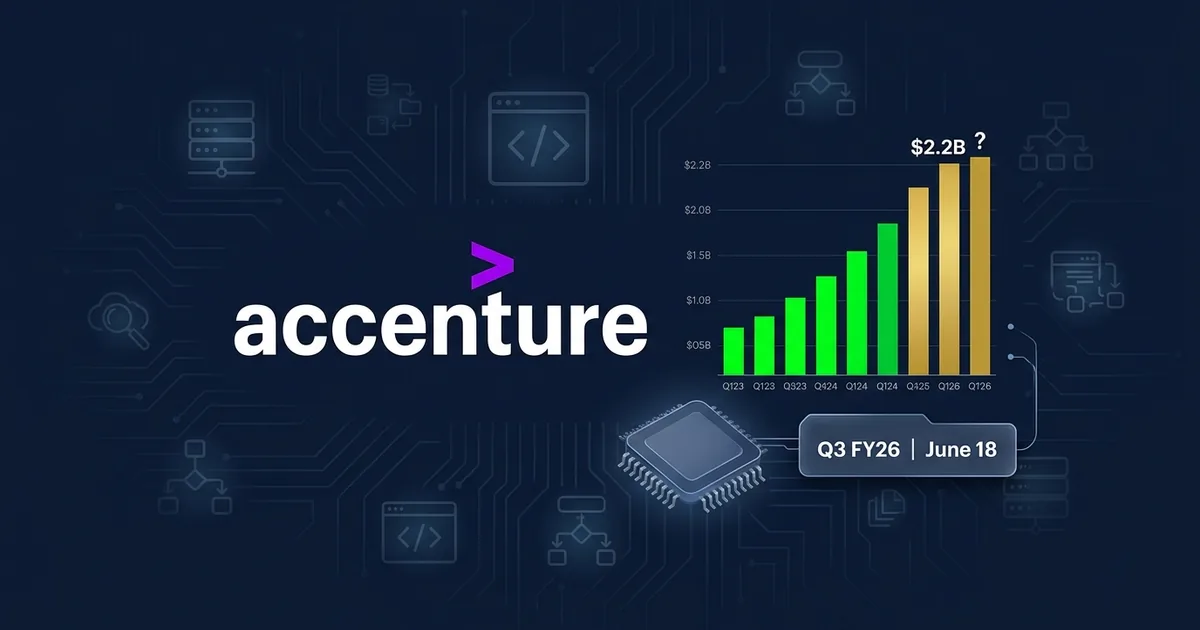
Accenture reports its fiscal Q3 2026 earnings before the bell on Thursday, and the headline everyone is waiting for is not revenue growth or margins. It is the AI bookings figure, the metric that has become the de facto scorecard for whether enterprise AI spending is real or still a science project.
The Bar Is Set by Q2 Record
In February, Accenture reported Q2 fiscal 2026 results that included record bookings of 22.1 billion dollars and advanced AI bookings of 2.2 billion dollars for the quarter. The company raised its free cash flow and EPS guidance for the full year and reiterated revenue growth of 2% to 5% in local currency. The stock moved on the AI number, not the topline.
That 2.2 billion dollars in a single quarter tells you where the enterprise market is heading. Companies are not buying AI demos anymore. They are buying implementation at scale: workflow automation, agentic systems, data pipeline redesigns, and the consulting hours to make all of it work inside legacy environments. Accenture, with more than 85,000 AI and data professionals, is the clearest pure play on that demand.
What Q3 Needs to Show
The consensus expectation is that AI bookings accelerate past 2.5 billion dollars for Q3, based on the pipeline commentary management gave in the Q2 call. Anything below 2 billion dollars would signal that the enterprise AI spending cycle is decelerating, which would pressure every services stock in the sector, from Infosys to IBM Consulting.
Revenue growth is expected to hold in the 4% to 5% range in local currency, consistent with the full-year guide. Margins matter less here than the bookings mix: the higher the AI component of new bookings, the more the market will believe that Accenture is shifting from a labor-hours business to an AI-augmented outcomes business with better long-term unit economics.
The Macro Backdrop Helps
The Iran peace deal market-wide risk-on mood gives Accenture a friendlier tape heading into the print. Services stocks have been out of favor relative to chip and infrastructure names, but a strong AI bookings beat could catalyze a rotation into the “picks and shovels of enterprise AI” trade, which benefits consulting and integration firms.
The ServiceNow warning in April that Iran-related uncertainty was delaying enterprise software deals is also relevant context. If Accenture reports strong bookings despite the geopolitical headwind, it suggests that AI projects are less discretionary than traditional IT spending, a thesis the market wants to believe but has not yet fully priced.
The Bigger Enterprise AI Question
Accenture Q3 is not just an Accenture story. It is the best real-time data point on whether the 200 billion-dollar-plus enterprise AI market that McKinsey and BCG keep projecting is actually materializing in signed contracts. Chip companies like Nvidia, AMD, and Broadcom measure AI demand through hardware shipments. Cloud platforms like AWS, Azure, and GCP measure it through compute consumption. Accenture measures it through the last mile: does the enterprise actually sign the contract to put AI into production?
That is why Thursday number matters more than anything else in the enterprise tech earnings calendar this month.