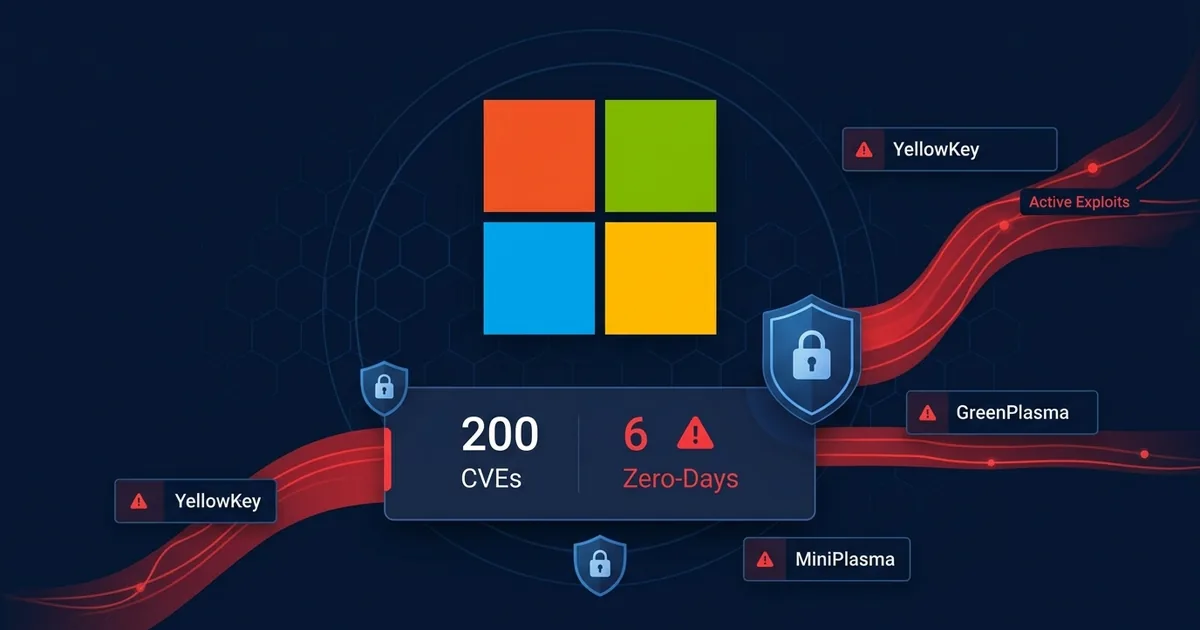
Microsoft just shipped the largest single monthly security update in the history of its Patch Tuesday program, fixing over 200 vulnerabilities across Windows, Office, Azure, and a dozen other products. The update includes patches for six zero-day vulnerabilities, three of which were actively exploited in the wild before the fix arrived. For enterprise security teams already stretched thin by the Iran-driven threat environment, this is one of the most consequential patch cycles in years.
The Numbers Behind the Record
The June 2026 Patch Tuesday addressed 200 CVEs across Microsoft’s product portfolio, surpassing the previous record of 167 set in April 2024. Of those, 33 are rated Critical, 166 are rated Important, and one is rated Moderate. Twenty-eight of the Critical flaws are remote code execution vulnerabilities, the category that gives attackers the ability to run arbitrary code on a target system without physical access.
BleepingComputer reported that when Chromium-based Edge patches and third-party components are included, the total CVE count for June reaches 571. That number underscores the expanding attack surface that comes with Microsoft’s strategy of integrating AI, cloud, and browser capabilities into a single platform ecosystem.
The Zero-Days That Were Already Being Exploited
Three of the six zero-days patched this month were under active exploitation before the update shipped: YellowKey, GreenPlasma, and MiniPlasma. The naming convention, assigned by researchers who discovered the exploit chains, signals that these are not isolated bugs but coordinated attack sequences targeting different layers of the Windows stack.
YellowKey targets a privilege escalation path in the Windows kernel. GreenPlasma exploits a memory corruption flaw in Microsoft Defender, the company’s built-in antivirus product, which means the security software itself was the attack vector. MiniPlasma targets a vulnerability in Hyper-V, Microsoft’s virtualization platform, with implications for cloud hosting environments running on Windows Server.
The Zero Day Initiative’s analysis noted that the combination of a kernel exploit, a Defender bypass, and a Hyper-V escape in a single patch cycle represents a worst-case scenario for enterprise defenders. An attacker chaining all three could theoretically move from initial access to hypervisor compromise without triggering any of the security controls that most organizations rely on.
Why This Matters Beyond IT Departments
The business impact of a record Patch Tuesday extends far beyond the security operations center. Patch deployment at scale is operationally expensive. Large enterprises running tens of thousands of Windows endpoints need to test patches against their application stacks before deployment, a process that typically takes 48 to 72 hours for Critical patches and up to two weeks for the full update set.
During that testing window, every unpatched system is a potential entry point. The cybersecurity insurance industry has been tightening coverage requirements around patch cadence, with several major underwriters now requiring documented evidence of Critical patch deployment within 72 hours as a condition of coverage renewal.
The cybersecurity sector has been growing rapidly to meet exactly this kind of demand, with companies like Palo Alto Networks reporting 60% growth in next-generation security annual recurring revenue. Record-breaking patch volumes are a tailwind for every managed security provider, endpoint detection vendor, and vulnerability management platform in the market.
The Broader Attack Surface Problem
Microsoft’s 200-CVE month is not an anomaly. It is the predictable consequence of a product portfolio that has expanded dramatically over the past five years. Azure, Microsoft 365, Teams, Copilot, Defender, Intune, GitHub, and LinkedIn all run on interconnected infrastructure. Every new integration creates new code paths, and every new code path is a potential vulnerability.
The company has invested heavily in secure development practices, including its Secure Future Initiative launched in late 2024, but the math is working against them. More products mean more code. More code means more bugs. More bugs mean more patches. The question is not whether Microsoft can eliminate vulnerabilities but whether the cadence of discovery and remediation can keep pace with the cadence of exploitation.
What Enterprise Security Teams Should Do Now
The immediate priority is the three actively exploited zero-days. YellowKey, GreenPlasma, and MiniPlasma should be treated as emergency patches with a 24-hour deployment target for internet-facing systems and a 72-hour target for internal infrastructure. The Hyper-V vulnerability (MiniPlasma) deserves particular urgency for organizations running virtualized workloads on Windows Server, which includes most of the enterprise cloud and hosting market.
For the remaining 197 patches, standard risk-based prioritization applies: Critical remote code execution flaws first, elevation of privilege flaws second, everything else on the regular monthly cycle. The scale of this update means that automated patch management tools are not optional; any organization still managing Windows updates manually is accepting risk that no board of directors should be comfortable with.