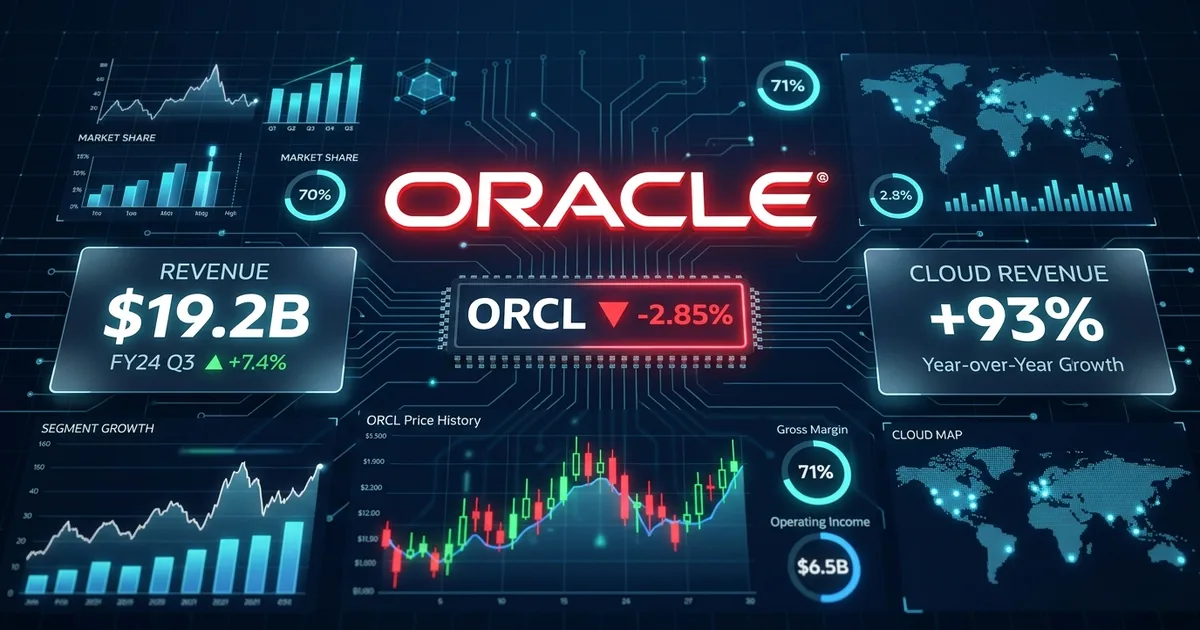
Oracle just posted the kind of quarter most enterprise software companies dream about, and the stock still dropped 7% after hours. The disconnect tells you everything about where the AI infrastructure race stands right now: even record cloud growth cannot outrun investor anxiety over what it costs to stay in the game.
The Numbers That Should Have Been a Victory Lap
Oracle reported fiscal Q4 adjusted earnings per share of $2.11, clearing the $1.97 Wall Street consensus by a comfortable margin. Total revenue rose 21% year over year to $19.2 billion, also ahead of estimates. The crown jewel was Cloud Infrastructure (IaaS) revenue, which hit $5.8 billion for the quarter, up 93% from the same period a year ago. Full-year cloud infrastructure revenue reached $18.1 billion, up 77%.
Those are not incremental gains. Oracle Cloud Infrastructure has gone from an afterthought in the hyperscaler conversation to a legitimate fourth option behind AWS, Azure, and Google Cloud. Larry Ellison and Safra Catz have spent years positioning OCI as the enterprise-grade alternative, and the numbers are finally validating the thesis.
Why the Stock Cratered Anyway
The earnings beat was overshadowed by what came next: Oracle disclosed plans to raise an additional $20 billion through a combination of equity and debt financing, bringing total planned capital raises to roughly $40 billion. Capital expenditures in just the first nine months of fiscal 2026 already reached $39.2 billion, more than triple the $12.1 billion spent in the same period of fiscal 2025.
That is a staggering acceleration. Oracle’s official earnings release confirmed that the spending is concentrated on data center buildouts to support AI workloads, GPU procurement, and capacity expansion for existing contracts with Microsoft, xAI, and other large-scale cloud customers.
Investors reacted the way they increasingly react to AI capex announcements: by selling first and asking questions later. The stock fell over 7% in extended trading before partially recovering to roughly a 1% decline. The pattern mirrors what happened to Meta earlier this year when it unveiled its $200 billion Hyperion data center plans, and it echoes the broader tension across Broadcom’s AI chip earnings trajectory where strong revenue growth coexists with investor unease about the capital required to sustain it.
The Dilution Question
The equity component of the $40 billion raise is what stung shareholders most. Debt financing is one thing. Issuing new shares to fund data centers dilutes existing ownership, and Oracle is essentially telling the market that internally generated cash flow, even at record levels, is not enough to keep pace with AI demand.
This is not unique to Oracle. TechBuzz reported that the capital raise signals Oracle’s aggressive push into AI infrastructure, but investors are clearly weighing the dilution risk against the revenue upside. Morgan Stanley separately projected this week that global AI-linked debt issuance will top $570 billion in 2026, suggesting Oracle is one of many companies racing to the bond and equity markets simultaneously.
What the Remaining Performance Obligations Say
One number that bulls will cling to: Oracle’s remaining performance obligations (RPO), essentially contracted future revenue, hit a record. The company’s cloud backlog has been growing faster than its revenue, which means the demand pipeline is there. The question is whether Oracle can convert that backlog into revenue without spending itself into negative free cash flow territory.
Gross margins did compress during the quarter, a direct consequence of the data center ramp. Management guided for continued margin pressure in fiscal 2027 as new facilities come online and GPU clusters scale. The bet is that utilization rates will catch up, but that requires executing on a build schedule that spans multiple continents and thousands of megawatts of power capacity.
The Bigger Picture for AI Capex
Oracle’s Q4 tells the same story playing out across every major cloud and AI infrastructure company in 2026: demand is real, growth is strong, and the capital required to meet that demand is testing the limits of what public markets will tolerate. The company beat on every metric that matters for the current quarter, and the market punished it for what the next four quarters will cost.
For investors, the calculus is straightforward but uncomfortable. If OCI continues growing at anything close to 93%, the $40 billion in capital raises will look prescient within two years. If cloud growth decelerates, or if the AI spending cycle cools before Oracle’s new capacity fills, the company will be carrying a significantly diluted share count and a heavier debt load with less to show for it.
The broader signal is that AI infrastructure is entering a phase where execution risk matters more than vision. Every hyperscaler has announced plans to spend hundreds of billions. The winners will be the ones who convert that spending into contracted revenue before the market’s patience runs out. Oracle’s Q4 suggests it can. Oracle’s stock price suggests the market is not yet convinced.