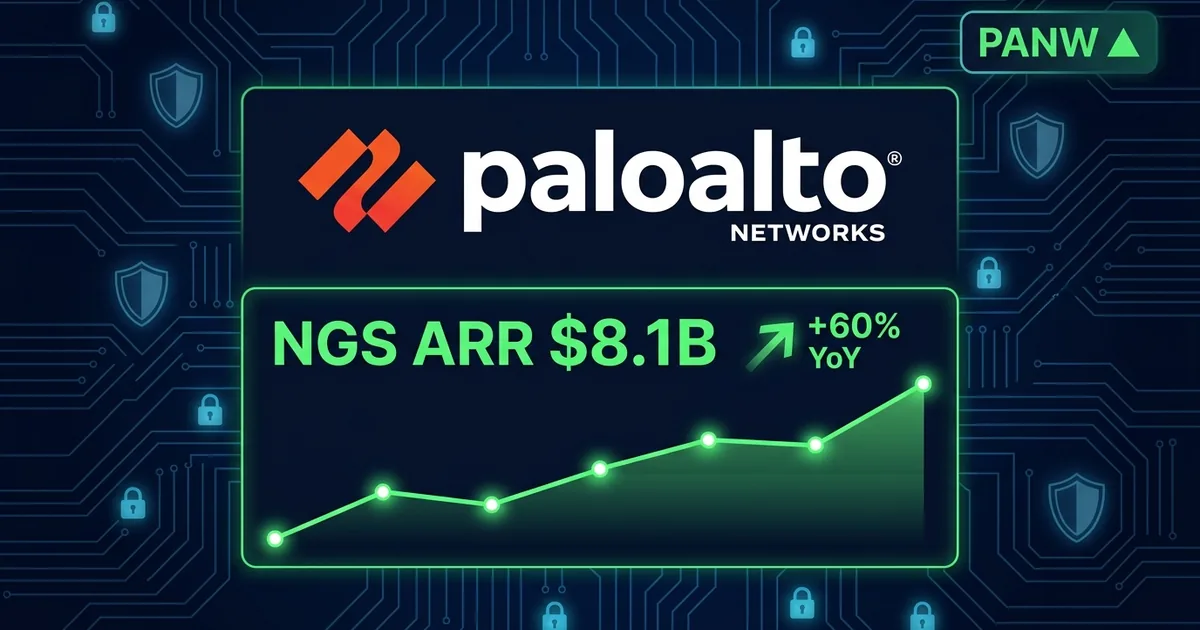
Palo Alto Networks just delivered the quarter that cybersecurity bulls have been waiting for, and the numbers make the case that enterprise security spending is accelerating, not pulling back, despite broader tech-budget caution.
The company reported fiscal third-quarter results that beat Wall Street on every major metric: adjusted earnings per share of $0.85 versus the $0.80 consensus, revenue of $3.00 billion versus the $2.94 billion expectation, and year-over-year revenue growth of 31%. But the headline number is the one that matters most to growth investors: next-generation security (NGS) annual recurring revenue hit $8.13 billion, up 60% from a year ago.
The Platformization Bet Is Paying Off
CEO Nikesh Arora has spent the past two years executing what he calls “platformization,” the strategy of consolidating fragmented point-product security tools onto Palo Alto’s integrated platform. The theory was straightforward: enterprises are exhausted by managing dozens of security vendors, and whoever can offer a unified platform with AI-driven threat detection will capture an outsized share of wallet.
The Q3 results suggest that bet is landing. Remaining performance obligations (RPO) reached $13.4 billion, up 25% year over year, signaling a deep backlog of committed customer spending. The company raised its full-year guidance across the board: NGS ARR of $8.90 billion to $8.95 billion (59% to 60% growth), RPO of $20.9 billion to $21.0 billion, and revenue of $11.415 billion to $11.425 billion representing 24% annual growth.
Those are not incremental revisions. That is a company telling the market it sees sustained demand through at least the next two quarters.
Why Cybersecurity Is Diverging From the Broader Tech Selloff
The results arrive at an interesting moment. Tech layoffs continue to ripple across the sector, with ClickUp cutting 22% of staff and GitLab announcing a 14% workforce reduction this same week. Yet cybersecurity budgets appear to be moving in the opposite direction.
The reason is structural. Every AI deployment, every cloud migration, every agentic workflow creates new attack surface. The CNBC analysis of Palo Alto’s results noted that the company’s AI-powered security offerings are increasingly the gateway drug: enterprises come for the AI threat detection and stay for the platform consolidation.
The macro environment also helps. Geopolitical tension, from the ongoing Iran conflict to persistent state-sponsored cyber campaigns, keeps security high on every CISO’s priority list. Regulatory pressure from the SEC’s disclosure rules and the EU’s NIS2 directive means boards cannot deprioritize cyber spending even when other IT budgets get squeezed.
The Stock Reaction Tells a Story
Shares initially surged as much as 12% in after-hours trading on the earnings release, then pulled back to roughly flat by the next session’s close. That volatile pattern suggests the beat was already partially priced in after a 60% stock run-up through May, and some investors used the strength to take profits.
But the pullback does not diminish the fundamental signal. A company growing NGS ARR at 60% with a $13.4 billion backlog is not a one-quarter story. Palo Alto is building compounding revenue streams that will sustain through multiple budget cycles.
The AI Security Premium
What separates this earnings cycle from previous Palo Alto beats is the explicit AI revenue contribution. The company disclosed that its Cortex XSIAM platform, the AI-powered security operations center product, crossed $1 billion in ARR during the quarter. That product did not exist three years ago. Its growth trajectory suggests enterprises are not just buying AI-adjacent security tools but specifically paying a premium for machine-learning-driven threat detection that can process alerts at a scale no human SOC team can match.
The timing is instructive. Microsoft’s disclosure this week of a production bug that exposed account tokens across several Microsoft 365 Android apps, and Google’s June Android security bulletin patching 124 vulnerabilities, underscore why enterprises are willing to pay Palo Alto’s platform premium. The attack surface is expanding faster than headcount can cover it, and AI-driven automation is the only path that scales.
The Competitive Landscape
The platformization race is not Palo Alto’s alone. CrowdStrike, Fortinet, and Zscaler are all making similar consolidation pitches. But Palo Alto’s Q3 numbers suggest it is pulling ahead on the enterprise tier where deal sizes are largest and switching costs are highest. CrowdStrike’s comparable metric, its ending ARR, grew 32% in its most recent quarter, a strong number, but roughly half Palo Alto’s NGS ARR growth rate.
The gap matters because enterprise security procurement is increasingly winner-take-most within each account. When a Fortune 500 company consolidates from 15 point products to three platforms, the vendor that wins the initial consolidation deal gets compounding cross-sell opportunities for years. Palo Alto’s RPO backlog of $13.4 billion is the financial expression of those locked-in relationships.
What It Means for the Security Stack
For investors parsing the AI-era infrastructure stack, the takeaway is clear: cybersecurity is not discretionary spending. It is the cost of doing business in a world where every new AI agent, every new API endpoint, and every new cloud workload is another door that needs locking. Palo Alto just proved it has the platform to sell the lock, and the backlog to sustain the growth rate investors are paying for.