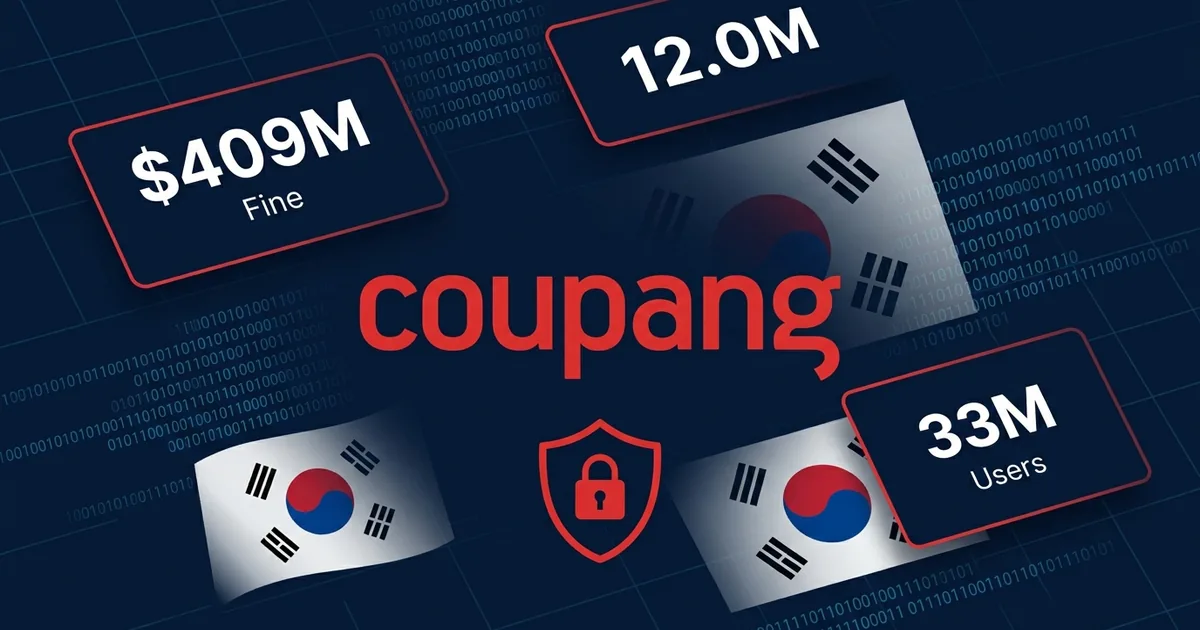
South Korea just set a new price for failing to protect consumer data, and it is $409 million. Coupang, the country’s dominant e-commerce platform, has been fined 624.7 billion won by the Personal Information Protection Commission in what is now the largest data breach penalty in South Korean history. The sheer scale of the breach, 33 million users, and the insider-threat vector behind it make this a case study every company handling consumer data at scale should be reading closely.
What Happened and How It Went Undetected
The breach traces back to a former Coupang engineer who exploited a cryptographic signing key to gain unauthorized access to user data over several months, beginning around April 2025. The exposed information included names, email addresses, phone numbers, physical addresses, and order histories for more than 33 million customers, effectively the majority of Coupang’s user base in South Korea.
What makes this particularly damaging is the detection failure. South Korean law requires companies to identify and report breaches within 72 hours. Coupang did not. The Personal Information Protection Commission found that the company’s basic safety management systems were inadequate and that negligent internal controls, not a sophisticated external attack, allowed the breach to persist.
The Financial Impact Goes Far Beyond the Fine
The $409 million penalty surpasses the previous South Korean record, a 134.8 billion won fine levied against SK Telecom last year for a similar data exposure incident. But the fine is only part of Coupang’s total liability. In December 2025, the company announced a customer compensation plan totaling approximately 1.7 trillion won, or about $1.2 billion.
Combined, Coupang is looking at roughly $1.6 billion in direct costs from a single breach event. For a company that reported revenue of 45 trillion won in 2025, the fine alone represents about 1.4% of annual revenue. That ratio is in line with the upper end of GDPR penalties in Europe and signals that South Korean regulators are now matching their Western counterparts in enforcement severity.
The Insider Threat Problem
The fact that this breach was caused by an insider, not an external hacker, is the detail that should concern every enterprise security team. A former engineer with knowledge of the company’s authentication infrastructure was able to use a signing key to access production data for months. The implication is that Coupang’s key management, access controls, and anomaly detection systems all failed simultaneously.
Insider threats account for roughly 25% of all data breaches globally, according to Verizon’s 2025 Data Breach Investigations Report, but they tend to be the most expensive per record because insiders know where the valuable data lives and how to avoid detection. Coupang’s case is a textbook example. The attacker did not need to phish anyone, exploit a zero-day, or brute-force a password. They already had the credentials, and nobody noticed when those credentials were used in ways that should have triggered alerts.
The contrast with the Meta AI chatbot security breach earlier this month is instructive. That incident involved external actors exploiting a chatbot vulnerability. Coupang’s breach was internal, slower, and arguably more preventable.
What This Means for Data Privacy Regulation in Asia
South Korea has been steadily tightening its data protection framework since the Personal Information Protection Act was amended in 2023. The Coupang penalty is the clearest signal yet that the country intends to enforce those rules at a scale that creates genuine financial consequences for violations.
The timing matters. Japan is advancing its own APPI amendments, and Singapore’s PDPA was updated last year with significantly higher penalty caps. Across the Asia-Pacific region, data privacy enforcement is converging toward European GDPR levels, both in the scope of what constitutes a violation and in the size of the penalties that follow.
For U.S.-listed companies with significant Asian operations, the Coupang case is a warning. Coupang trades on the NYSE, and the combination of a $409 million fine, $1.2 billion in compensation, and reputational damage is the kind of event that reprices data security risk for an entire sector. Companies that treat data protection as a compliance checkbox rather than an engineering priority are carrying more risk than their share prices reflect.
The Larger Pattern
Coupang’s fine arrives in a year when data breach costs are accelerating globally. IBM’s 2025 Cost of a Data Breach Report put the average breach cost at $4.88 million, but mega-breaches involving more than 10 million records routinely exceed $300 million when regulatory penalties, litigation, and customer remediation are included. Coupang’s $1.6 billion total cost sits firmly in that category.
The lesson is not subtle. Companies that fail to implement basic controls, proper key management, employee access auditing, real-time anomaly detection, are not just accepting technical risk. They are accepting financial risk at a scale that can move earnings, stock prices, and regulatory trajectories across entire markets.