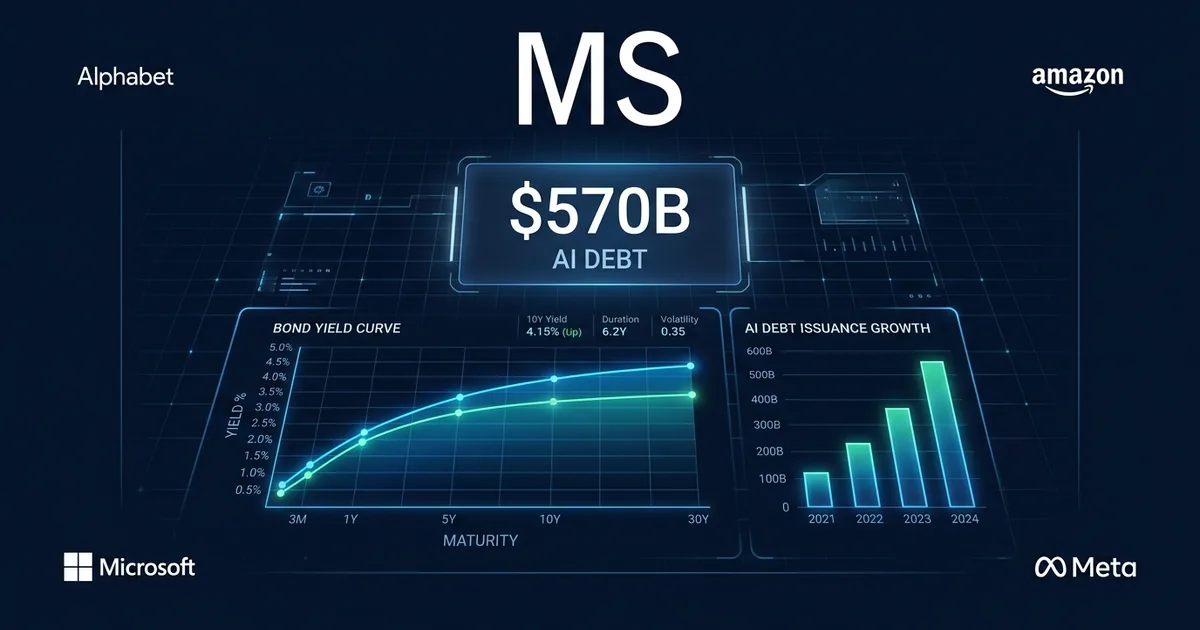
The AI infrastructure buildout is no longer being funded primarily from cash flow or equity. It is being funded with debt, and the numbers are getting large enough to reshape credit markets. Morgan Stanley projects that global AI-related debt issuance will more than double to nearly $570 billion in 2026, a figure that would make AI infrastructure one of the single largest categories of corporate borrowing on the planet.
The Scale of What Is Happening
Through the end of May, AI-related debt had already reached approximately $236 billion, roughly four times the level in the same period last year. Tech Startups reported that Morgan Stanley expects the full-year total to nearly double from there, driven by a combination of hyperscaler bond issuances, data center developer financing, and GPU procurement facilities.
The spending behind this borrowing is equally staggering. Morgan Stanley estimates that Alphabet, Amazon, Microsoft, and Meta will collectively spend about $700 billion on AI-related capital projects in 2026. Annual hyperscaler spending is projected to exceed $1 trillion by 2027. These are not venture-backed startups burning through a Series C. These are the most valuable companies in the world, and they are borrowing at scale because even their balance sheets cannot cover the pace of buildout.
Why Debt, Not Equity
The shift from equity to debt financing is a rational response to current market conditions, but it carries its own risks. Interest rates remain elevated. The Federal Reserve has held its benchmark rate above 3.5%, and the May CPI report showed headline inflation at 4.2%, limiting the prospects for near-term cuts. Borrowing at these rates is expensive.
Yet companies are choosing debt over equity for several reasons. Equity issuance dilutes existing shareholders, as Alphabet learned when its $80 billion equity raise sent shares lower despite strong fundamentals. Debt does not dilute. It also provides tax advantages through interest deductibility. And the bond market has shown remarkable appetite for AI-linked paper, with several recent offerings oversubscribed by two to three times.
The geographic diversification of this borrowing is notable. Hyperscalers are issuing debt in euros, yen, and pounds in addition to dollars, broadening their investor base and tapping into capital pools where rates are lower. TechTimes noted that this multicurrency strategy reflects a level of financial sophistication that signals AI infrastructure is being treated as a long-duration asset class, not a speculative bet.
What $570 Billion Actually Funds
The money flows into three primary categories. First, data center construction, the physical plants that house GPU clusters, cooling systems, and networking infrastructure. Second, GPU and accelerator procurement, primarily from Nvidia but increasingly from AMD, custom ASICs, and emerging chipmakers. Third, power infrastructure, including long-term energy contracts, on-site generation, and grid upgrades.
Each category has its own cost curve and timeline. Data centers take 18 to 36 months to bring online. GPU clusters can be deployed faster but require the physical space to exist first. Power contracts often span a decade or more and represent commitments that outlast any individual AI model generation.
The result is a capital structure that looks less like a technology company and more like a utility or an energy company: heavy upfront capital expenditure, long payback periods, and returns that depend on sustained demand over years. That comparison is not lost on credit rating agencies, which have begun treating AI infrastructure bonds as a distinct asset class with its own risk profile.
The Risk Nobody Wants to Talk About
The implicit assumption behind $570 billion in AI debt is that demand for AI compute will continue to grow at or near current rates for the foreseeable future. If it does, these bonds will look like some of the best corporate debt issued in the 2020s. If it does not, the companies carrying this debt will face a combination of overcapacity, margin compression, and debt service obligations that cannot be easily restructured.
The historical parallel is the telecom buildout of the late 1990s, when companies like WorldCom and Global Crossing borrowed aggressively to build fiber optic networks. When demand failed to materialize at the projected pace, the debt became unsustainable and the resulting collapse reshaped the industry. The current AI players are far more profitable and better capitalized than the telecom companies of that era, but the structural risk, borrowing against future demand that may not arrive on schedule, is similar.
What Investors Should Watch
Three metrics will determine whether the AI debt boom creates value or risk. First, utilization rates at new data centers. If GPU clusters fill quickly with paying customers, the capex converts to revenue. If utilization lags, the debt burden grows relative to cash flow. Second, interest rate trajectory. If the Fed manages to cut rates in late 2026 or 2027, existing AI bonds will appreciate and future borrowing costs will fall. If rates stay elevated, the carrying cost of $570 billion in debt becomes a meaningful drag on earnings. Third, competitive dynamics. If all four major hyperscalers build simultaneously and demand proves finite, pricing power evaporates and margins compress, making it harder to service the debt.
The AI debt boom is the financial system’s bet that artificial intelligence is the next electricity, not the next crypto. Morgan Stanley’s $570 billion number says the credit markets believe that bet. The next 24 months will determine whether they are right.