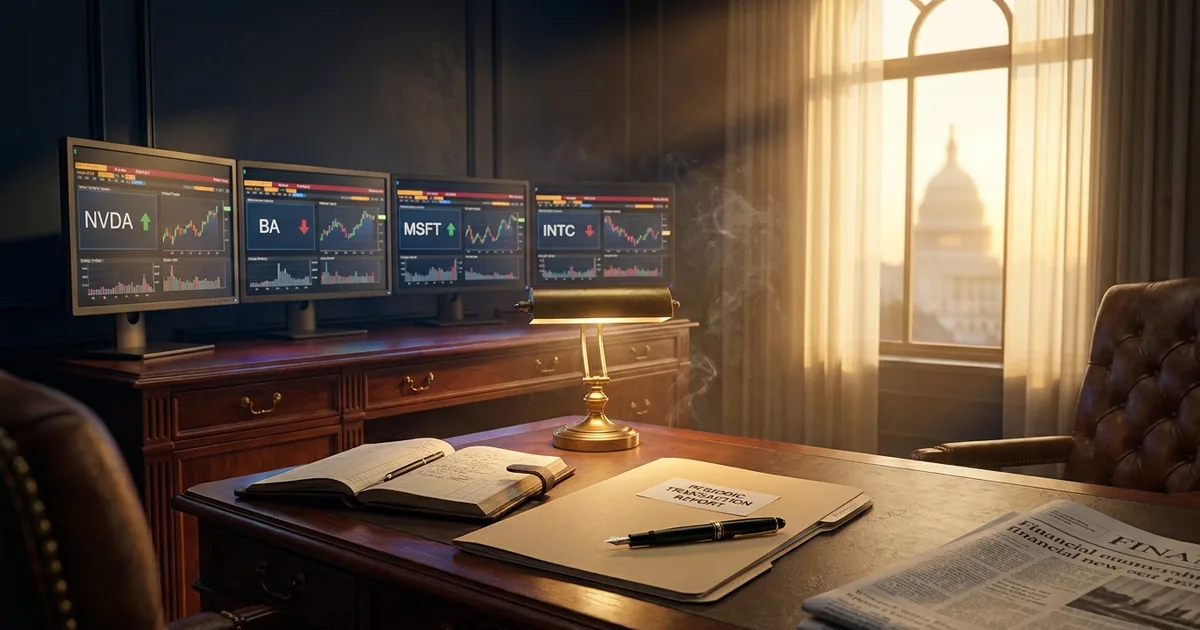
President Trump’s personal stock portfolio executed a flurry of trades in Nvidia, Boeing, Microsoft, and Intel over recent weeks, all four of them companies the President is actively negotiating over with China this week. Bloomberg first reported the disclosures Thursday, citing periodic transaction filings made public through routine government ethics processes. The trades landed during the same week the US cleared Nvidia H200 sales to Chinese tech giants and as Boeing’s 500-jet China order, the centerpiece deliverable of the Trump-Xi summit wrapping in Beijing this week, was being finalized.
The story is going to dominate political coverage through the weekend. The market story is more interesting.
What The Disclosures Show
The Bloomberg reporting details a series of personal account transactions in four names: Nvidia, Boeing, Microsoft, and Intel. The amounts disclosed were broad ranges, as is standard under STOCK Act reporting requirements. The law mandates ranges, not exact dollar figures, with the brackets going up to $50 million per transaction.
The trades were executed across multiple weeks leading up to the Beijing trip, the last of them landing days before the Trump-Xi summit announcement. All four companies are at the center of the US-China trade architecture. Nvidia just got the H200 export license expansion. Boeing just landed the 500-jet order, which we covered in detail earlier this week. Intel is the linchpin of the CHIPS Act manufacturing buildout that the administration has been promoting. Microsoft holds the OpenAI partnership and is the single largest enterprise software vendor with Chinese government contracts.
In short: every name in the portfolio touched the Beijing agenda. That is the part that matters legally, politically, and reputationally.
What The STOCK Act Actually Requires
The 2012 Stop Trading on Congressional Knowledge Act, originally aimed at members of Congress, has been extended in spirit to senior executive branch officials including the President. The reporting requirements are clear: any transaction over $1,000 must be disclosed within 45 days, in dollar ranges, with broad asset categories.
Trump’s disclosures complied with the timeline. They are public. They were filed through the appropriate channels.
What the law does not address is the conflict-of-interest question. The President is not subject to the federal conflict-of-interest statute (18 U.S.C. § 208) that applies to other executive branch officials. He is not required to divest. He is not required to use a blind trust. He is required to disclose, and he disclosed.
The political question, then, is not whether the trades were legal. They were. The question is whether the President of the United States executing trades in companies whose stock prices are directly affected by his policy decisions creates an unacceptable appearance of self-dealing.
The Pelosi Comparison
Anyone who lived through the Nancy Pelosi STOCK Act controversy of 2022 will recognize the playbook. Pelosi’s husband Paul executed options trades in Nvidia, Tesla, and Apple that consistently outperformed broader market benchmarks. The disclosures triggered a wave of voter outrage and a brief bipartisan effort to ban congressional stock trading entirely. The effort died in committee.
The Trump trades will likely follow a similar arc. There will be hearings, there will be statements from both sides of the aisle, there will be a brief media cycle, and the underlying law will not change. The pattern is consistent across administrations: the political class is not inclined to ban itself from a wealth-building tool.
What is different about Trump’s case is the magnitude and the conflict density. The President is the principal of the negotiations whose outcomes affect the stocks in question. That is a tighter loop than congressional committee membership, and it is harder to defend.
The Market Read
Wall Street’s reaction was muted. Nvidia opened flat Friday. Boeing was off 0.4%. Intel was up 0.6%. Microsoft barely moved. The disclosures did not change the underlying fundamentals of any of the four companies, and traders have largely concluded that the political damage will be absorbed without translating into regulatory or business consequences.
The longer-term read is more nuanced. If the disclosures fuel a renewed push for STOCK Act reform, particularly extension to the President, the political price could come due in the 2026 midterms. If a compliant House committee opens an inquiry, it could become a sustained political headache. Neither outcome currently looks likely under the existing congressional balance.
For investors trying to handicap the political risk premium on US large-cap tech, the answer for now is that the premium is unchanged. The market has priced in chaotic governance for over a decade. One more headline does not move the dial.
What To Watch
Three signals will tell you whether this story has legs beyond the news cycle.
First: whether any of the disclosures triggered front-running concerns. If Bloomberg’s reporting expands to show the trades were executed before specific policy announcements (rather than coincident with them), the legal calculus changes materially. The current reporting suggests timing is consistent with public information, but the documentary record is still incomplete.
Second: whether congressional Democrats use the disclosures to revive STOCK Act expansion. There is precedent for bipartisan support of reform when the political moment is right. The current moment is not particularly inviting, but a hot summer news cycle could change that.
Third: whether the broader anti-corruption narrative gains traction with independent voters. Polling data on Trump’s perceived ethics is already underwater. Whether that translates into electoral consequences in 2026 depends on a hundred variables outside this disclosure file.
For now, the trades are public. The legal box is checked. The political question is open. And the market has decided, for the moment, that none of it matters.