The IPO market just got the catalyst it has been waiting eighteen months for. Cerebras Systems, the AI chip startup that has spent eight years insisting Nvidia’s GPUs are the wrong shape for AI inference, opened on the Nasdaq Thursday under ticker CBRS at $350 a share against a $185 IPO price, and triggered a circuit breaker before the bell finished ringing. By the close, the stock was up 68% on the day, the company carried a roughly $95 billion market cap, and CEO Andrew Feldman was sitting on a paper fortune of $3.2 billion.
The deal raised $5.55 billion at a $48.8 billion offer valuation, with the underwriters’ over-allotment likely to push gross proceeds north of $6 billion. According to Bloomberg’s reporting, the order book was oversubscribed roughly 20 times, and the deal is the largest US technology IPO since Uber in 2019. That is not a typo. Nothing in the AI infrastructure boom has thrown off a debut this loud.
The Wafer Scale Engine Story Wall Street Finally Bought
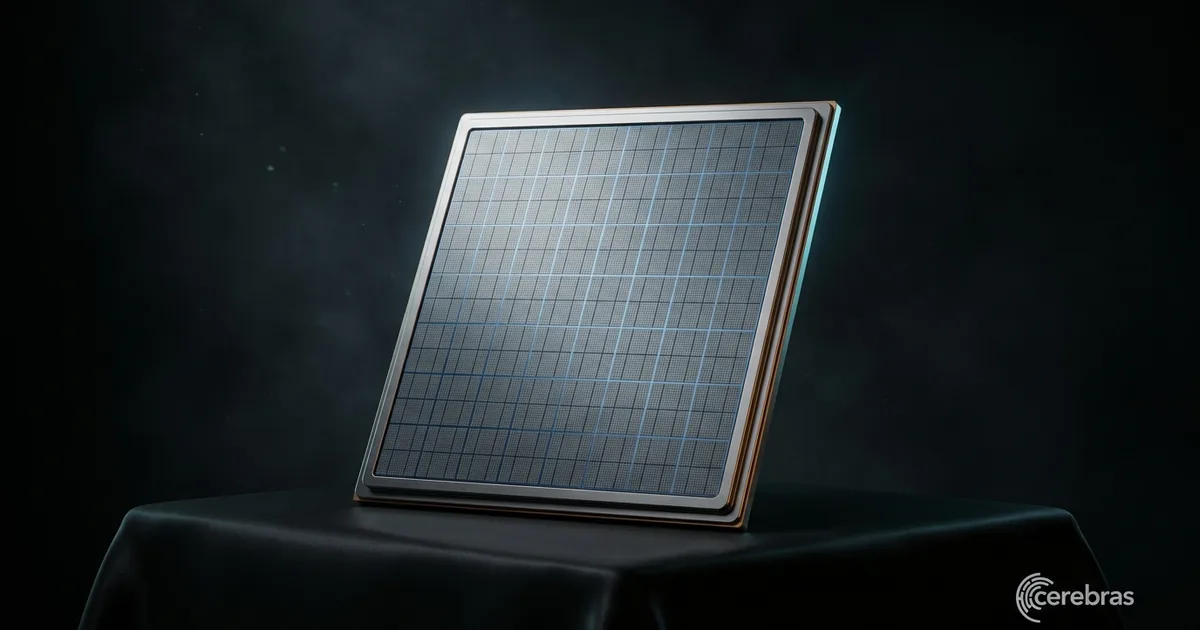
Cerebras has been pitching the same idea since 2018: instead of stitching together hundreds of small GPUs into a cluster, build one giant chip the size of a dinner plate and run AI workloads on it natively. The company calls this the Wafer Scale Engine, and the third generation, the WSE-3, ships with 900,000 cores on a single piece of silicon.
For years, Wall Street treated this as a science project. Nvidia’s CUDA stack was too entrenched, the AI inference market was too small, and Cerebras’s revenue base looked thin against Jensen Huang’s $200 billion-plus annual base. The pitch was elegant. The numbers were not.
What changed is the inference economics. As model deployment shifts from training to inference, latency and cost-per-token become the metrics that matter. Cerebras’s wafer-scale architecture has a structural advantage there: keeping all weights on a single chip avoids the network overhead that eats GPU clusters alive. The company has been quietly racking design wins, including a $20 billion cloud commitment from OpenAI signed in January and an Amazon Web Services deployment announced in March.
When the prospectus dropped two weeks ago with $4.6 billion ARR (up from roughly $400 million a year prior), the math on the WSE thesis suddenly looked different. By the time the bell rang Thursday, retail and institutional money was clawing for allocation.
What This IPO Means For The 2026 Pipeline
The Cerebras pop reopens a window that has been functionally closed since the 2022 rate cycle began. Yes, HawkEye 360 popped 28% on its NYSE debut last week. Yes, Fervo Energy popped 33% Tuesday. But neither carried the weight of a flagship AI chip name with a $48 billion offer valuation and a 20x oversubscribed book.
The pipeline waiting behind it: Robinhood’s second retail venture IPO, Nebius (which just reported 684% sales growth on AI data center demand), Stripe (perpetually rumored), and a long list of vertical AI companies that have been holding back in the secondary market. None of them will read Thursday’s tape and conclude that conditions are getting worse.
The risk to the bull case is well known. Cerebras’s customer concentration is brutal. OpenAI alone represents a sizable chunk of the $20 billion forward commitment. AWS and a handful of sovereign cloud customers (notably G42 in the UAE) make up most of the rest. If OpenAI’s compute strategy shifts toward Anthropic-style multi-vendor agnosticism, the ARR base looks fragile. Bloomberg’s reporting Friday that OpenAI CFO Sarah Friar warned the company may need to raise additional capital is exactly the kind of headline that should put a cap on Cerebras’s near-term multiple.
Nvidia, Notice Served
The competitive read is more interesting than the IPO read. Cerebras now has a war chest, a public stock to use as M&A currency, and a story Wall Street is willing to pay 20x ARR for. That is the playbook AMD has been running for two years against Nvidia in data center, and it has worked: AMD’s Q1 2026 data center revenue hit $5.8 billion as Lisa Su closed the gap with Jensen Huang.
Add Cerebras to the chase pack and Nvidia’s competitive moat starts to feel narrower. Google’s TPU 8 silicon is taking direct aim, AMD is pressing on inference, and Cerebras now has the public capital to go after the same TAM with a fundamentally different architecture.
Jensen Huang doesn’t lose sleep at $185. He might at $350. Cerebras’s market cap at Friday’s open was roughly 5% of Nvidia’s. Five years ago that would have been laughable. After Thursday, it is just numbers.
The Tape
CBRS closed Thursday at roughly $310, off the intraday high of $385 but still up 68%. Friday’s session opened weaker as profit-taking hit, with the stock trading around $290 by midday. Implied volatility on the listed options remains north of 90%, which is the market’s polite way of saying nobody knows where this prints in three months.
The IPO window is open. The flagship name went off cleanly. The architecture story finally has a public proxy. And the AI chip trade just got more interesting than it has been in two years. According to CNBC’s report on the debut, the stock briefly halted trading three separate times during its first session, an unusual outcome that signals just how much pent-up demand was sitting in the order book.
For investors who missed the allocation, the lesson is the one Wall Street keeps relearning: when a category-defining IPO comes out hot, the mistake is usually fading it on day one. CBRS is now a public name in a market that is finally hungry for one.