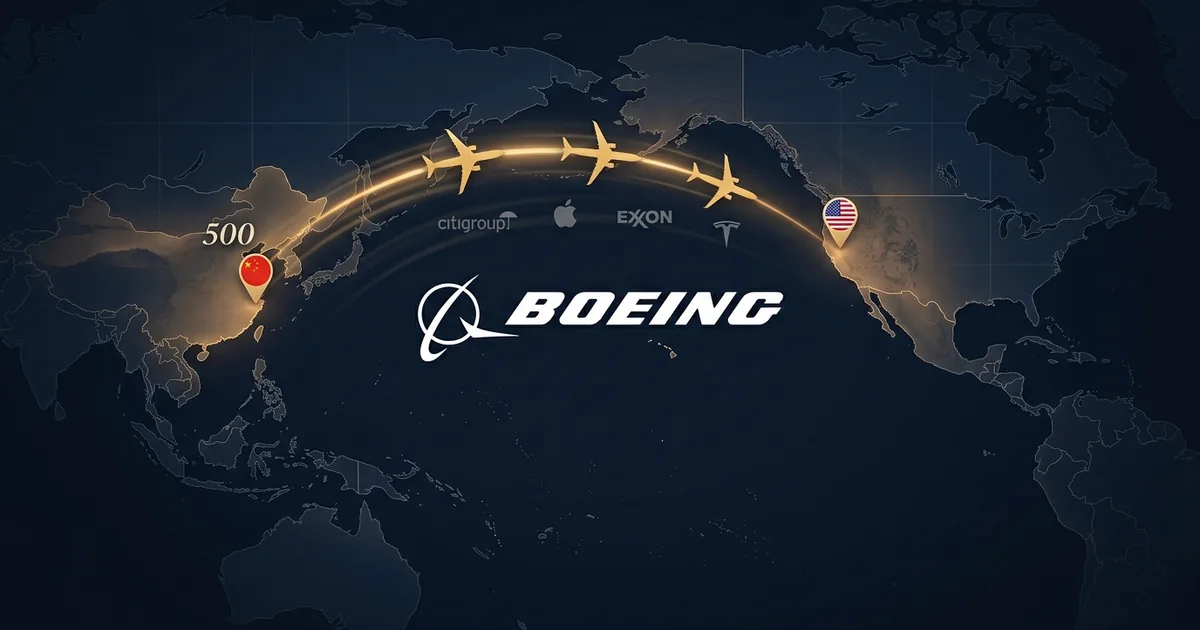
Air Force One lifts off for Beijing on Wednesday night, and Wall Street is already pricing the trip. President Trump’s first state visit to China since 2017 is set up around a 500-jet Boeing order, a renegotiation of US LNG and crude exports to Chinese buyers, and an unresolved fight over whether Nvidia chips ever land in Shanghai data centers. The corporate roster traveling with him is the real tell. Boeing CEO Kelly Ortberg and Citigroup CEO Jane Fraser are confirmed for the delegation, with reporting suggesting Apple’s Tim Cook and Exxon’s Darren Woods are also along for the ride. Notably absent from the public list: Nvidia’s Jensen Huang.
The Boeing Setup Is The Headline Number, And The Markets Already Bit
Boeing shares are up roughly 20% from their late-March lows, almost entirely on the rising probability that this trip closes a deal the company has been building toward for two years. Bloomberg’s reporting puts the package at as many as 500 737 MAX narrowbodies, with talks also covering roughly 100 widebodies split between 787 Dreamliners and the not-yet-certified 777X. At list prices, the combined package would clear $50 billion. Real airline contracts deliver discounts of 40 to 55%, so the cash number is meaningfully lower. The optics number is what matters here.
The history rhymes. In November 2017, Boeing inked orders and commitments for 300 aircraft during Trump’s last Beijing trip, a package the company valued at more than $37 billion at list. Most of those orders quietly stalled or were never delivered, casualties of the trade war that started months later. The lesson the Street has learned is that signed-in-Beijing is not the same as built-and-flying. Until the 737 MAX deliveries land in Shanghai, this is a stock catalyst, not a backlog event.
Boeing’s negotiating position is also weaker than the deal size suggests. Airbus has used the four-year freeze in US-China commercial aviation to lock up Chinese airline fleets with A320 NEO and A350 orders. Boeing needs the China channel to clear its inventory of completed 737 MAX 8s that have been parked in Wichita and Renton waiting for buyers. Beijing knows this. The size of the order is the price of admission for whatever Xi actually wants in return.
Who’s On The Plane Is The Real Story
The corporate delegation list is the most useful preview of the actual agenda, and it tells you what’s on the table that the public statements aren’t going to admit. Ortberg gets Boeing. Fraser gets Citi’s onshore China banking license fight, plus the broader US financial services access ask that has been frozen since 2024. Cook gets Apple’s manufacturing exemption from the next tariff round, which is the single highest-stakes corporate item on the trip. Woods gets the LNG and crude export framework.
The missing names tell you more. Jensen Huang’s absence from the public roster is the most important data point of the week. If Trump were arriving in Beijing ready to hand Xi the Nvidia H200 import green light, Huang would be on the plane. He’s not, which means either the chip framework is still being negotiated below the principals or it’s the bargaining chip the White House is holding back for the press conference reveal. Either way, Nvidia investors who priced certainty into the trade got ahead of the data.
Tesla CEO Elon Musk is also reportedly traveling. That puts the Shanghai gigafactory expansion, the data-localization fight, and the autonomous-vehicle approval roadmap on the agenda. None of those are likely to produce headline announcements, which is why Musk’s presence is interesting. He gets in the room on the trips where the policy is being shaped, not the trips where it’s being announced.
LNG, Crude, And The Energy Diplomacy Play
Brent at $107 a barrel and the Strait of Hormuz still closed give the energy track of this summit more urgency than any of the previous Trump-Xi sessions. The administration wants Chinese buyers to absorb US LNG and crude volumes that need a home now that Asian demand is being redirected by the Iran shock. We covered the Iran weapons tariff and the supply-chain front it opened in April, and the energy realignment in this summit is the next chapter of that same story.
China has reasons to play along. The country imports roughly 75% of its oil and its Iran-sourced volumes are caught in the Hormuz blockade. US Gulf Coast LNG and Permian crude are the cleanest substitutes, even at a political premium. The deal that emerges is likely to be a multiyear offtake agreement rather than a single-cargo announcement, which gives both sides something to celebrate without committing either side to a hard price floor.
AI Chips Are The Trade That Hasn’t Happened Yet
The Nvidia chip framework is the file that has been sitting on the desk for nine months. Trump approved limited H200 sales to China earlier this year subject to conditions Beijing has refused to accept. The Chinese position is that they don’t want the dumbed-down version of Nvidia’s flagship line. They want full Blackwell access, which Washington has so far refused to provide. The Beijing summit is the highest-level forum to break that stalemate, and the absence of Huang from the public delegation list suggests the deal isn’t ready to be photographed.
If something does emerge, the read-through is bigger than the Nvidia P&L. A US-China AI chip framework would reprice the entire export-controls regime, including Memory, Advanced Micro Devices’ MI300 line, and ASML’s high-NA EUV machines. The downside for Nvidia is that any framework Beijing will accept probably caps margins on China-bound volumes, which is the part the bulls have been pretending doesn’t exist.
What To Watch When The Joint Statement Drops
Three signals worth tracking. First, whether the Boeing announcement is denominated in firm orders or in “intent to purchase” letters. Firm orders move the backlog. Letters of intent move only the stock. Second, whether the LNG framework names volumes or just direction. The Permian and Gulf Coast operators need cargo math, not press releases. Third, whether the AI chip language mentions specific SKUs or stays at the “expanded cooperation” altitude. Specific SKUs matter; generalities are theater.
The corporate guest list told you the agenda. Now the question is whether the statement matches the delegation, or whether the people who flew in for the deal go home empty.