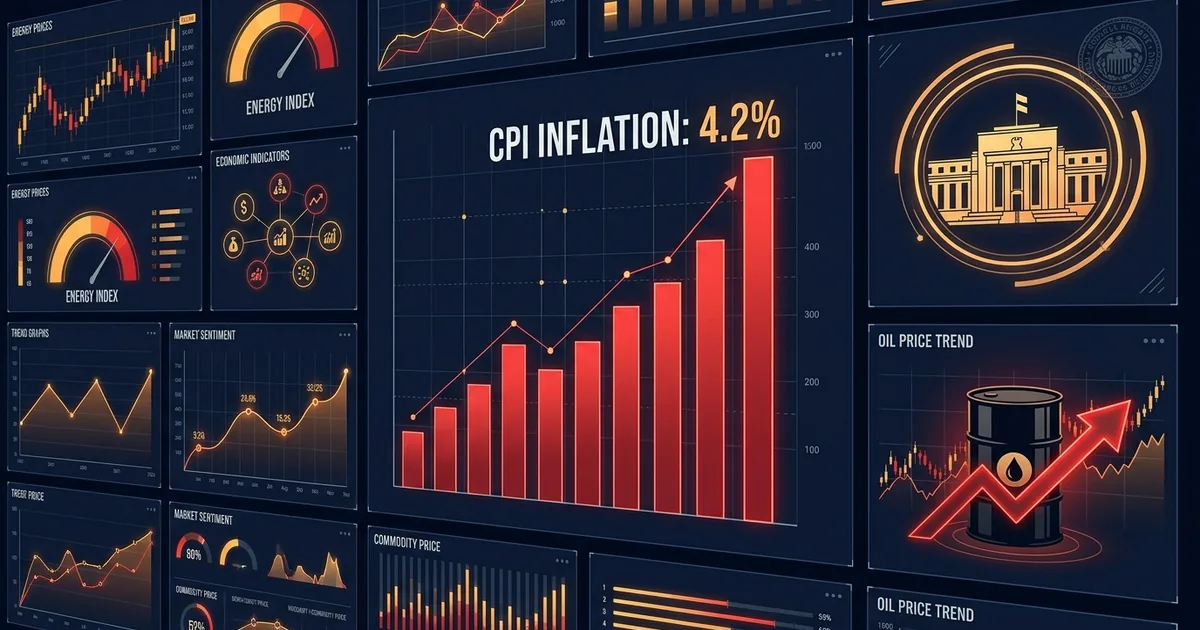
The May Consumer Price Index landed at 4.2% year-over-year on Tuesday, the highest reading since April 2023 and a sharp acceleration from April’s 3.8%. Energy prices did the damage, surging 3.9% in a single month as the Strait of Hormuz conflict continued to choke global oil supply. The number matched Wall Street expectations, but that is cold comfort when inflation is running more than double the Federal Reserve’s 2% target.
The Numbers Behind the Headline
The Bureau of Labor Statistics reported headline CPI rose 0.5% month-over-month, with energy accounting for more than 60% of the monthly increase. Energy prices are now up 23.5% on a 12-month basis, a direct consequence of the production shutdowns across six Gulf oil-producing nations since hostilities escalated near the Strait of Hormuz.
Core CPI, which strips out volatile food and energy, offered the report’s only silver lining. The monthly core reading came in at 0.2%, below the 0.3% consensus, while the annual rate held at 2.9%. Shelter costs, the largest single component of the index, rose 0.3% for the month (3.4% annually), half the pace of April. Food prices ticked up a modest 0.2%. Core commodities actually posted a 0.1% decline.
The gap between headline and core tells a clear story: this is an energy shock, not a broad-based inflation spiral. The problem is that energy shocks hit consumers at the gas pump and the grocery checkout regardless of what the core number says.
What the Fed Sees
The Federal Open Market Committee meets next week, and Tuesday’s print almost certainly guarantees another hold. The fed funds rate has been locked at its current level since the emergency hike in March, and the central bank has no good options. Cut rates and risk fueling inflation further. Raise rates and risk tipping an already strained economy into contraction.
BTN analyzed the rising probability of a June rate hike after last week’s jobs report showed the labor market running hotter than expected. Tuesday’s CPI complicates that picture. The softer core print gives hawks less ammunition, but the 4.2% headline gives doves nothing to work with either.
Market pricing via CME FedWatch currently implies roughly a 60% chance of no change on June 17, with the remaining probability split between a 25 basis point hike and a hold with hawkish guidance. The bond market is telling a similar story: the 10-year Treasury yield barely moved on the CPI release, suggesting traders had already priced in a hot headline.
The Energy Tax Nobody Voted For
For American households, the math is straightforward and painful. Gasoline prices have risen more than 30% since the Hormuz disruption began. Airfares are up. Shipping costs are filtering through to shelf prices with a typical three-to-six-month lag, meaning the worst of the consumer impact may not arrive until late summer.
The political dimension is impossible to ignore. An analysis from FactSet noted that consumer inflation expectations have climbed to their highest level since 2022, a sentiment shift that risks becoming self-reinforcing if businesses begin pricing in expected cost increases.
Retailers and consumer-facing companies are already adjusting. Walmart flagged elevated input costs in its last earnings call. Target trimmed full-year guidance. The restaurant and hospitality sector, which operates on thin margins even in good times, is absorbing energy costs it cannot fully pass through without destroying demand.
What Comes Next
The June 17 FOMC decision will be the market’s next inflection point. If the Fed holds and signals patience, equities may stabilize on the assumption that policymakers see the energy shock as transitory. If officials signal that a July hike is on the table, expect another leg down in rate-sensitive sectors: housing, tech, and anything carrying heavy debt loads.
The deeper question is whether core inflation can continue to cool while headline inflation runs hot. History suggests it can, but only if the energy shock remains contained. A further escalation in the Hormuz conflict, or a disruption to commercial shipping lanes, would blow that thesis apart. For now, the market is choosing to believe the core number. Whether that optimism survives the summer depends entirely on a 21-mile-wide strait halfway around the world.