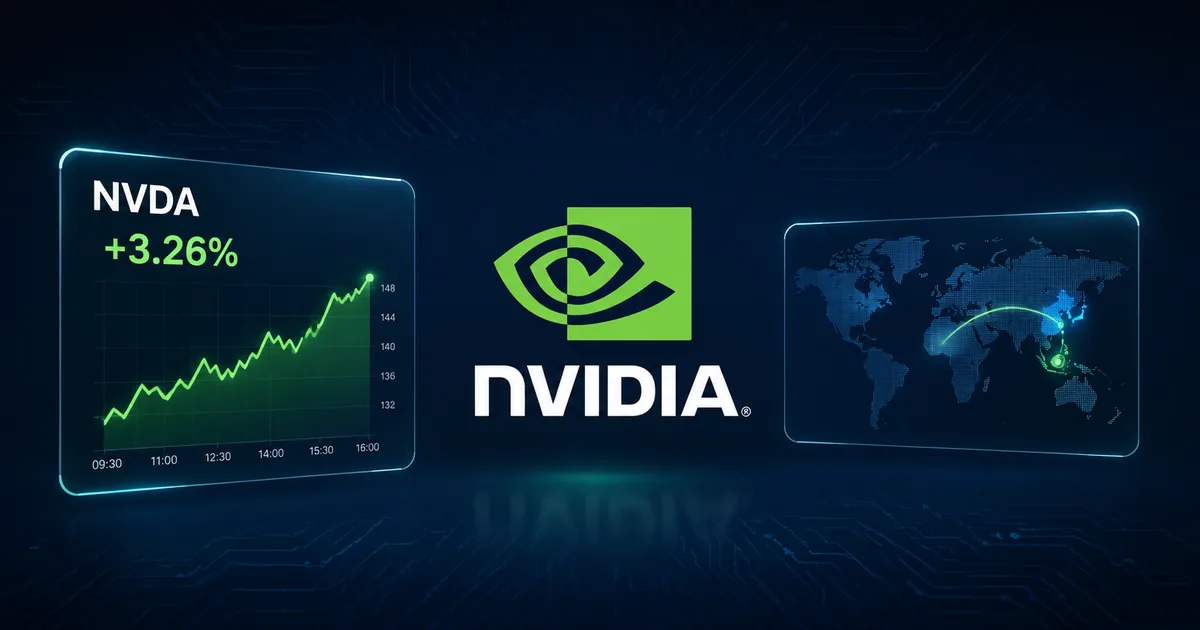
Nvidia closed Wednesday at $205.39, up 3.26%, on the same day the White House accused a Chinese lab of running its banned Blackwell servers out of Thailand. Nobody on the sell side attributed the move to the accusation, and that indifference is the most useful information in the whole story.
Michael Kratsios, director of the White House Office of Science and Technology Policy, alleged in a post on X first reported Wednesday that Moonshot AI “acquired GB300-equipped servers and has accessed GB300s in Thailand, likely to train its AI models.” He paired it with a second charge: that Moonshot built “a sophisticated internal platform to conduct large scale distillation against U.S. models, allowing them to quickly switch between multiple methods of access to avoid detection,” using Anthropic’s Fable to train its new Kimi K3 system. Moonshot and Nvidia have not responded publicly.
Read that as an equity analyst and the first allegation is not a problem for Nvidia. It is a demand signal.
Smuggled Chips Are Chips Nvidia Already Sold
This is the part that gets lost when export controls are covered as a national-security story rather than a revenue story.
A GB300 sitting in a Bangkok data center is a GB300 that cleared Nvidia’s order book, shipped, and was recognized as revenue. Nvidia does not lose money when hardware ends up somewhere the Commerce Department did not intend. The export-control regime is a constraint on Nvidia’s addressable market, and gray-market leakage quietly relieves that constraint at no cost to the company. Every credible report of diversion is, in accounting terms, evidence of demand the restrictions were supposed to have suppressed and did not.
Jensen Huang has been unusually direct about the policy for over a year. He told reporters at Computex that “the export control was a failure,” arguing the rules handed Chinese firms both the motivation and the state backing to build domestic substitutes faster. He has an obvious commercial interest in that view. He is also describing his own order book.
The scale is not trivial. Federal prosecutors charged a Supermicro co-founder and two others over a scheme to route roughly $2.5 billion in Nvidia-equipped servers to China through Southeast Asian shell companies, and researchers have tracked hundreds of millions of dollars in diverted hardware inside single quarters. Southeast Asian transshipment is a structural feature of this trade, not an anomaly.
So the market’s shrug was rational on the hardware question. The risk to Nvidia was never the smuggling. It is whatever Washington does next.
The Real Threat Is a Free Model That Is Almost as Good
Moonshot released Kimi K3 on July 16 as a roughly 2.8-trillion-parameter open-weight system, among the largest openly released to date. The company claims it trails only Anthropic’s Claude Fable 5 and OpenAI’s GPT-5.6 on overall capability. Axios framed the release as the moment China erased America’s AI lead.
Set the geopolitics aside and look at the P&L implication, because it is severe.
American frontier labs price inference on the assumption that frontier capability is scarce. That assumption is what supports per-token pricing, enterprise seat licenses, and the valuations built on top of them. A free, downloadable model that delivers most of the capability at zero marginal licensing cost does not need to win benchmarks to do damage. It only needs to be good enough to become the buyer’s alternative in a procurement negotiation.
Every enterprise CIO evaluating a contract renewal now has a credible walk-away option that costs nothing but compute. That is margin compression, and it arrives whether or not anyone proves how Kimi K3 was trained.
Anthropic and OpenAI are the exposed parties here, not Nvidia. Nvidia sells the shovels, and an open-weight model that thousands of firms want to run locally sells a great many shovels. The labs sell the gold.
Why the Language Changed to Theft This Week
Which brings us to the actual strategic move, and it is worth being clear-eyed about the sequencing.
Treasury Secretary Scott Bessent told CNBC and Fox Business a day before Kratsios posted that the administration has a tool ready: “If we see, especially that overseas models are stealing from our great companies, we have the ability to sanction them because of this theft.” He added that Treasury has found “watermarks of our U.S. large language models on many of the Chinese models.”
Export controls stop capability from being built. They do nothing about capability that has already been built and given away. Kimi K3’s weights are downloaded and mirrored, and no agency can recall them.
Sanctions are a different instrument entirely. They reach the company, its financing, its cloud providers, and the counterparties that transact with it. They can raise the cost of doing business with Moonshot for firms that have nothing to do with chips. For a lab whose distribution strategy depends on being freely adopted, being designated is a commercial problem, not just a diplomatic one.
The pattern is not new. Anthropic has said operators tied to Alibaba’s Qwen unit ran nearly 25,000 fraudulent accounts to extract more than 28.8 million interactions from Claude, a case we covered when the distillation campaign surfaced in June. What is new is the government treating that conduct as a sanctionable offense rather than a terms-of-service dispute between private firms.
Worth noting for anyone modeling the enforcement risk: Anthropic accused Moonshot of distillation back in February but has not said publicly that it has evidence tying Kimi K3 specifically to Fable. Kratsios asserted the link. The evidentiary record behind it is not public.
What Investors Should Actually Watch
Bessent is scheduled to represent the United States in AI talks with China in September. That timing matters more than Wednesday’s post.
An administration that intended to sanction Moonshot immediately would not need to announce the legal theory eight weeks early. Pre-announcing the tool is how you build a bargaining position. The likeliest read is that the theft framing is leverage being staged for a negotiation, with actual designation held in reserve.
Three things to track between now and then. Whether Anthropic produces technical evidence, which would move this from assertion to case. Whether Treasury names any entity, which would reprice Moonshot’s counterparty risk overnight. And whether enterprise buyers actually shift budget toward open weights, which is the only one of the three that shows up in anyone’s revenue.
Nvidia’s 3.26% says the market has already priced the hardware story. It has not begun to price what happens to software margins when the second-best model in the world is free.