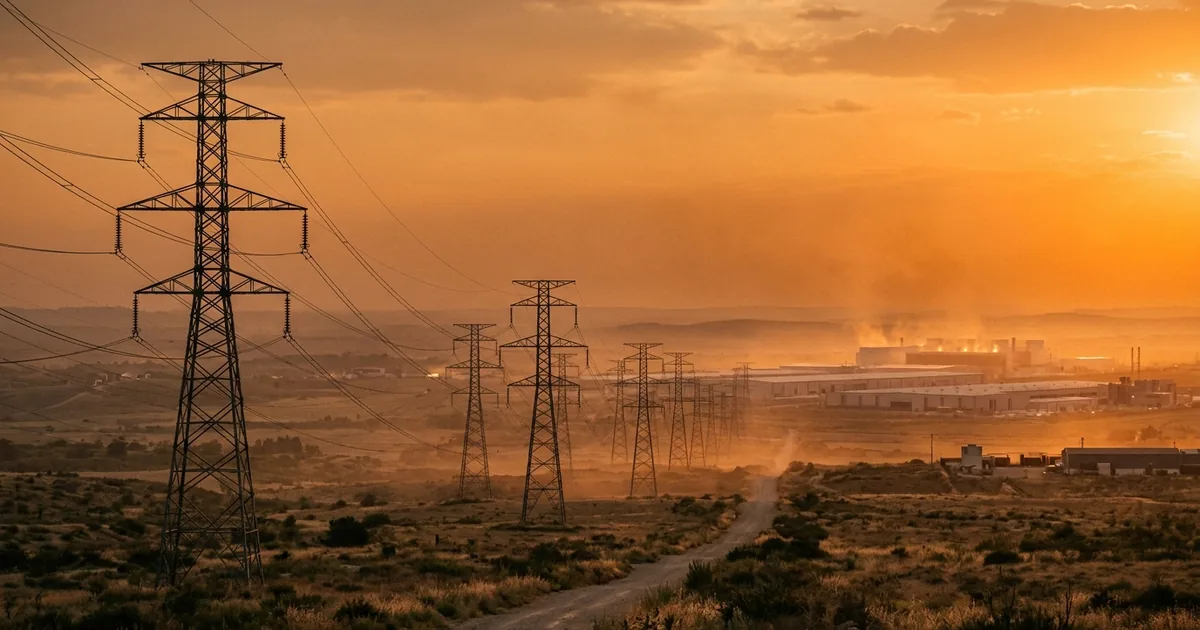
The biggest electricity grid in the United States spent the day before July 4 operating under federal emergency orders, and the reason is not just the heat. PJM Interconnection, which keeps the lights on for 65 million people across 13 states and Washington, D.C., escalated its emergency procedures Thursday as CNBC reported the operator was working to avoid rolling blackouts, with demand forecast to hit 166,304 megawatts, enough to break a record that has stood since 2006.
Read that last part again. The all-time peak on America’s largest grid was set two decades ago, at 165,563 megawatts, and it survived every heat wave since. What finally broke it was not weather alone. It was weather plus the most aggressive industrial load growth in modern American history: the AI data center buildout, arriving faster than anyone can build the power plants to feed it.
What the Emergency Orders Actually Do
Energy Secretary Chris Wright signed two emergency orders under Section 202(c) of the Federal Power Act on June 30, and The Hill reported they took effect just before midnight that night and run through 11:59 p.m. EDT on July 3, covering the exact window when roughly 160 million Americans sat under extreme heat alerts.
The first order is familiar playbook: PJM can dispatch specific generating units beyond their normal environmental permit limits, letting plants run flat out past emission caps for the duration of the emergency. Grid operators have leaned on that tool for years.
The second order is the one the business world should be staring at. Utility Dive reported that it authorizes PJM to direct transmission owners to curtail data centers and other large energy consumers with at least 50 megawatts of peak load, forcing them onto their own backup generators within 15 minutes of an emergency signal. Hospitals, 911 call centers, water treatment plants, air traffic control, and defense installations are exempt. Server farms are not.
That is a federal order telling the crown jewels of the AI economy: when the grid gets tight, you unplug first.
The Third Time Is a Pattern, Not an Emergency
Here is the detail that turns a weather story into a structural one. This is the third time in 2026 alone that PJM has needed a 202(c) order with data center curtailment authority, after a January cold snap and a May squeeze driven by heat and plant maintenance. Emergency powers are supposed to be the break-glass option. Three activations in six months means the glass is permanently broken.
The underlying math is not complicated. Data center demand in PJM territory, which includes Northern Virginia’s Data Center Alley, the densest concentration of server farms on the planet, has grown faster than new generation has come online. Older coal and gas plants keep retiring on schedule while replacement capacity sits in a multi-year interconnection queue. The reserve margin that used to absorb a brutal heat wave has been eaten, megawatt by megawatt, by hyperscaler campuses that run at near-full load around the clock.
PJM itself has been unusually blunt about the trajectory. In its hot weather operations update, the operator walked through the record-breaking forecasts while emphasizing the emergency tools it hoped not to use. Hope is not a capacity plan.
Follow the Money: Who Pays and Who Profits
The cost of this squeeze is already flowing to two places, and neither of them is a hyperscaler’s income statement.
The first is wholesale power prices, which spiked across PJM as the heat dome settled in, with real-time prices in parts of the footprint trading at multiples of normal levels. Those costs land on utilities first and ratepayers eventually. PJM’s most recent capacity auctions have already cleared at record levels, and those charges are showing up on household bills from Ohio to Virginia right now. Consumers are, in effect, paying an AI infrastructure surcharge without ever being asked.
The second is political capital. Public patience for the data center boom is thinning fast, and the business community should not pretend otherwise. A Reuters/Ipsos poll found 57 percent of Americans worried about data centers driving up their energy costs, sentiment we covered when opposition to the AI data center buildout started showing up in polling last month. Every emergency order that names data centers as the load to shed hands that opposition another talking point.
On the winners’ side of the ledger, the trade is obvious and it is already crowded. Turbine makers, grid equipment suppliers, and merchant generators with dispatchable capacity in PJM territory are printing money in this environment. Fox Business reported the emergency authority was secured precisely because record demand left no slack anywhere else in the system. Scarcity is a business model, and right now the scarce commodity is firm power.
The Uncomfortable Question for the Hyperscalers
Microsoft, Amazon, Google, Meta, and the rest have spent two years promising that their data center expansion comes with matching investment in new generation. Some of that is real: nuclear restarts, long-term power purchase agreements, on-site gas turbines. But the July 3 emergency exposes the timing gap. The data centers are online now. Most of the promised generation is not, and the interconnection queue means much of it will not arrive before 2028 or later.
In the meantime, the federal government has quietly established a precedent that should worry every chief financial officer betting on uninterrupted compute: when supply gets tight, Washington will order the AI economy to power down before it lets suburban air conditioners fail. That is the politically rational choice, and it will be the politically rational choice every summer until the generation gap closes.
The grid held on Thursday. The record will fall again, probably within twelve months, because the load growth driving it has not slowed. The question worth watching is not whether PJM survives the next heat wave. It is whether the companies that created this demand start paying the full cost of serving it, or whether ratepayers and emergency orders keep quietly covering the difference.