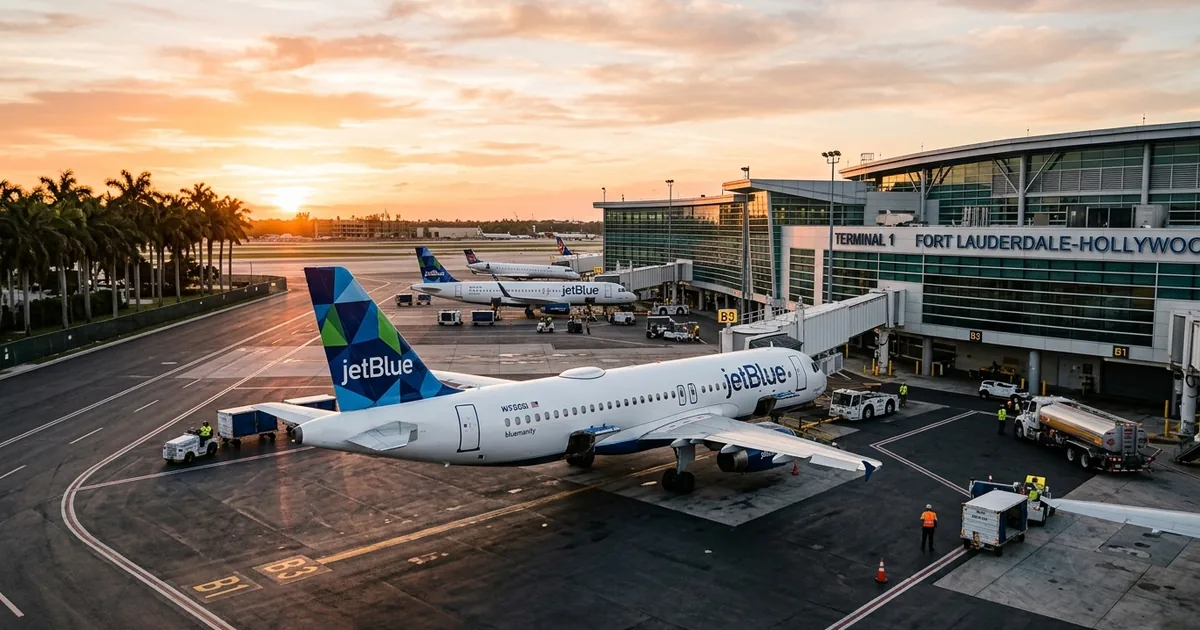
JetBlue is pulling the ripcord on New York. The airline announced this week that it will close flight attendant and tech operations bases at Newark and LaGuardia, cut two transcontinental routes, and redirect the freed-up capacity to Fort Lauderdale, where gate space is suddenly abundant after Spirit Airlines ceased operations on May 2.
A Calculated Retreat From the Most Competitive Market in America
The New York metro area is the most congested, most expensive, and most carrier-saturated aviation market in the country. JetBlue has competed there for a quarter century, but the economics have shifted. Newark capacity is down about 7% compared with June 2025, and the airline’s departing seats across the entire New York system have fallen 2.9% year over year.
The closures are not symbolic. Simple Flying reported that JetBlue is dropping two cross-country routes from Newark and shuttering crew bases at both Newark and LaGuardia this autumn. Those are fixed-cost centers: real estate, staff, maintenance infrastructure. Closing them signals that JetBlue’s leadership does not expect to reverse the New York pullback anytime soon.
The strategic logic is straightforward, if uncomfortable for a brand that built its identity on making New York flying affordable. JetBlue cannot win a war of attrition against Delta at LaGuardia, United at Newark, and American at JFK simultaneously. Not with $9 billion in debt on the books. Not when the most attractive growth opportunity in a decade just opened 1,100 miles south.
Fort Lauderdale: From Secondary Hub to Primary Bet
Spirit’s collapse changed the math overnight. Fort Lauderdale-Hollywood International Airport lost its anchor tenant, and JetBlue moved fast. The airline has boosted its market share at Fort Lauderdale from 19.7% to 33.9% in the span of a year, growing departing-seat capacity from roughly 333,000 to over 432,000 monthly seats.
Aviation Week reported that JetBlue is accelerating its Fort Lauderdale buildout with expanded transcontinental premium service, adding daily Mint business-class flights to San Diego, Los Angeles, and San Francisco. The carrier is also evaluating lounge locations at the airport, a signal that it sees Fort Lauderdale as a long-term premium hub, not a seasonal overflow valve.
The Spirit Airlines collapse that BTN covered in May left a vacuum in the ultra-low-cost segment. JetBlue is not filling it with bargain fares. Instead, it is positioning Fort Lauderdale as a premium leisure and business hub, competing with American Airlines’ nearby Miami operation on service quality rather than price.
The Debt Question
JetBlue’s balance sheet is the elephant on the tarmac. The airline carries approximately $9 billion in total debt, a hangover from the failed Spirit merger attempt and years of pandemic-era borrowing. Every route decision and base closure has to be evaluated through the lens of cash flow, not growth ambition.
Fort Lauderdale helps on that front. Airport costs at Fort Lauderdale are significantly lower than at JFK or Newark, where landing fees, gate leases, and crew positioning expenses eat into thin margins. The premium Mint product also generates higher per-seat revenue than coach seats on the same routes, which matters when you need to service debt payments while growing.
The risk is concentration. JetBlue is trading diversified exposure across the Northeast corridor for a heavier bet on a single Florida airport. If a hurricane disrupts operations for even a week during peak season, the financial impact would be amplified compared with a geographically spread network.
What This Means for Travelers and Competitors
For New York-area travelers, the practical impact is fewer JetBlue options on certain routes, particularly transcontinental flights from Newark. For Fort Lauderdale passengers, the shift means more premium service, more destinations, and potentially lower fares as JetBlue and American compete for South Florida dominance.
For the industry, JetBlue’s pivot is a case study in post-consolidation reallocation. When a competitor exits the market (Spirit), the survivors do not simply absorb its passengers in place. They reshuffle their entire networks to optimize for where the opportunity is greatest. The opportunity, JetBlue’s management has concluded, is in Florida.
Whether that bet pays off depends on execution, fuel prices, and whether Fort Lauderdale can absorb the growth without the operational bottlenecks that plague larger hubs. JetBlue’s next two earnings calls will be the scorecard.