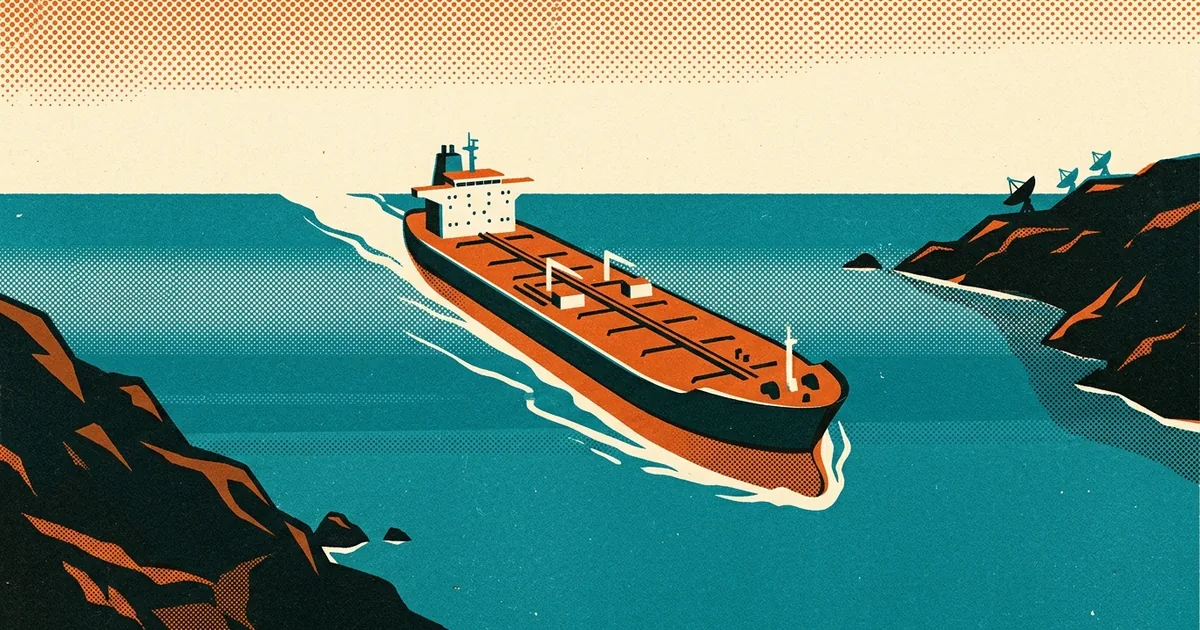
The US military hit two Iranian rocket launchers on Larak Island on Sunday, the first acknowledged strike on Iranian forces in about a month, and oil went up roughly 2 percent. Every wire story led with that number. The number they left out is the one that actually explains this market: the International Energy Agency now expects global oil demand to fall by 1.6 million barrels per day this year, and it attributes that directly to the closure of the strait the US was defending.
Read those two facts together and the standard framing inverts. Hormuz is no longer functioning as a supply shock that lifts prices. After six months of war it has become a demand sink that caps them. That is not good news, and treating a muted price response as reassurance is the mistake worth avoiding this week.
What Happened on Sunday
US forces struck launchers on Larak Island in southern Iran that were being prepared to fire rockets dispersing sea mines into the waterway, according to CNBC. It broke a lull of several weeks in a conflict now past its sixth month. Iran answered with strikes on US positions in Jordan and the United Arab Emirates.
The market response was orderly. West Texas Intermediate added 1.8 percent to $84.94 and Brent rose 1.9 percent to $89.79 in Sunday trading, with Brent reaching $90.69 on Monday. US equity futures barely flinched: Dow futures off 74 points, S&P 500 futures down 0.2 percent.
Here is the context that matters. Brent sat above $90 on August 18, when we covered the lapse of the Iran ceasefire. Two weeks later, after the shooting resumed and mines were nearly laid in the world’s most important oil chokepoint, Brent is at $90.69. The strait got materially more dangerous and the price went essentially nowhere.
The Price That Did Not Move
The muted response is not complacency. It reflects a physical adjustment that already happened.
Before the war, 120 to 140 vessels crossed the strait daily, roughly half of them tankers moving about 20 million barrels a day, close to a fifth of global oil. At the worst of the fighting that collapsed to as few as two tankers a day. Roughly 24 vessels transited in a recent week. Bloomberg reported on August 27 that flows had begun creeping back to 6 to 8 million barrels a day as Gulf producers pushed exports out despite the risk, still well under half the pre-war rate.
What has not normalised is the cost of going through. War risk cover now runs between 7.5 and 10 percent of a vessel’s value, against 0.25 percent before the war. Run that against a five year old very large crude carrier worth about $138 million, as The National did, and the arithmetic is brutal:
- Pre-war premium on a single transit: roughly $345,000
- Current premium at 7.5 percent: about $10.4 million
- At 10 percent: about $13.8 million
- Spread across a VLCC’s roughly 2 million barrels: somewhere near $5 per barrel, before a drop of crude is sold
That premium is a permanent tax on the route for as long as the war runs. It does not spike on strike headlines because it is already priced at crisis levels. Sunday changed the news cycle. It did not change the insurance slip.
Demand Is the Real Casualty
Supply disruptions raise prices. Demand destruction lowers them. Hormuz is now delivering more of the second, which is why the tape looks calm while the underlying situation deteriorates.
The IEA and OPEC both cut their outlooks, as OilPrice reported: the agency sees demand dropping 1.6 million barrels per day in 2026, while OPEC trimmed expected growth to 580,000 barrels a day from 780,000. US commercial crude inventories built by 17.4 million barrels in a single week in August to 424.4 million, roughly 2 percent below the five year average. The IEA’s August market report frames the reopening of the waterway as increasingly urgent precisely because stockpiles are doing the work prices normally would.
Meanwhile the institution that historically absorbed shocks has been weakened. The UAE, worth around 1.4 percent of global supply and holding meaningful spare capacity, has left OPEC. The cartel’s ability to stabilise a genuine supply break is smaller now than at any point in this conflict.
Our Read
The calm price is being misread, and companies with Gulf exposure are the ones who will pay for the misreading.
A flat oil price in these conditions is not a sign the crisis is contained. It is a sign that enough industrial activity, shipping and trade has already been priced out of existence to offset the loss of a fifth of the world’s seaborne crude. That is a worse outcome than $110 oil, because a high price is a cost you pay and lost demand is commerce that simply does not happen. It shows up later, in freight volumes, in Gulf state budgets, in the earnings of every shipper and refiner that rerouted.
The policy failure is specific and it belongs to Washington and Tehran jointly. Six months in, there is no reopening framework, only a strike tempo and competing lists of conditions. Sunday’s operation was defensible on its own terms, since mining the strait would be a categorical escalation. But a defensive strike is not a strategy, and the absence of one is now measurable in the IEA’s demand line.
The number to watch is not Brent. It is the daily transit count and the war risk rate. If premiums start easing off 7.5 percent, the reopening is real. Until then, every 2 percent move on a strike headline is noise on top of an economy that already left.