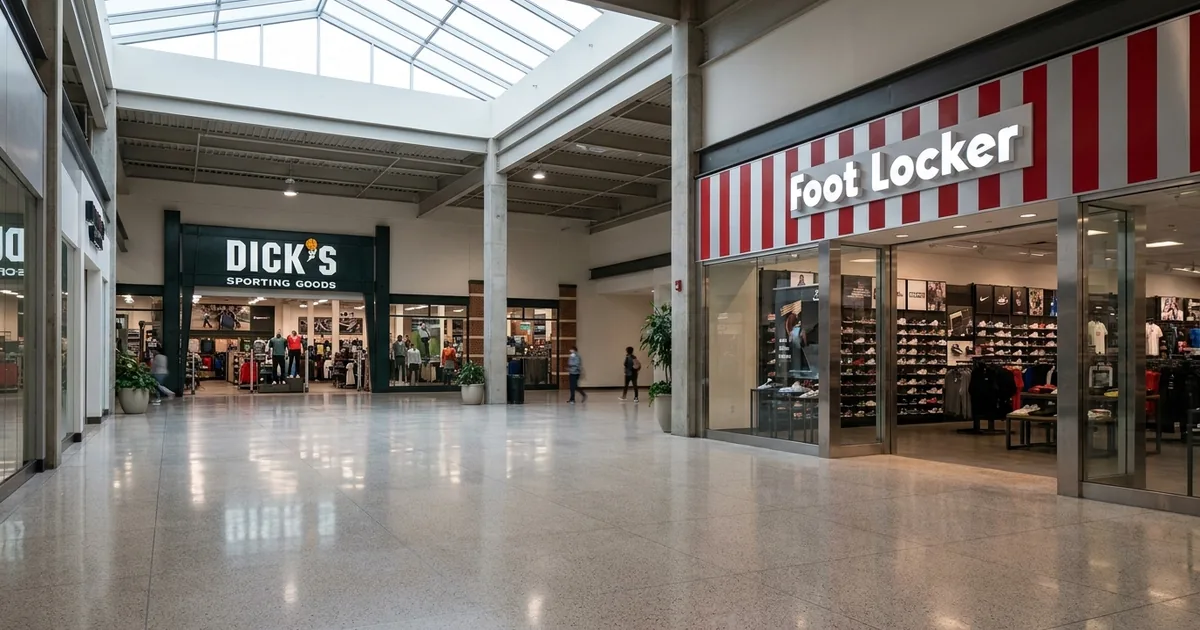
Dick’s Sporting Goods lost close to 30% of its market value on Tuesday, the worst single session in the company’s history as a public retailer. The striking part is what did not go wrong. Comparable sales at Dick’s own stores grew 4.9%, a number most of American retail would sign for without reading the rest of the page. The core chain is healthy. The problem is the chain it bought.
Foot Locker, acquired for $2.4 billion in a deal announced in May 2025, delivered a 3.6% decline in proforma comparable sales for the quarter. Management then cut the Foot Locker full-year outlook to a range of flat to down 2%, and that single revision pulled the entire consolidated forecast down with it. Investors did not reprice a bad quarter. They repriced an acquisition thesis.
The Numbers Behind the Drop
For the quarter ended August 1, Dick’s reported adjusted earnings of $3.53 per diluted share against a consensus near $3.76, on revenue of $5.59 billion versus the $5.65 billion analysts modeled. Revenue was up 53.2% year over year, but that growth is almost entirely the arithmetic of consolidating Foot Locker’s store base, not underlying demand.
The guidance is where the damage sits. In its second-quarter release, the company put full-year adjusted earnings at $11.00 to $12.00 per share. Wall Street had been carrying $14.20. The midpoint of that new range sits roughly 19% below where the street was, which is not a trim, it is a reset. Consolidated operating income guidance fell from a prior band of $1.69 billion to $1.81 billion down to $1.45 billion to $1.55 billion. Net sales guidance slipped to $21.9 billion to $22.2 billion.
Executive Chairman Ed Stack pointed at an increasingly promotional market and at Foot Locker’s dependence on sneaker launches, retro releases and aging footwear styles. Forbes noted the stock was tracking toward its worst day in three years before the selling accelerated into the close and made it the worst day, full stop.
The Deal Underwrote an Operating Problem That Turned Out to Be a Category Problem
Here is the part worth sitting with. When Dick’s bought Foot Locker, the logic was legible and, on paper, defensible: buy distribution into the sneaker channel, buy international footprint, and apply a better operator to an underperforming asset. That thesis assumes Foot Locker’s weakness is operational. Fix the merchandising, fix the store fleet, fix the vendor relationships, and the margin comes back.
Nine months ago, Stack sat on CNBC and made exactly that case.
The turnaround premise has now collided with something an operator cannot fix by working harder. Retro sneaker demand is softening, and the launch-driven model that Foot Locker is built around depends on a product calendar Dick’s does not control. Nike sets it. When we covered Nike’s fourth-quarter results and its direct-sales decline, the same pressure was visible from the brand side of the relationship. A retailer whose economics hinge on somebody else’s hype cycle is a price taker wearing an operator’s costume.
The core chain grew 4.9%. The acquisition took the whole company down 30%. That is not a quarter, that is an underwriting error surfacing on schedule.
Discounting Is the Tell
Stack’s phrase about an increasingly promotional market deserves more attention than the earnings miss. Promotional intensity in athletic footwear means inventory is moving at prices nobody planned for, and it means competitors are willing to defend share with margin. That is a category signal, not a company signal, and it lands on Dick’s twice: once through Foot Locker’s mall-based footprint, and once through its own footwear assortment.
The consumer backdrop is not helping. Walmart’s most recent quarter showed comp-sales deceleration even at the value end of the market, which is usually the last place shoppers abandon. Discretionary sporting goods sit far up the vulnerability curve from groceries. A $180 retro basketball shoe is one of the easiest line items in a household budget to postpone.
What This Says About the Retail M&A Playbook
The broader lesson runs past Dick’s. American retail has spent three years consolidating on the theory that scale solves margin: buy the struggling competitor, strip the duplicated overhead, and let the surviving banner absorb the volume. It works when the acquired business is mismanaged. It fails when the acquired business is correctly managed inside a shrinking category, because then you have paid a control premium for exposure you could have shorted for free.
Dick’s now carries both sides of the athletic trade. The upside case, that footwear demand normalizes and Foot Locker’s international doors become the growth engine, is still live. But the company has handed itself a multi-year integration during a promotional cycle, and it has done so with a guidance range wide enough to signal that management is not confident about the bottom of it. A $1.45 billion to $1.55 billion operating income band, revised down mid-year, is a company telling you it does not yet know where the floor is.
Jim Cramer, discussing the collapse on CNBC, framed the question every holder now faces: whether this is a broken stock or a broken company. The 4.9% comp at the legacy stores argues for the former. The guidance cut argues that it will take longer than one holiday season to prove.
Watch the next print for one number above all others: Foot Locker comps. If that line stabilizes near flat, the integration story survives and Tuesday looks like an overreaction. If it deteriorates again, Dick’s will be answering a harder question than how the quarter went. It will be answering why it bought the business at all.