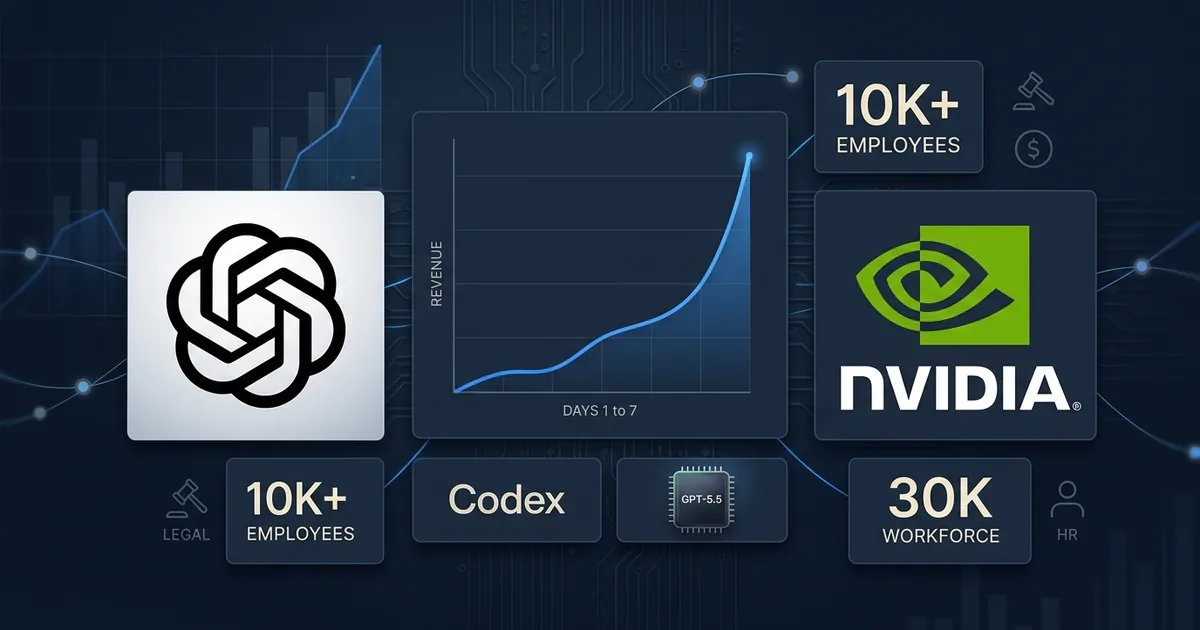
A week after OpenAI rolled GPT-5.5 into Codex, the company is making an unusually specific revenue claim, and NVIDIA is offering the testimonial that explains it. OpenAI said on May 9 that API revenue is now growing more than 2x faster than any prior model release, and that Codex revenue itself doubled in under seven days. That alone would be a strong week. The corroborating data point is what makes this a story: NVIDIA confirmed in a blog post that more than 10,000 of its employees, across legal, finance, marketing, HR, and operations, are now using Codex, and Jensen Huang is framing the 30,000-person company as restructuring work around AI agents.
This is the moment agentic coding stops being a developer assistant and starts being a line item the CFO has to model into FY27 headcount.
What “Doubled” Actually Buys OpenAI
OpenAI’s API business contributes roughly 25% of total revenue, with enterprise now more than 40% of the mix according to disclosures cited by TechCrunch. Two-x faster API growth than any prior release is a real lever in that mix. It is also a useful fact pattern for OpenAI’s investor narrative one week after the company closed a $122 billion October raise and signaled $50 billion of 2026 compute spend.
The math is the thing. Codex doubling in seven days from a base built across the prior year is not a viral spike. It implies enterprise seat deployment, not consumer curiosity. Annual contracts do not double in a week unless something has decisively moved on the other side of the procurement table.
NVIDIA’s Memo Is the Real Tell
The OpenAI press release gives you the headline. NVIDIA gives you the proof.
More than 10,000 employees outside engineering at NVIDIA, across legal, finance, marketing, HR, and operations, now have Codex deployed. Jensen Huang’s framing is not “developers move faster.” It is that a 30,000-person company is reorganizing how non-engineering work gets done around AI agents. That is the language every CIO and head of HR will hear next week from a friendly board member or vendor.
NVIDIA is not a neutral reference customer. The company has a vested interest in any narrative that sells more GPUs, and OpenAI is the largest individual driver of that demand. But the specificity of the claim, 10,000 non-engineering staff, hard count, named departments, is exactly the detail enterprise buyers cite back to procurement when they need to justify the line item. The implicit pitch is that if NVIDIA’s lawyers and HR generalists are running on Codex, yours can be too.
Seat Economics, Just Compressed
The harder story sits one layer down. If Codex genuinely deploys to 10,000 non-engineering employees at one Fortune 500 customer, the seat economics for incumbent enterprise SaaS look different on Tuesday than they did on Friday.
Seat-based software, the entire model that built Salesforce, ServiceNow, and Workday, depends on the assumption that each human employee is the unit of consumption. Agentic tools quietly invert that. One Codex instance can draft a contract redline, run a marketing-ops query, and pull together a board pack. That is three different SaaS subscriptions today, sold at three different per-seat ratios. Our earlier reporting flagged the pressure agentic AI is already putting on the legacy enterprise SaaS stack, and Codex’s seven-day doubling adds a fresh data point.
If revenue per non-engineering employee is now bid by Codex at OpenAI’s rate card, the seat-multiple incumbents trade on starts to look generous. That repricing does not have to be sudden. It just has to be visible enough to pressure the next renewal cycle.
Where Anthropic Is, and Where Cursor Goes
The first competitive question is where Anthropic’s enterprise answer lands. SaaStr reported earlier this year that Anthropic passed OpenAI in revenue while spending 4x less on training. The contrast with this week’s Codex print is instructive. OpenAI is leaning into agent volume and enterprise distribution. Anthropic has built a leaner cost structure that throws off margin. Both can be true. Both also leave room for an enterprise Claude Code answer monetized at this scale, and so far we have not seen one.
The second question is what Codex doing 2x in a week means for Cursor at a $50 billion valuation. Cursor’s pitch has always assumed it could ride the developer-tool curve without OpenAI cleaning up the agent layer above it. Codex now telling the market that non-engineering deployment is the bigger TAM, with NVIDIA’s 10,000-employee buy-in as proof, makes that thesis harder to defend to a Series F lead.
What ARR Multiples Have to Reprice
This is not a “SaaS is dead” story. It is a different one. Pricing power in software has always been a function of who controls the user interface, and seat-based SaaS owned that interface for two decades. Codex at 2x weekly growth, paired with NVIDIA’s restructuring memo, hands the interface to OpenAI for a meaningful slice of non-engineering work. Public-market multiples for incumbent enterprise SaaS already compressed through Q1 on the AI-driven tech layoff narrative. The Codex print suggests that compression has another leg.
The signal to watch over the next earnings cycle is not whether Salesforce or Workday meets a quarterly number. It is what they say about seat counts at renewal, and how much they are willing to discount to keep them.