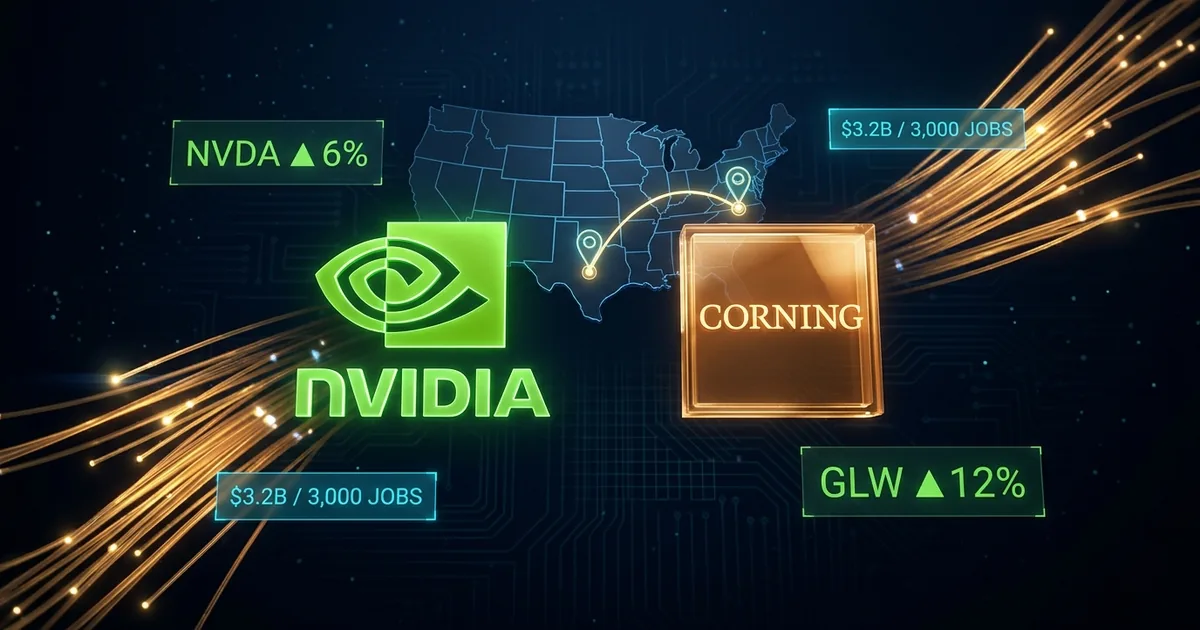
The largest inland reshoring of AI hardware supply yet announced is a copper-to-glass story dressed up as a Rust Belt revival. Nvidia and Corning unveiled a multi-year partnership this week to build three new advanced manufacturing facilities across North Carolina and Texas focused on the optical connectivity components that move data between GPUs at hyperscale. Corning will 10x its US optical connectivity capacity and expand US fiber capacity by more than 50 percent. Nvidia gets the right to invest up to $3.2 billion. The market priced the deal cleanly: GLW jumped 12 percent on the day, NVDA added roughly 6 percent, and 3,000 new American manufacturing jobs landed inside the Trump reshoring narrative with the timing of a press-release set piece.
The bigger story is structural. Nvidia is not just placing a supply order. It is using $3.2 billion of optionality to build the optical plumbing that underwrites its rack-scale AI systems for the second half of the decade.
What Co-Packaged Optics Actually Means
Inside the rack-scale Nvidia systems sold to hyperscalers and sovereign AI buyers, GPUs talk to each other through copper inside the rack and fiber between racks. The copper layer has hit physical limits as bandwidth demand has scaled. Co-packaged optics, the technology category Corning will be manufacturing at the new facilities, replaces a portion of that internal copper with optical interconnects that move more data per watt at a lower thermal cost. The simplification: less heat, fewer cables, more compute density per square foot of data-center floor space.
For the customers actually buying the systems, the mechanical detail matters less than the economic one. Co-packaged optics is the supply-chain piece that determines whether Nvidia can actually ship the volume of rack-scale systems the order book implies. Without the optical capacity, the GPU shipments hit a packaging bottleneck. With the optical capacity onshored and locked in through a $3.2 billion option, the bottleneck moves elsewhere.
The Reshoring Frame and the Politics
The deal landed on Washington’s desk inside an unusually receptive window. The Trump reshoring narrative has been hunting for a marquee AI-supply announcement that puts factory jobs on a press conference rather than chip fab dollars on an investor slide. Nvidia and Corning delivered both inside one transaction. North Carolina and Texas are politically valuable states inside the administration’s industrial-policy story, and the 3,000 new jobs are the right scale to show up in regional employment reports without overpromising.
The Nvidia side of the trade is more interesting than the Corning side. The company gets the political cover that comes with a marquee onshoring deal, the supply security that comes with a dedicated US optical capacity buildout, and the pricing power that comes from being Corning’s largest single customer commitment in a generation. The cost of the option, $3.2 billion phased in across the buildout, is a fraction of the $50 to $80 billion of optical infrastructure analysts now project will be needed to support the rack-scale systems Nvidia plans to ship through 2028.
The Hyperscaler Procurement Read
For the hyperscaler procurement organizations that buy from Nvidia, the deal changes the supply-chain calculus. Microsoft, Alphabet, Meta, Amazon, Oracle, and CoreWeave have spent the past eighteen months chasing Nvidia GPU allocations against shipment constraints set in part by the upstream packaging and optical layers. A US-based optical capacity buildout that 10x’s Corning’s domestic output reduces a portion of that constraint and pulls the tail risk of a Taiwan-centered supply chain back into the continental US. That is the right shape of risk to take off the table from a Pentagon procurement perspective and from a Microsoft balance-sheet perspective.
The procurement implication that matters most is more subtle. Hyperscalers that have built their AI capex models around Nvidia rack-scale systems now have a more credible long-term supply visibility than they had on Tuesday. That visibility gets baked into the next round of capex commits, which gets disclosed on the next round of earnings calls, which feeds the broader AI capex cycle that AMD’s Q1 print already showed compounding past consensus expectations. Nvidia just made the rest of its book look more shippable.
The OEM Roadmap Lever
The reading nobody on the wire wrote up is the negotiating grip Nvidia just acquired over the OEM bench. For the system integrators that build Nvidia rack-scale solutions for hyperscalers, including Dell, Supermicro, and HPE, the optical layer has been a meaningful cost and roadmap variable. With Corning’s domestic capacity locked into a $3.2 billion option backed by Nvidia, the OEM bench just got a clearer roadmap and a less-flexible negotiating posture on the optical bill of materials. That tightens Nvidia’s grip on the system-level architecture in ways the announcement did not surface.
For Corning, the deal is a step-change in the equity story. The company has spent two decades being valued as a specialty glass operator with a sleepy fiber-optic franchise. The $3.2 billion option converts the fiber business into an AI infrastructure name with measurable visibility into the rack-scale buildout. The 12 percent move on the announcement is a multiple expansion driven by category re-classification, not just by the next two quarters of volume.
What Cable Suppliers and Component OEMs Just Saw
The downstream read is harder for the cable and connector suppliers that have been competing for the same optical bill of materials. Per Nvidia’s announcement coverage on the Nvidia Newsroom, the partnership is structured to be exclusive in scope rather than co-development. Companies like Coherent, Lumentum, II-VI, and the smaller transceiver specialists are now operating in a US optical-supply environment where Corning has a privileged relationship with the largest single buyer of optical capacity on the planet. Some of those companies will become Corning’s downstream customers. Others will see their addressable share shrink.
For investors looking for the second-derivative trades, the cleanest are the long-Corning-supplier names that feed Corning’s US capacity expansion, including specialty glass and equipment vendors. The harder trades are short the standalone transceiver vendors that have been pricing themselves on volume and now compete against an integrated Nvidia-Corning supply chain.
Three Things to Watch From Here
The deal is announced. The execution risk is real. Three reads matter from here. First, the construction and ramp timeline at the new North Carolina and Texas facilities, which will determine whether the optical capacity actually shows up in the rack-scale shipments hyperscalers are now modeling. Second, the next round of hyperscaler capex disclosures, which will reveal whether the supply visibility translates into actual incremental commits or simply locks in the existing pipeline. Third, the regulatory and competitive response, particularly from the Coherent and Lumentum bench and from the European optical operators that just got reframed as supply-chain backups rather than supply-chain primaries.
For CNBC’s full deal coverage, the headline framing was 3,000 jobs and a $3.2 billion onshoring commitment. The analytical framing is that Nvidia just bought the optical roadmap of the second half of the decade for the cost of one quarter of revenue, and the AI capex cycle just got another reason to compound through 2028. The press release looks like a jobs story. The earnings calls will reveal it as a supply-chain story.