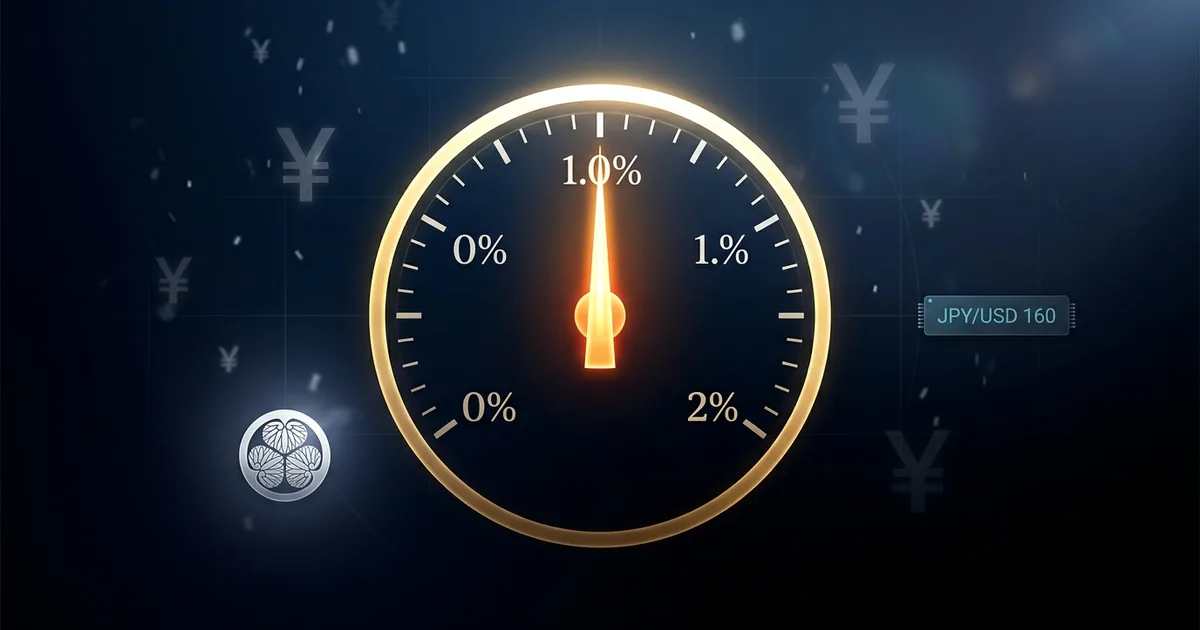
Japan’s central bank just pushed borrowing costs to their highest level since September 1995, and the man who chairs the board was watching from a hospital bed. The Bank of Japan raised its benchmark rate by 25 basis points to 1.0% in a 7-1 vote on Tuesday, a move that underscores how aggressively Tokyo is now responding to an inflation problem it spent three decades wishing it had.
The Rate Hike That Almost Didn’t Happen
Governor Kazuo Ueda, 74, was admitted to hospital in early June for treatment of an infected liver cyst, forcing him to miss the June policy meeting entirely. It was the first time a sitting BOJ governor has been absent from a rate-setting session since the current framework began in 1998. Deputy Governor Ryozo Himino stepped in to preside over the vote, while his counterpart Shinichi Uchida handled the post-meeting press conference.
The lone dissenter was board member Toichiro Asada, who argued that downside risks to production and employment outweighed the upside risks to prices. The other seven members disagreed. In its policy statement, the board noted that underlying inflation could accelerate above the 2% target amid rising energy costs, a clear signal that additional tightening remains on the table.
Ueda was discharged on Thursday and is expected to return to work next week, though he will continue outpatient treatment for roughly two more weeks.
Why Energy Costs Forced Tokyo’s Hand
The rate hike is Japan’s fourth since it ended its long experiment with negative interest rates in March 2024. What changed the math is the same force reshaping monetary policy across every major economy: energy prices driven higher by the Iran conflict and the prolonged disruption to Strait of Hormuz shipping lanes.
Japan imports virtually all of its oil and natural gas. With Brent crude still trading near $80 per barrel despite the interim U.S.-Iran peace agreement, imported energy inflation has been bleeding into consumer prices, food costs, and industrial inputs for months. Core CPI has held stubbornly above 3%, and the BOJ’s own forecasts now project underlying inflation accelerating rather than cooling.
The situation mirrors what the European Central Bank faced earlier this month when it raised its deposit rate to 2.25%, its first hike since 2023, citing the same energy-driven inflation pressures. Central banks that spent years trying to generate inflation are now scrambling to contain it, and the geopolitical roots of the price surge make traditional monetary tools a blunt instrument.
The Yen Problem That Won’t Go Away
The yen has been drifting near 160 per dollar through June, a level that makes imports more expensive and compounds the inflation Japan is trying to fight. The rate hike should theoretically support the currency by narrowing the interest rate differential with the United States, but with the Federal Reserve holding its benchmark at 3.50% to 3.75% and signaling potential hikes of its own, the gap remains enormous.
Al Jazeera reported that the yen showed only a modest reaction to the rate decision, suggesting traders had largely priced in the move. The bigger question is whether the BOJ will push further. At 1.0%, Japan’s policy rate is still the lowest among G7 economies by a wide margin. If energy costs remain elevated and the yen continues to weaken, the pressure for additional hikes will only intensify.
Markets Read the Room Before the Board Did
Japanese equities barely flinched at the announcement, and for good reason: the move was telegraphed weeks ago. The futures market had priced in the hike at roughly 85% probability heading into the meeting, and the yen’s drift toward 160 had already told the story of capital flows adjusting to a tighter BOJ. What was not priced in was the drama of a governor-less decision, and even that proved to be a non-event. Deputy Governor Uchida told reporters that Ueda’s absence had “not a big impact” on the deliberation, a line designed to project institutional stability but one that also raises a deeper question: if the BOJ can raise rates to a three-decade high without its own chair in the room, how much of Japanese monetary policy is genuinely debated versus pre-cooked by consensus before the vote?
What Comes Next for Global Rate Policy
The BOJ’s move completes a striking reversal in the global monetary landscape. Three of the world’s most important central banks have now tightened policy in June: the ECB, the BOJ, and the Fed (which held rates steady but signaled through its dot plot that the next move could be upward). The era of easy money is not just over; the pendulum is actively swinging in the other direction.
For investors, the takeaway is that the “higher for longer” thesis has gone global. Japanese government bond yields will rise, putting pressure on the massive carry trade that has used cheap yen borrowing to fund positions in higher-yielding assets. If that trade unwinds disorderly, the ripple effects will reach well beyond Tokyo.
The real test comes in the second half of 2026. If the Strait of Hormuz fully reopens and oil prices normalize, the BOJ may find room to pause. If they don’t, a central bank that spent 30 years at zero will find itself in the unfamiliar position of debating how high is too high.