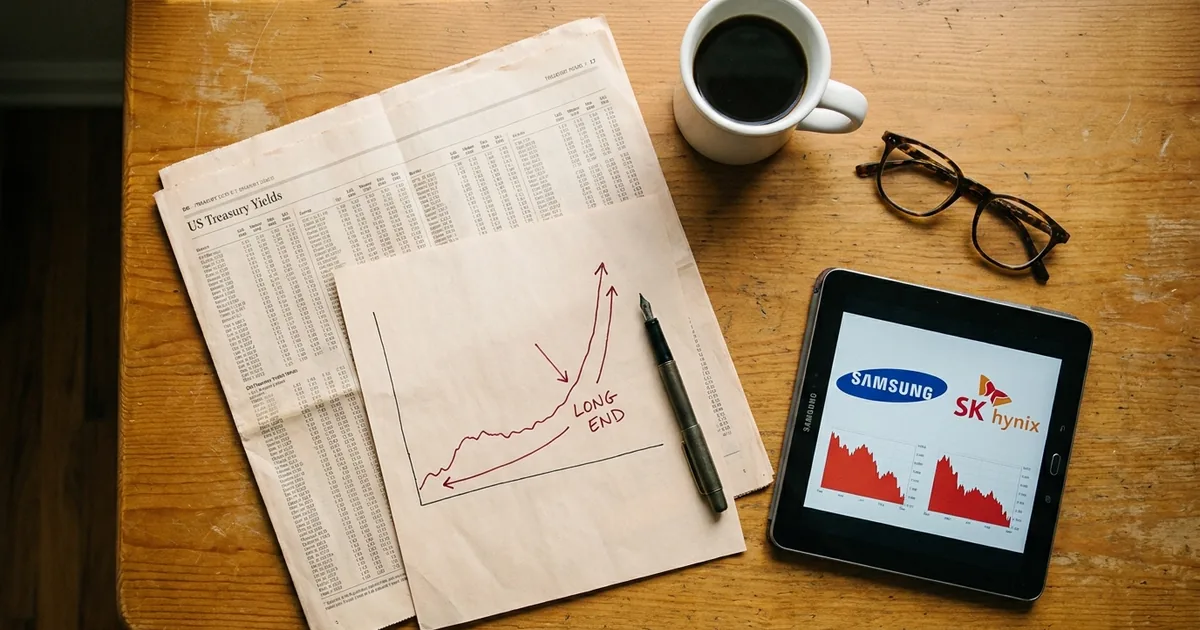
The yield on the 30-year US Treasury bond pushed past 5.33% on Tuesday, its highest level since 2007, and by Wednesday morning in Asia the invoice arrived somewhere nobody in Washington was watching. South Korea’s Kospi fell 5.7% to 6,487.34, Samsung Electronics shed 7.5%, and SK Hynix dropped 8.8%. Nothing happened to memory demand overnight. What happened is that the price of money moved, and the most crowded long-duration trade on the planet found out it was leveraged to a number set in the Treasury market.
The Long End Is Repricing Something Other Than Growth
Start with what this is not. This is not a growth scare, and it is not an inflation shock. July CPI came in at 0.1% on the month for an annual rate of 3.4%, uncomfortable but landing exactly on consensus. Nothing in that print justifies a 30-year yield at levels last seen when Countrywide was still writing mortgages.
What is moving is the term premium, the extra compensation investors demand for lending to the government for three decades instead of rolling short paper. That premium is a confidence measure, and it is being marked down. CNBC put the 30-year above 5.33% on Tuesday for a fresh 19-year high, driven by fiscal and inflation worries rather than any single data release. At the shorter end, Bloomberg tracked the 10-year climbing to roughly 4.75%, the highest since early 2025, in thin August trading that also saw corporate issuance set an all-time record for the month at more than $145 billion.
That supply matters more than it sounds. Every one of those corporate deals competes for the same pool of duration buyers the Treasury needs, in a month when the national debt is closing on $40 trillion. Add a Middle East ceasefire that lapsed without resolution, pushing oil higher and putting a floor under inflation expectations, and the bid for 30-year paper thins out fast.
A term premium is not an opinion about next quarter. It is a price on the credibility of everything standing behind the paper, and that price is going up.
Why Seoul Absorbed the Blow
The mechanism deserves precision, because the headline version, chip stocks fell, gets the causation backwards.
An AI infrastructure company is a long-duration asset. Its cash flows sit years out, in data centers that have not been energized and chips that have not shipped. Discount those flows at 4.75% instead of 4.1% and the present value falls hard, mechanically, with no change in the underlying business. Every basis point at the long end is a tax on stories that pay off in 2029.
South Korea is where that tax bites deepest, and the reason is index construction. Samsung and SK Hynix now account for roughly half the Kospi’s total weight, up from about a quarter at the end of last year, after a bull run fueled by exactly the AI optimism now being repriced. An index that concentrated is not a diversified market. It is a levered bet on two memory makers wearing a national flag. Associated Press coverage of the Asian session put the Kospi’s decline alongside a jump in oil prices, while Japan took the same hit in smaller size, with the Nikkei 225 off 2.82% and Kioxia falling as much as 11%.
Foreign investors did the selling, and they sold the liquid thing they could exit fastest. That is not a verdict on Samsung’s high-bandwidth memory roadmap. It is a margin call on a factor.
The Fed Chair Who Asked for This
Here is the part that separates this selloff from an ordinary rate move, and it is the actual why.
Federal Reserve Chair Kevin Warsh has spent his tenure arguing that the central bank should exert less influence over asset prices and let markets set appropriate rates. As doctrine, that is defensible and has a long intellectual pedigree. As practice, in a year carrying a $40 trillion debt load and a lapsed ceasefire, it means the institution that historically anchored the long end has announced it would rather not. Yields hit their post-2007 highs in late July right after the Fed held rates steady, which was the market’s first real test of what that doctrine costs.
Investors took him at his word. When the Fed stops signaling, the term premium is no longer suppressed by the expectation of intervention, so investors price duration risk themselves. They are pricing it higher. We wrote in early August that the July payrolls miss landed in a guidance vacuum that forced rates to reprice without a Fed anchor, and the same vacuum is doing the work now, at the far end of the curve where the damage compounds.
The uncomfortable read is that this is working as designed. Warsh wanted price discovery. A 5.33% 30-year is price discovery. What he has not addressed publicly is whether he is willing to sit through the equity repricing that honest long-end pricing implies, because that repricing has now started offshore and is walking west.
What Breaks Next
US futures were soft but orderly early Wednesday, with S&P 500 futures off 0.18% and Nasdaq 100 futures down 0.37%, a market that has not yet decided whether Asia’s session was a rout or a rotation. Tuesday’s tape was less ambiguous: QQQ fell 1.69% while SPY gave up 0.68%, the spread you would expect if duration is the thing being sold.
Watch three places. Mortgage rates, which track the long end and reach household budgets with a lag measured in weeks, and which have already started following yields higher. Corporate refinancing, where that record August issuance now has to clear at repriced levels. And AI capex guidance, where companies committing to multi-year buildouts have been underwriting them against a cost of capital that no longer exists. Our read on second-quarter GDP and the bond market’s reaction flagged the same tension in slower motion.
The AI trade was never only a bet on model quality. It was a bet on cheap duration, and duration just got expensive. That does not make the technology wrong. It makes the financing assumptions underneath it wrong, and financing assumptions are what get repriced first.