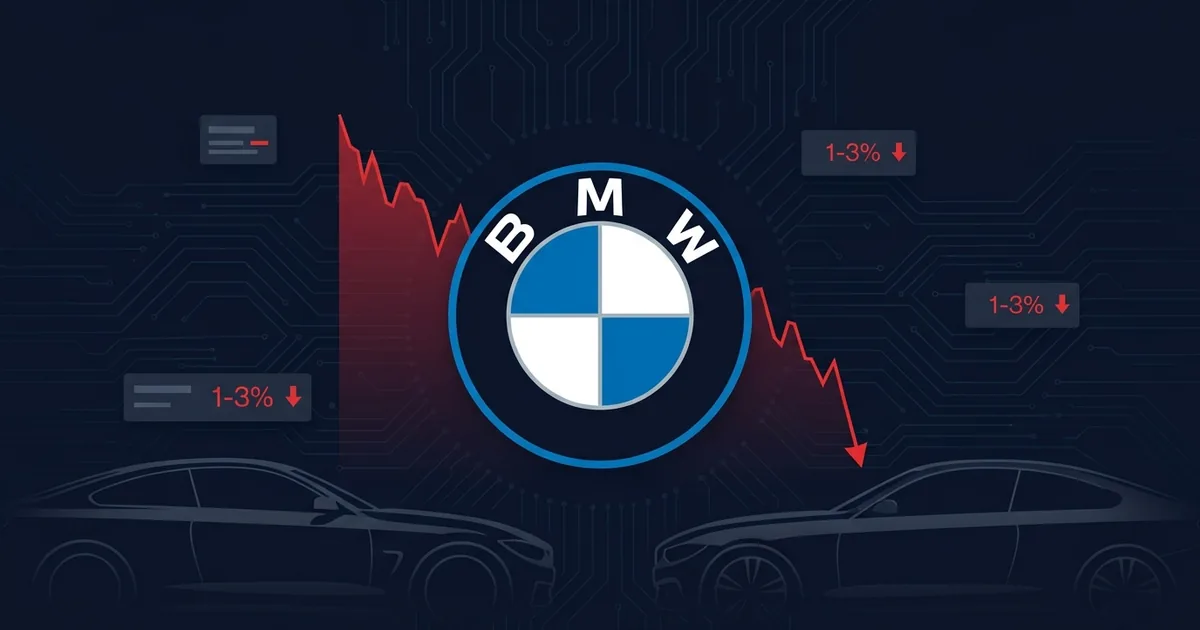
BMW just told investors to brace for a brutal year. The German automaker slashed its 2026 automotive operating margin guidance to 1-3%, down from an already cautious 4-6% forecast, sending shares plunging 8% intraday to their lowest level in more than five years.
The Numbers Behind BMW’s Margin Collapse
Let’s be precise about what happened here, because the headline alone undersells the damage. BMW now expects group profit before tax to fall “significantly,” which in the company’s own disclosure language means a decline of more than 15%. That is not a soft landing. That is a controlled crash.
The margin cut, first reported by CNBC, reflects two forces slamming into BMW simultaneously: a deepening collapse in Chinese demand and the cascading economic effects of the Iran war. New CEO Milan Nedeljkovic, barely settled into the top seat, had to stand up and announce accelerated cost-cutting measures before he could even put his own strategic stamp on the company.
BMW’s peers felt the shockwave immediately. Mercedes-Benz and Volkswagen shares were dragged lower in sympathy, a reminder that when one of the Big Three German automakers issues a warning this severe, the entire sector reprices.
China Is No Longer a Growth Story for German Automakers
The China numbers are staggering and getting worse. BMW deliveries in the country tumbled 12.5% across 2025, and Q1 2026 brought another 10% drop. That is not a temporary blip. That is an accelerating downturn in what was, until recently, the single most important profit engine for premium European automakers.
Chinese consumers are shifting to domestic EV brands at a pace that caught legacy automakers off guard. BYD, NIO, and Xiaomi are eating into the premium segment with vehicles that cost less and, increasingly, match or exceed European quality in the features Chinese buyers care about most: software, connectivity, and autonomous driving capability. BMW’s brand cachet still matters in China, but it matters less each quarter.
The competitive dynamics have flipped. Five years ago, German automakers could count on China to subsidize thinner margins elsewhere. Now China is actively compressing those margins, and there is no obvious replacement market of that scale anywhere in the world.
The Iran War Factor: Energy Costs and Consumer Confidence
The second force crushing BMW’s outlook is the ongoing Iran conflict, which has driven European energy costs higher and eroded consumer sentiment across the continent. As Euronews reported, BMW explicitly cited the war’s impact on both its cost structure and the buying mood of its core European customers.
This is where the story connects to a broader macro picture. The Iran conflict has reshaped energy markets and rattled investor confidence across sectors, but automakers face a particularly nasty double hit. They absorb higher energy costs in manufacturing while also watching their customers pull back on big-ticket purchases because those same energy costs are eating into household budgets.
BMW’s German manufacturing base, still enormous despite years of offshoring, makes the company especially exposed to European energy price volatility. Every spike in natural gas or electricity prices flows directly into production costs, and there is only so much a premium automaker can pass along to buyers who are already hesitant.
What Nedeljkovic’s Cost-Cutting Signals About the Road Ahead
New CEO Milan Nedeljkovic inherits a company that needs to move fast on costs without gutting the investments that will determine whether BMW stays relevant in the EV transition. That is an extraordinarily difficult balancing act.
The cost-cutting acceleration he announced will almost certainly mean headcount reductions, supplier renegotiations, and a harder look at which vehicle programs justify continued investment. BMW has been spending heavily on its Neue Klasse EV platform, and the temptation to trim those budgets will be real. But cutting EV investment to protect short-term margins is exactly the kind of decision that looks prudent today and catastrophic in three years.
For investors, the question is straightforward: is this the bottom, or is BMW still catching a falling knife? The margin guidance of 1-3% leaves almost no cushion. If China deteriorates further or energy costs spike again, BMW could be looking at breakeven or worse in its automotive division.
The broader lesson here extends beyond Munich. The era when German automakers could rely on premium pricing, Chinese growth, and stable European energy costs to generate comfortable margins is over. BMW just said the quiet part out loud. Mercedes-Benz and Volkswagen will likely have their own reckonings before the year is out.
The investors who got out today at an 8% loss may end up being the lucky ones.