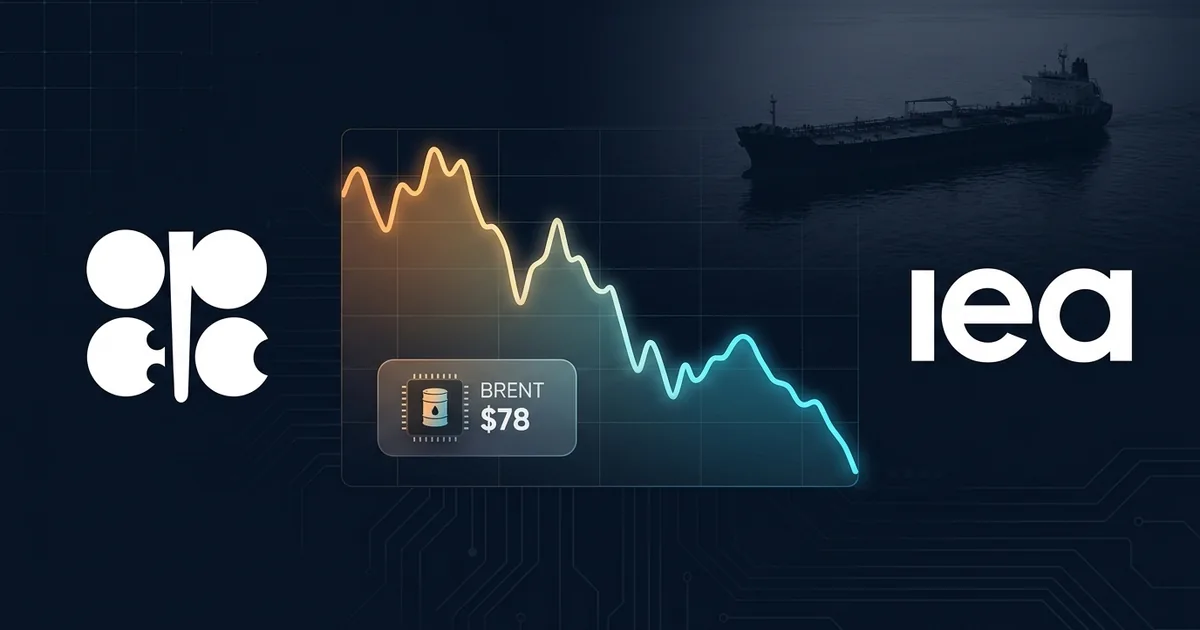
Three Saudi crude tankers switched their transponders back on in the Gulf of Oman on Thursday, the first Saudi-owned barrels to clear the Strait of Hormuz since the waterway shut in March, and they sailed straight into a fight over whether the world is about to drown in oil. OPEC Secretary General Haitham Al Ghais says it will not. The International Energy Agency has already put the glut on the calendar.
That gap, between the producer cartel that sells the barrels and the agency that speaks for the consumers who buy them, is the most important number in energy markets right now. It is worth more to a trading desk than any single price print.
Two Forecasts, One Waterway
The IEA’s June report reads like a post-mortem on a crisis that has not technically ended. The agency now sees global oil demand contracting by 420,000 barrels a day in 2026, to 104 million barrels a day, which is 1.3 million below what it expected before the war. High prices did the damage, the kind of demand destruction that does not snap back when the shooting stops. Then comes the whiplash: as the IEA flagged in its latest outlook, supply falls 3.9 million barrels a day this year to 102.4 million, before surging 8 million barrels a day in 2027 to 110.3 million. Supply outruns demand by a wide margin. That is the glut, and the IEA has it dated.
Al Ghais is not buying the demand half of that story. “Despite all the commentary out there that oil demand is declining, we have not registered signs of that yet,” he said, and OPEC’s monthly report holds its 2026 demand-growth call near 1.2 million barrels a day, a world apart from the IEA’s outright contraction. One of these institutions is going to be badly wrong by Christmas.
The Market Is Voting With the IEA, for Now
Price action is the tiebreaker traders actually trust, and on Thursday it broke against OPEC. Brent slid 1.4 percent to $78.41 and US crude fell 1.25 percent to $75.83 as the peace terms firmed up. The bigger tell is what is sitting offshore: roughly 62 million barrels of crude on close to three dozen supertankers, queued to sail for Asia within weeks. When that wall of oil lands in Chinese and South Korean ports, it competes with the West African and American barrels those refiners bought to ride out the shock.
The bank desks have already repriced. Goldman Sachs cut its fourth-quarter Brent call to $80 from $90 and now models a $75 average for 2027, while more than 60 million barrels stage for the run to Asia. Goldman expects tanker traffic through the strait to recover fully by the end of July. Morgan Stanley lands in the same neighborhood at $80 for the quarter. None of those numbers describe a market that fears a shortage. They describe a market bracing for too much.
Why OPEC Needs To Be Right
Follow the incentive and the forecast war stops looking like a technical disagreement. If the IEA is correct and an 8-million-barrel surplus is coming in 2027, OPEC+ faces the choice it has spent two years trying to avoid. It can defend price by holding barrels off the market, which hands market share to US shale and other non-OPEC producers, or it can pump and accept a lower price on every barrel it sells. Neither path is comfortable for budgets in Riyadh or Abu Dhabi that assume oil well north of $70.
A bullish demand forecast is how OPEC keeps that choice theoretical for a little longer. The group already made a symbolic output increase during the closure to signal it could backfill the missing Iranian-adjacent supply. Talking the demand number up does similar work: it justifies bringing barrels back without conceding that the post-war market cannot absorb them. The credibility cost is real, though. OPEC has run hotter on demand than the IEA for three years running, and the gap has mostly resolved in the agency’s favor.
The Physical Recovery Is Slower Than the Spreadsheet
Here is the wrinkle that complicates both forecasts. The deal Trump and Iranian President Masoud Pezeshkian signed at Versailles reopens Hormuz without tolls for at least 60 days and lifts the US naval blockade, but moving oil is not a light switch. ADNOC chief executive Sultan Al Jaber warned that even with the conflict over, it will take at least four months to get flows back to 80 percent of pre-war levels, and full volumes may not return before the first or second quarter of 2027. He also tallied the damage already done: fuel prices up 30 percent, fertilizer up 50 percent, airfares up roughly 25 percent since late February.
That slow physical recovery is why prices have not collapsed outright even as the glut narrative takes hold, a dynamic we traced when the peace deal first cracked oil and rallied equities. The barrels are coming, but the lag between a signed memorandum and a fully functioning shipping lane is measured in seasons, not days. For now that lag is the only thing standing between OPEC’s optimism and the IEA’s surplus.
The Test Comes Before the Glut Does
The 2027 overhang is a problem OPEC can argue about for another year. The credibility test arrives much sooner. The next round of inventory data and the next OPEC+ meeting will show whether Al Ghais is reading resilient demand that the IEA missed, or talking his book while the tankers do the deciding. The three Saudi ships now clearing the strait are the first data points in that argument. There are about three dozen more right behind them.